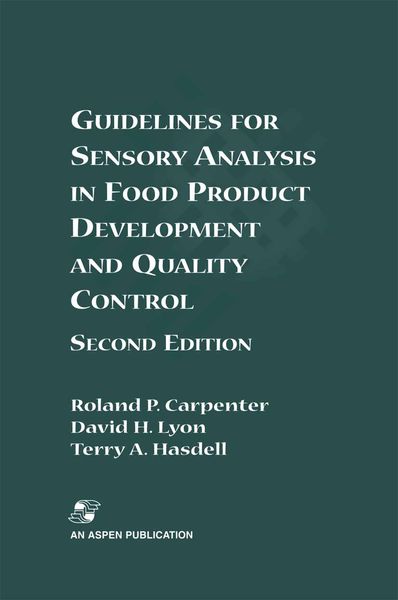
Produktbild: Guidelines for Sensory Analysis in Food Product Development and Quality Control
- 12%

Guidelines for Sensory Analysis in Food Product Development and Quality Control

12% sparen

93,99 € UVP 106,99 €

inkl. gesetzl. MwSt., Versandkostenfrei

Lieferung nach Hause

Beschreibung

Produktdetails

Einband

Taschenbuch

Erscheinungsdatum

30.04.2000

Verlag

Springer Us

Seitenzahl

210

Maße (L/B/H)

22,9/15,2/1,4 cm

Gewicht

353 g

Auflage

Second Edition 2000

Sprache

Englisch

ISBN

978-0-8342-1642-6

Beschreibung

Produktdetails

Einband

Taschenbuch

Erscheinungsdatum

30.04.2000

Verlag

Springer Us

Seitenzahl

210

Maße (L/B/H)

22,9/15,2/1,4 cm

Gewicht

353 g

Auflage

Second Edition 2000

Sprache

Englisch

ISBN

978-0-8342-1642-6

Herstelleradresse

Springer-Verlag KG
Sachsenplatz 4-6
1201 Wien
AT

Email: GPSR Kontakt

Noch keine Bewertungen vorhanden

Verfassen Sie die erste Bewertung zu diesem Artikel

Helfen Sie anderen Kundinnen und Kunden durch Ihre Meinung.

Kundinnen und Kunden meinen

Bewertungen (0)

  • Produktbild: Guidelines for Sensory Analysis in Food Product Development and Quality Control
  • 1—What Is Sensory Analysis Used for?.- 1.1 Providing Answers to Practical Questions.- 1.2 Specifications and Quality Control.- 1.3 Shelf-Life Studies.- 1.4 Taint Potential.- 1.5 Product Matching.- 1.6 Product Reformulation.- 1.7 Product Mapping.- 1.8 Product Acceptability.- 2—The Relationship of Physiology and Psychology to Sensory Analysis.- 2.1 Introduction.- 2.2 What Role Do the Senses Play?.- 2.3 How Do the Senses Interact?.- 2.4 Thresholds and Sensitivity.- 2.5 Individual Differences.- 2.6 Perception—The Link with the Senses.- 2.7 Which Psychological Factors May Affect Sensory Results?.- 3—How To Use Sensory Analysis To Meet Your Objective.- 3.1 Formulating the Objective.- 3.2 Decisions about Data.- 3.3 Tests Used To Achieve the Objective.- 3.4 Principles of Questionnaire Design.- 4—The Products for Sensory Analysis.- 4.1 The Nature of the Products.- 4.2 The Number of Products.- 4.3 The Assessment of the Products.- 5—Who Are the Right People for Sensory Analysis?.- 5.1 What Type of Person Is Required?.- 5.2 Selecting People for Specific Tasks.- 5.3 How Many Assessors?.- 5.4 How To Select Assessors.- 5.5 How To Train Assessors.- 5.6 Health and Welfare of Assessors.- 6—Experimental Design and Data Analysis.- 6.1 Experimental Design.- 6.2 Data Analysis.- 7—Reporting and Recording.- 7.1 Style and Content.- 7.2 Background and Objectives.- 7.3 Methods.- 7.4 Analysis of Data.- 7.5 Presentation of Results.- 7.6 Interpretation and Discussion of Results.- 7.7 Conclusions.- 7.8 Recommendations.- 7.9 Retaining Records.- 8—Putting Sensory Analysis into Practice.- 8.1 Resources.- 8.2 Practical Constraints.- 8.3 Organizing The Sensory Test.- 8.4 Assessor Briefing and Motivation.- 8.5 Setting Standards for Sensory Panels.- 8.6 Monitoring Performance of Assessors and the Panel.- 9—Case History: Specification and Quality Control.- 9.1 Background.- 9.2 Method and Approaches.- 9.3 Implementation.- 10—Case History: Shelf-Life Studies.- 10.1 Background.- 10.2 Methods and Approaches.- 10.3 Analysis and Presentation of Results.- 11—Case History: Taint Investigation.- 11.1 Background.- 11.2 Methods.- 11.3 Results.- 12—Case History: Taint Prevention.- 12.1 Background.- 12.2 Methods.- 12.3 Results.- 13—Case History: Mapping of Coffee Products.- 13.1 Introduction.- 13.2 Aims.- 13.3 Descriptive Analysis of Coffee.- 13.4 Implications for Product Matching/Mapping.- 13.5 Consumer Preferences for Coffee.- 13.6 Relating Consumer Preferences to Sensory Attributes.- 13.7 Implications for Product Matching/Mapping.- 14—Case History: Quality Control in Product Batching.- 14.1 Background.- 14.2 Methods and Approaches.- 14.3 Recommendations.- 15—Case History: Graphical Methods for Monitoring Profile Panel Performance.- 15.1 Introduction.- 15.2 Methods and Results.- 15.3 Conclusions.- Appendixes.- Appendix A—Some Useful Tables for Sensory Tests.- Appendix B—Glossary of Terms Used in Sensory Analysis.- Appendix C—Some Useful Contacts.