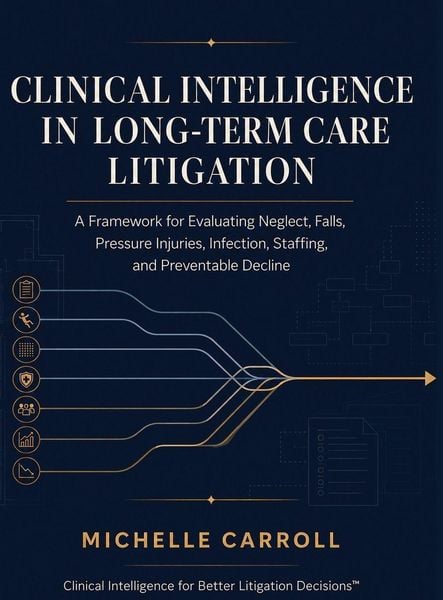
Clinical Intelligence in Long-Term Care Litigation
-
- Englisch ausgewählt
87,99 €
inkl. gesetzl. MwSt.,
Beschreibung
Produktdetails
Einband
Gebundene Ausgabe
Erscheinungsdatum
18.08.2026
Verlag
Lexcura SummitSeitenzahl
232
Maße (L/B/H)
27,9/21,6/1,9 cm
Gewicht
1039 g
Sprache
Englisch
EAN
9798952094383
Long-term care litigation rarely turns on a single chart entry. It develops across months of assessments, care plans, medication records, incident reports, wound documentation, staffing records, hospital transfers, and competing explanations for decline. The challenge is not simply finding what happened. It is determining what the evidence can actually support.
Clinical Intelligence in Long-Term Care Litigation provides attorneys, clinical reviewers, risk professionals, and expert teams with a disciplined framework for evaluating neglect, falls, fractures, pressure injuries, infection, delayed transfer, staffing concerns, and preventable decline.
Using the Lexcura Clinical Intelligence Model, Michelle Carroll shows readers how to move from fragmented records to a clear, defensible analysis. The book explains how to establish the resident's baseline, identify recognized risks, reconstruct the clinical timeline, compare planned care with delivered care, evaluate regulatory and system responsibility, test alternative explanations, and determine whether the evidence supports a meaningful causal connection.
Readers will learn how to:
- Assess record integrity and identify missing or contradictory documentation
- Establish baseline vulnerability, function, cognition, mobility, nutrition, skin condition, and existing disease burden
- Analyze falls, fractures, pressure injuries, infection, delayed escalation, and functional decline
- Distinguish an unavoidable outcome from a preventable event or missed opportunity
- Evaluate whether interventions were ordered, communicated, implemented, monitored, and revised
- Use imaging and objective findings within the complete clinical sequence
- Examine staffing and system-capacity evidence without relying on numbers alone
- Build timelines around clinical turning points rather than isolated entries
- Test claimant and defense theories against the same evidentiary standard
- Identify assumptions, contradictions, alternative causes, and limits in the available proof
- Convert complex clinical evidence into a litigation-ready output
The book also includes practical checklists, targeted record-request guidance, deposition preparation tools, causation worksheets, alternative-explanation testing, and structured questions for evaluating the strength and limits of a case.
Written for professionals who must make consequential decisions from incomplete and sometimes inconsistent healthcare records, this book emphasizes disciplined reasoning over predetermined conclusions. It does not assume that every poor outcome establishes neglect, nor that age, frailty, or disease automatically explains every injury. Instead, it asks the questions that matter: What was known? What action was required? What care was actually delivered? What changed? What alternative explanation is strongest? And what difference would appropriate action realistically have made?
Clinical Intelligence in Long-Term Care Litigation is a practical guide for building clearer case theories, identifying evidentiary weaknesses earlier, preparing more focused discovery and deposition strategies, and making better litigation decisions.
Noch keine Bewertungen vorhanden
Verfassen Sie die erste Bewertung zu diesem Artikel
Helfen Sie anderen Kundinnen und Kunden durch Ihre Meinung.
Kurze Frage zu unserer Seite
Vielen Dank für dein Feedback
Wir nutzen dein Feedback, um unsere Produktseiten zu verbessern. Bitte habe Verständnis, dass wir dir keine Rückmeldung geben können. Falls du Kontakt mit uns aufnehmen möchtest, kannst du dich aber gerne an unseren Kund*innenservice wenden.
zum Kundenservice