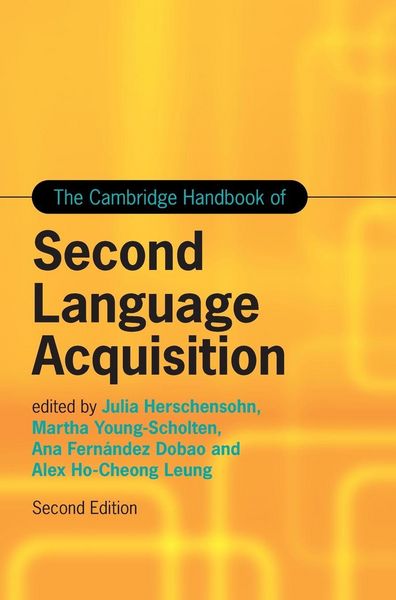
The Cambridge Handbook of Second Language Acquisition
-
- Hardcover ausgewählt
- Taschenbuch
- eBook
-
Sprache:Englisch
-
Verlag:Cambridge Academic
214,99 €
inkl. gesetzl. MwSt.,
Beschreibung
Produktdetails
Einband
Gebundene Ausgabe
Erscheinungsdatum
20.04.2026
Abbildungen
Worked examples or Exercises
Herausgeber
Herschensohn Julia + weitereVerlag
Cambridge AcademicSeitenzahl
760
Maße (L/B/H)
25/17,5/4,5 cm
Gewicht
1467 g
Auflage
2 Revised edition
Sprache
Englisch
ISBN
978-1-00-940067-1
Now in its second edition, this Handbook is a current overview of Second Language (L2) research, providing state-of-the-art synopses of recent developments in each sub-area of the field, and bringing together contributions by emerging scholars and experts in Second Language Acquisition (SLA). Since the first edition, broad socio-political movements, alternative views of bilingualism, emergence of global markets, vast expansion of electronic resources, the development of social media, and the availability of big data have transformed the discipline, and this edition has been thoroughly updated to address these changes. It is divided into six main parts: Part I situates SLA in terms of research and practice; Part II explores individual cognitive, age-related and neurolinguistic similarities and differences; Part III outlines external, sociocultural, and interactive factors; Part IV presents profiles of bilinguals who take differing paths of acquisition; Part V describes interlanguage properties; and Part VI comprises clear models of L2 development.
Noch keine Bewertungen vorhanden
Verfassen Sie die erste Bewertung zu diesem Artikel
Helfen Sie anderen Kundinnen und Kunden durch Ihre Meinung.
Kurze Frage zu unserer Seite
Vielen Dank für dein Feedback
Wir nutzen dein Feedback, um unsere Produktseiten zu verbessern. Bitte habe Verständnis, dass wir dir keine Rückmeldung geben können. Falls du Kontakt mit uns aufnehmen möchtest, kannst du dich aber gerne an unseren Kund*innenservice wenden.
zum Kundenservice