• Produktbild: The Cambridge Handbook of Second Language Acquisition
  • Produktbild: The Cambridge Handbook of Second Language Acquisition

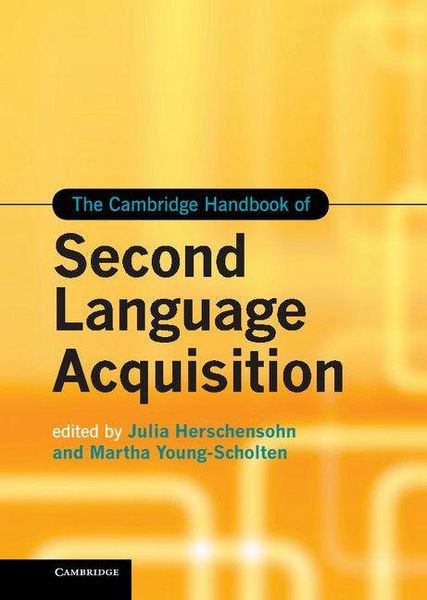
The Cambridge Handbook of Second Language Acquisition

193,99 €

inkl. gesetzl. MwSt., Versandkostenfrei


Beschreibung

Produktdetails

Einband

Gebundene Ausgabe

Erscheinungsdatum

25.02.2013

Abbildungen

13 b/w illus. 17 tables

Herausgeber

Julia Herschensohn + weitere

Verlag

Cambridge University Press

Seitenzahl

840

Maße (L/B/H)

25/17,5/4,9 cm

Gewicht

1600 g

Sprache

Englisch

ISBN

978-1-107-00771-0

Beschreibung

Rezension

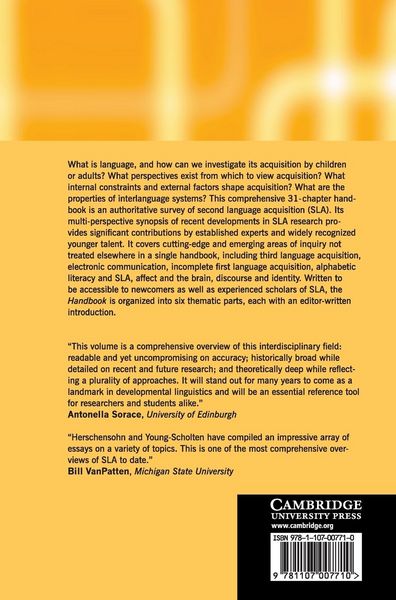
'This volume is a comprehensive overview of this interdisciplinary field: readable and yet uncompromising on accuracy; historically broad while detailed on recent and future research; and theoretically deep while reflecting a plurality of approaches. It will stand out for many years to come as a landmark in developmental linguistics and will be an essential reference tool for researchers and students alike.' Antonella Sorace, University of Edinburgh

Produktdetails

Einband

Gebundene Ausgabe

Erscheinungsdatum

25.02.2013

Abbildungen

13 b/w illus. 17 tables

Herausgeber

Verlag

Cambridge University Press

Seitenzahl

840

Maße (L/B/H)

25/17,5/4,9 cm

Gewicht

1600 g

Sprache

Englisch

ISBN

978-1-107-00771-0

Herstelleradresse

Libri GmbH
Europaallee 1
36244 Bad Hersfeld
DE

Email: gpsr@libri.de

Noch keine Bewertungen vorhanden

Verfassen Sie die erste Bewertung zu diesem Artikel

Helfen Sie anderen Kundinnen und Kunden durch Ihre Meinung.

Kundinnen und Kunden meinen

Bewertungen (0)

Die Leseprobe wird geladen.
  • Produktbild: The Cambridge Handbook of Second Language Acquisition
  • Produktbild: The Cambridge Handbook of Second Language Acquisition
  • Introduction Julia Herschensohn and Martha Young-Scholten; Part I. Theory and Practice: 1. Theories of language from a critical perspective Jan Koster; 2. History of the study of L2 acquisition Margaret Thomas; 3. Theoretical approaches Florence Myles; 4. Scope and research methodologies Melinda Whong and Clare Wright; Part II. Internal Ingredients: 5. The role of the native language Claire Foley and Suzanne Flynn; 6. Learning mechanisms and automatization Richard Towell; 7. Generative approaches and the poverty of the stimulus Bonnie D. Schwartz and Rex A. Sprouse; 8. Learner internal psychological factors Jean-Marc Dewaele; 9. Alphabetic literacy and adult L2 acquisition Elaine Tarone, Kit Hansen and Martha Bigelow; Part III. External Ingredients: 10. Negotiated input and output interaction María del Pilar García Mayo and Eva Alcón Soler; 11. Second language identity construction Elizabeth Miller and Ryuko Kubota; 12. Socialization Daniel Véronique; 13. Variation Vera Regan; 14. Electronic interaction resources Astrid Ensslin and Cedric Krummes; Part IV. Biological Factors: 15. Age related effects Julia Herschensohn; 16. Childhood L2 acquisition Belma Haznedar and Elena Gavruseva; 17. Incomplete L1 acquisition Silvina Montrul; 18. Third language acquisition Jason Rothman, Jennifer Cabrelli Amaro and Kees de Bot; 19. Language processing Alice Foucart and Cheryl Frenck-Mestre; 20. Affect and the brain Andrea Mates and Anna Joaquin; Part V. Properties of Interlanguage Systems: 21. The lexicon James Milton and Giovanna Donzelli; 22. Semantics Laurent Dekydtspotter; 23. Discourse and pragmatics Roumyana Slabakova; 24. Morphosyntax Tania Ionin; 25. Phonology and speech Ellen Broselow and Yoonjung Kang; Part VI. Models of Development: 26. Explaining change in transition grammars Michael Sharwood Smith, John Truscott and Roger Hawkins; 27. Stage-like development and organic grammar Anne Vainikka and Martha Young-Scholten; 28. Emergentism, connectionism and complexity models Randal Holme; 29. Input, input processing and focus on form Joe Barcroft and Wynne Wong; 30. Sociocultural theory and the zone of proximal development Amy Snyder Ohta; 31. Nativelike and non-nativelike attainment Donna Lardiere.