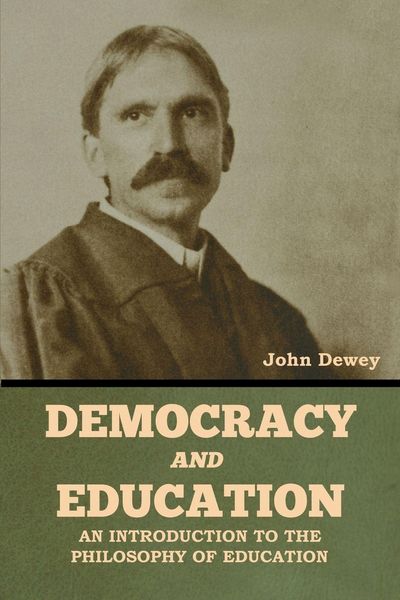
Democracy and Education An Introduction to the Philosophy of Education
-
- Hardcover
- Taschenbuch ausgewählt
- eBook
-
Sprache:Englisch
-
Verlag:Indoeuropeanpublishing.Com
- Lector House 22,99 €
- Hawk Press 22,99 €
- True Sign Publishing House 29,99 €
- Bibliotech Pr 23,99 €
- Natal Publishing, Llc 18,99 €
- Culturea 26,90 €
- Martino Fine Books 25,99 €
- Cosimo 25,99 €
- Digireads.com 18,99 €
- Creative Media Partners, LLC 28,99 €
- FV éditions 26,99 €
- HarperCollins 23,99 €
- Smk Books 27,99 €
- Simon & Brown 17,99 €
- Merchant Books 22,99 €
- Touchladybirdlucky Studios 24,99 €
- Z & L Barnes Publishing 21,99 €
- Indoeuropeanpublishing.Com 25,99 € ausgewählt
25,99 €
inkl. gesetzl. MwSt.,
Lieferung nach Hause
Beschreibung
Produktdetails
Einband
Taschenbuch
Erscheinungsdatum
06.01.2023
Verlag
Indoeuropeanpublishing.ComSeitenzahl
302
Maße (L/B/H)
22,9/15,2/1,8 cm
Gewicht
493 g
Sprache
Englisch
EAN
9798889420040
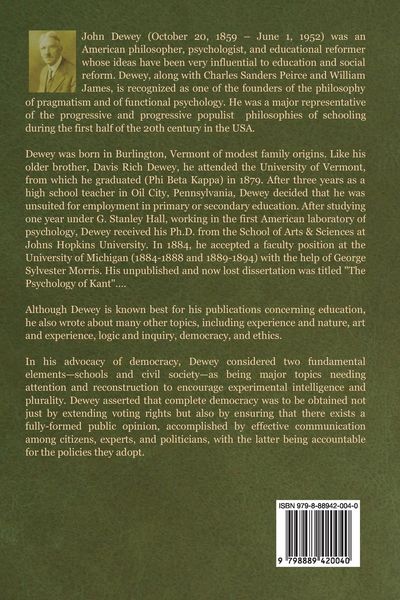
In Democracy and Education, Dewey argues that the primary ineluctable facts of the birth and death of each one of the constituent members in a social group determine the necessity of education. On one hand, there is the contrast between the immaturity of the new-born members of the group (its future sole representatives) and the maturity of the adult members who possess the knowledge and customs of the group. On the other hand, there is the necessity that these immature members be not merely physically preserved in adequate numbers, but that they be initiated into the interests, purposes, information, skill, and practices of the mature members: otherwise the group will cease its characteristic life. Dewey observes that even in a "savage" tribe, the achievements of adults are far beyond what the immature members would be capable of if left to themselves. With the growth of civilization, the gap between the original capacities of the immature and the standards and customs of the elders increases. Mere physical growing up and mastery of the bare necessities of subsistence will not suffice to reproduce the life of the group. Deliberate effort and the taking of thoughtful pains are required. Beings who are born not only unaware of, but quite indifferent to, the aims and habits of the social group have to be rendered cognizant of them and actively interested. According to Dewey, education, and education alone, spans the gap. Dewey's ideas were never broadly and deeply integrated into the practices of American public schools, though some of his values and terms were widespread. Progressive education (both as espoused by Dewey, and in the more popular and inept forms of which Dewey was critical) was essentially scrapped during the Cold War, when the dominant concern in education was creating and sustaining a scientific and technological elite for military purposes. In the post-Cold War period, however, progressive education had reemerged in many school reform and education theory circles as a thriving field of inquiry learning and inquiry-based science. Some find it cumbersome that Dewey's philosophical anthropology, unlike Egan, Vico, Ernst Cassirer, Claude Lévi-Strauss, and Nietzsche, does not account for the origin of thought of the modern mind in the aesthetic, more precisely the myth, but instead in the original occupations and industries of ancient people, and eventually in the history of science. A criticism of this approach is that it does not account for the origin of cultural institutions, which can be accounted for by the aesthetic. Language and its development, in Dewey's philosophical anthropology, have not a central role but are instead a consequence of the cognitive capacity. While Dewey's educational theories have enjoyed a broad popularity during his lifetime and after, they have a troubled history of implementation. Dewey's writings can also be difficult to read, and his tendency to reuse commonplace words and phrases to express extremely complex reinterpretations of them makes him susceptible to misunderstanding. So while he held the role of a leading public intellectual, he was often misinterpreted, even by fellow academics. Many enthusiastically embraced what they mistook for Dewey's philosophy, but which in fact bore little or a distorted resemblance to it. ... (Wikipedia.org)
Noch keine Bewertungen vorhanden
Verfassen Sie die erste Bewertung zu diesem Artikel
Helfen Sie anderen Kundinnen und Kunden durch Ihre Meinung.
Kurze Frage zu unserer Seite
Vielen Dank für dein Feedback
Wir nutzen dein Feedback, um unsere Produktseiten zu verbessern. Bitte habe Verständnis, dass wir dir keine Rückmeldung geben können. Falls du Kontakt mit uns aufnehmen möchtest, kannst du dich aber gerne an unseren Kund*innenservice wenden.
zum Kundenservice