
KI-Beratung Beta

Gutscheinbedingungen

**Gültig vom 23.11. bis 30.11.2026 | Gültig für nicht preisgebundene fremdsprachige Bücher | Einzelne Artikel können ausgeschlossen sein | Online auf www.bücher.de einlösbar | Click & Collect nur mit Online-Zahlung (Paypal/Kreditkarte) vorab | Nicht kombinierbar mit anderen Gutscheinen oder Preisaktionen | Nur einmal pro Einkauf einlösbar | Gutschein wird auf max. 500€ Bestellwert angerechnet | Keine Barauszahlung | Nicht gültig für Versandkosten und Services

  • Produktbild: Chemo Fog
  • Produktbild: Chemo Fog
Band 678

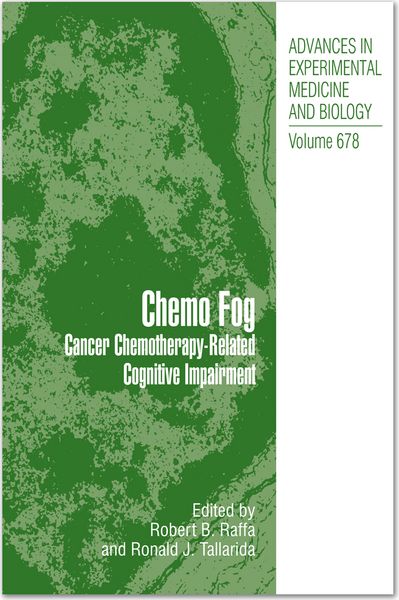
Chemo Fog Cancer Chemotherapy-Related Cognitive Impairment

139,99 €

inkl. gesetzl. MwSt., Versandkostenfrei


Beschreibung

Cancer patients have benefitted greatly from recent advances in the drugs, dose regimens, and combinations used to treat their primary tumor and for the treatment or prevention of spread of their disease. Due to the advances in chemotherapy and other aspects of prevention, early detection, and treatment...

Beschreibung

Cancer patients have benefitted greatly from recent advances in the drugs, dose regimens, and combinations used to treat their primary tumor and for the treatment or prevention of spread of their disease. Due to the advances in chemotherapy and other aspects of prevention, early detection, and treatment modalities, an increasing percentage of patients are surviving the disease. For some types of cancer, the majority of patients live decades beyond their diagnosis. For this they are forever thankful and appreciative of the drugs that helped lead to this increased survival rate. But no drug is devoid of adverse effects. This also applies to chemotherapeutic agents. The acute cytotoxic effects of these agents are well known––indeed are often required for their therapeutic benefit. The chronic adverse effects are varied and in some cases less well known. With the increase in survival rates, there has emerged a new awareness of these chronic adverse effects.

Portrait

ROBERT B. RAFFA, PhD, is Professor of Pharmacology and Chair of theDepartment of Pharmaceutical Sciences at Temple University School of Pharmacy in Philadelphia, Pennslyvania. He holds B Chem E and BS degrees in Chemical Engineering and Physiological Psychology, MS degrees in Biomedical Engineering and Toxicology, and a PhD in Pharmacology. He is the co-author or editor of several books on pharmacology and thermodynamics and over 200 articles in refereed journals, and is active in NIH-funded research, editorial, and professional society activities. Dr. Raffa became co-founder and president of the Forget-Me-Not Foundation in 2009.RONALD J. TALLAR IDA, PhD, is a Professor of Pharmacology at TempleUniversity School of Medicine. He has BS and MS degrees in physics/mathematics from Drexel University and a PhD in pharmacology. His work, primarily concerned with quantitative aspects of pharmacology, is represented in more than 250 published works that include eight books he has authored or co-authored. Dr. Tallarida currentlyteaches, serves on editorial advisory boards, conducts NIH-funded research, and is active in professional societies. Dr. Tallarida became co-founder and Vice-president of the Forget-Me-Not Foundation in 2009.

Produktdetails

Einband

Taschenbuch

Erscheinungsdatum

23.08.2016

Abbildungen

XXI, 216 p.

Herausgeber Robert B. Raffa + weitere

Produktdetails

Einband

Taschenbuch

Erscheinungsdatum

23.08.2016

Abbildungen

XXI, 216 p.

Herausgeber
Verlag Springer Us
Seitenzahl

216

Maße (L/B/H)

25,4/17,8/1,4 cm

Gewicht

460 g

Auflage

Softcover reprint of the original 1st ed. 2010

Sprache

Englisch

ISBN

978-1-4939-4099-8

Herstelleradresse

Springer-Verlag KG
Sachsenplatz 4-6
1201 Wien
AT

Email: ProductSafety@springernature.com

Noch keine Bewertungen vorhanden

Verfassen Sie die erste Bewertung zu diesem Artikel

Helfen Sie anderen Kundinnen und Kunden durch Ihre Meinung.

Kundinnen und Kunden meinen

Bewertungen (0)

  • Produktbild: Chemo Fog
  • Produktbild: Chemo Fog
  • Short Introduction and History.- Patient’s Perspective.- Oncology Nurse’s Perspective.- Oncology Pharmacist’s Perspective.- The Impact of Chemo Brain on the Patient with a High-Grade Glioma.- Neurocognitive Effects of Childhood Cancer Treatment.- The Economic Burden.- Designing Conceptual Model-Based Research in Chemotherapy-Related Changes in Cognitive Function.- Neuropsychologic Testing for Chemotherapy-Related Cognitive Impairment.- Imaging as a Means of Studying Chemotherapy-Related Cognitive Impairment.- Chemotherapy Associated Central Nervous System Damage.- Is Systemic Anti-Cancer Therapy Neurotoxic? Does Chemo Brain Exist? And Should We Rename It?.- Evaluation of Multiple Neurotoxic Outcomes in Cancer Chemotherapy.- Chemotherapy-Related Visual System Toxicity.- The Possible Role of Cytokines in Chemotherapy-Induced Cognitive Deficits.- Pharmacokinetics of Anti-Cancer Drugs Used in Breast Cancer Chemotherapy.- Combination Analysis.- Animal Models.- Chemo Brain (Chemo Fog) as a Potential Side Effect of Doxorubicin Administration: Role of Cytokine-Induced, Oxidative/Nitrosative Stress in Cognitive Dysfunction.- Effects of 5-FU.- Future Directions.