Acceptance and commitment therapy, or ACT (pronounced as a word rather than letters), is an emerging psychotherapeutic technique first developed into a complete system in the book Acceptance and Commitment Therapy by Steven Hayes, Kirk Strosahl, and Kelly Wilson.
ACT marks what some call a third wave in behavior therapy. To understand what this means, it helps to know that the first wave refers to traditional behavior therapy, which works to replace harmful behaviors with constructive ones through a learning principle called conditioning. Cognitive therapy, the second wave of behavior therapy, seeks to change problem behaviors by changing the thoughts that cause and perpetuate them.
In the third wave, behavior therapists have begun to explore traditionally nonclinical treatment techniques like acceptance, mindfulness, cognitive defusion, dialectics, values, spirituality, and relationship development. These therapies reexamine the causes and diagnoses of psychological problems, the treatment goals of psychotherapy, and even the definition of mental illness itself.
ACT earns its place in the third wave by reevaluating the traditional assumptions and goals of psychotherapy. The theoretical literature on which ACT is based questions our basic understanding of mental illness. It argues that the static condition of even mentally healthy individuals is one of suffering and struggle, so our grounds for calling one behavior ''normal'' and another ''disordered'' are murky at best. Instead of focusing on diagnosis and symptom etiology as a foundation for treatment-a traditional approach that implies, at least on some level, that there is something ''wrong'' with the client-ACT therapists begin treatment by encouraging the client to accept without judgment the circumstances of his or her life as they are. Then therapists guide clients through a process of identifying a set of core values. The focus of therapy thereafter is making short and long term commitments to act in ways that affirm and further this set of values. Generally, the issue of diagnosing and treating a specific mental illness is set aside; in therapy, healing comes as a result of living a value-driven life rather than controlling or eradicating a particular set of symptoms.
Emerging therapies like ACT are absolutely the most current clinical techniques available to therapists. They are quickly becoming the focus of major clinical conferences, publications, and research. More importantly, these therapies represent an exciting advance in the treatment of mental illness and, therefore, a real opportunity to alleviate suffering and improve people''s lives.
Not surprisingly, many therapists are eager to include ACT in their practices. ACT is well supported by theoretical publications and clinical research; what it has lacked, until the publication of this book, is a practical guide showing therapists exactly how to put these powerful new techniques to work for their own clients.
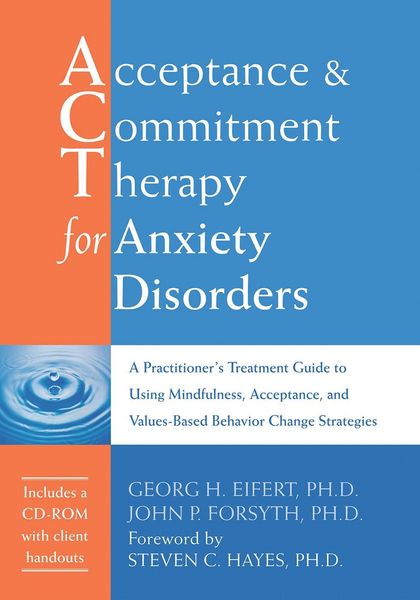
Acceptance and Commitment Therapy for Anxiety Disorders adapts the principles of ACT into practical, step-by-step clinical methods that therapists can easily integrate into their practices. The book focuses on the broad class of anxiety disorders, the most common group of mental illnesses, which includes general anxiety, panic disorder, phobias, obsessive-compulsive disorder, and post-traumatic stress disorder.
Written with therapists in mind, this book is easy to navigate, allowing busy professionals to find the information they need when they need it. It includes detailed examples of individual therapy sessions as well as many worksheets and exercises, the very important ''homework'' clients do at home to reinforce work they do in the office.