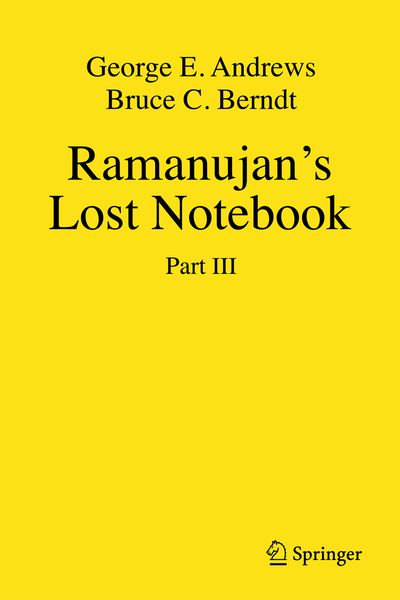
Ramanujan's Lost Notebook Part III
-
- Hardcover
- Taschenbuch ausgewählt
- eBook
-
Sprache:Englisch
-
Verlag:Springer Us
- Springer Us 139,99 € ausgewählt
- Springer 134,99 €
139,99 €
UVP
160,49 €
inkl. gesetzl. MwSt.,
Lieferung nach Hause
Beschreibung
Produktdetails
Einband
Taschenbuch
Erscheinungsdatum
17.07.2014
Verlag
Springer UsSeitenzahl
436
Maße (L/B/H)
23,5/15,5/2,5 cm
Gewicht
674 g
Auflage
2012
Sprache
Englisch
ISBN
978-1-4899-9497-4
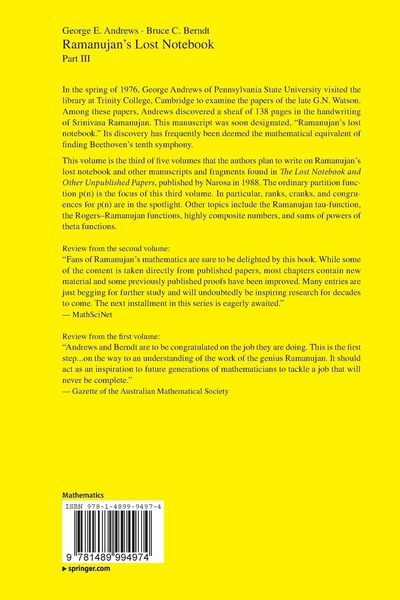
In the spring of 1976, George Andrews of Pennsylvania State University visited the library at Trinity College, Cambridge to examine the papers of the late G.N. Watson. Among these papers, Andrews discovered a sheaf of 138 pages in the handwriting of Srinivasa Ramanujan. This manuscript was soon designated, "Ramanujan's lost notebook." Its discovery has frequently been deemed the mathematical equivalent of finding Beethoven's tenth symphony.
This volume is the third of five volumes that the authors plan to write on Ramanujan’s lost notebook and other manuscripts and fragments found in The Lost Notebook and Other Unpublished Papers, published by Narosa in 1988. The ordinary partition function p(n) is the focus of this third volume. In particular, ranks, cranks, and congruences for p(n) are in the spotlight. Other topics include the Ramanujan tau-function, the Rogers–Ramanujan functions, highly composite numbers, and sums of powers of theta functions.
Reviewfrom the second volume:
"Fans of Ramanujan's mathematics are sure to be delighted by this book. While some of the content is taken directly from published papers, most chapters contain new material and some previously published proofs have been improved. Many entries are just begging for further study and will undoubtedly be inspiring research for decades to come. The next installment in this series is eagerly awaited."
- MathSciNet
Review from the first volume:
"Andrews a
nd Berndt are to be congratulated on the job they are doing. This is the first step...on the way to an understanding of the work of the genius Ramanujan. It should act as an inspiration to future generations of mathematicians to tackle a job that will never be complete."- Gazette of the Australian Mathematical Society
Noch keine Bewertungen vorhanden
Verfassen Sie die erste Bewertung zu diesem Artikel
Helfen Sie anderen Kundinnen und Kunden durch Ihre Meinung.
Kurze Frage zu unserer Seite
Vielen Dank für dein Feedback
Wir nutzen dein Feedback, um unsere Produktseiten zu verbessern. Bitte habe Verständnis, dass wir dir keine Rückmeldung geben können. Falls du Kontakt mit uns aufnehmen möchtest, kannst du dich aber gerne an unseren Kund*innenservice wenden.
zum Kundenservice