Beschreibung

Produktdetails

Einband

Taschenbuch

Erscheinungsdatum

28.09.2011

Verlag

Springer Us

Seitenzahl

224

Maße (L/B/H)

22,9/15,2/1,4 cm

Gewicht

365 g

Auflage

Softcover reprint of the original 1st ed. 1986

Sprache

Englisch

ISBN

978-1-4612-9285-2

Beschreibung

Produktdetails

Einband

Taschenbuch

Erscheinungsdatum

28.09.2011

Verlag

Springer Us

Seitenzahl

224

Maße (L/B/H)

22,9/15,2/1,4 cm

Gewicht

365 g

Auflage

Softcover reprint of the original 1st ed. 1986

Sprache

Englisch

ISBN

978-1-4612-9285-2

Herstelleradresse

Springer-Verlag GmbH
Tiergartenstr. 17
69121 Heidelberg
DE

Email: ProductSafety@springernature.com

Kundinnen und Kunden meinen

0 Bewertungen

Informationen zu Bewertungen

Zur Abgabe einer Bewertung ist eine Anmeldung im Konto notwendig. Die Authentizität der Bewertungen wird von uns nicht überprüft. Wir behalten uns vor, Bewertungstexte, die unseren Richtlinien widersprechen, entsprechend zu kürzen oder zu löschen.

Die Bewertungen sind nach Format, Anzahl Sterne und Datum sortiert.

Verfassen Sie die erste Bewertung zu diesem Artikel

Helfen Sie anderen Kund*innen durch Ihre Meinung

Kundinnen und Kunden meinen

0 Bewertungen filtern

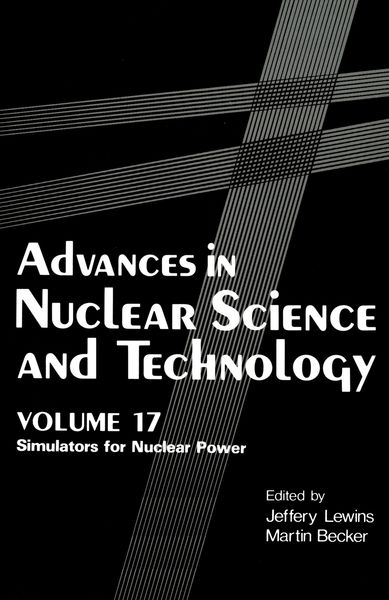
  • Produktbild: Advances in Nuclear Science and Technology
  • Produktbild: Advances in Nuclear Science and Technology
  • A Methodology for the Design of Plant Analysers.- I. Introduction.- II. CEGB Operations.- III. Historical Development within the CEGB.- IV. Design and Provision of Training Simulators.- V. Requirements of Design Quality Assurance.- VI. Simulation Language PMSP.- VII. Conservation of Validated Plant Models.- VIII. Converged Modelling Philosophy.- Acknowledgements.- References.- Models and Simulation in Nuclear Power Station Design and Operation.- I. Introduction.- II. Physical Full-Scale Engineering Models.- III. Part-Scale Models.- IV. Full-Scale Static Control Room Mock-ups.- V. Full-Scale Control Room Mock-ups with Dynamic Displays.- VI. Full-Scope Training Simulators.- VII. Large Simulation Facilities for Design.- VIII. Nuclear Plant Analysers.- IX. Predictive Devices Used as Operator Aids.- X. Heysham II Power Station Fault Level Monitoring and Indication Equipment.- XI. CEGB Essential System Integrating Simulator.- XII. Equipment, Systems and Human Reliability.- XIII. Testing of Automatic Control Loops.- XIV. Computer Hardware Necessary.- XV. Conclusions.- Acknowledgements.- References.- Psychological Aspects of Simulator Design and Use.- I. Introduction.- II. Simulator Uses and Human Factors.- III. Simulators as Learning Environments.- IV. Alternative Approaches to Training.- V. Remaining Tasks for the Full-Scope Simulator.- VI. Conclusions.- References.- The Development of Full-Scope AGR Training Simulators within the CEGB.- I. Introduction.- II. User Requirement.- III. Functional Specification.- IV. Choice of Plant Model Complexity.- V. Choice of Display and Tutorial Facilities.- VI. Computer and Interface Hardware.- VII. Software Development Strategy.- VIII. Long Term Support.- IX. Quality Assurance.- X. AGR Simulator System Design.- XI. Conclusions.- Acknowledgements.- References.- Parallel Processing for Nuclear Safety Simulation.- I. Introduction.- II. Problem Definition and Solution Methodology.- III. Solution of Gas-Flow Equations.- IV. Application to RELAPV.- V. Conclusions.- Acknowledgement.- References.- Developments in Full-scope, Real-time Nuclear Plant Simulators.- I. Introduction.- II. Nuclear Submarine Simulators.- III. The Hunterston ‘B’ Simulator.- IV. The Torness AGR Simulator.- V. Simulator System Design Philosophy.- VI. Automatic Testing.- VII. Computer System Architecture.- VIII. Conclusion.- Acknowledgement.- Authors’ Biography.