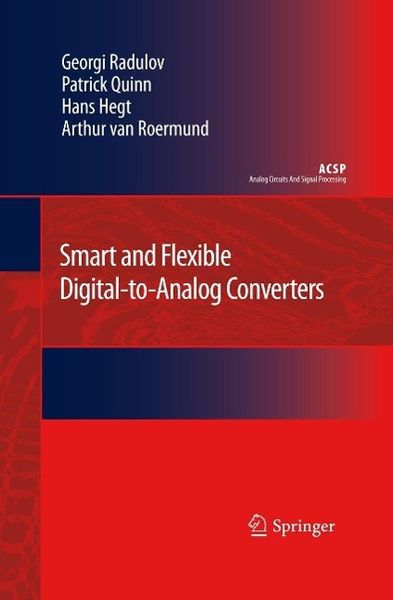
Smart and Flexible Digital-to-Analog Converters
-
- Hardcover
- Taschenbuch
- eBook ausgewählt
-
Form:Einzelkauf Download
-
Sprache:Englisch
149,79 €
inkl. gesetzl. MwSt.Beschreibung
Produktdetails
Format
Kopierschutz
Nein
Family Sharing
Nein
Text-to-Speech
Nein
Erscheinungsdatum
07.01.2011
Verlag
Springer NetherlandsSeitenzahl
310 (Printausgabe)
Dateigröße
11553 KB
Sprache
Englisch
EAN
9789400703476
Smart and Flexible Digital-to-Analog Converters proposes new concepts and implementations for flexibility and self-correction of current-steering digital-to-analog converters (DACs) which allow the attainment of a wide range of functional and performance specifications, with a much reduced dependence on the fabrication process.
DAC linearity is analysed with respect to the accuracy of the DAC unit elements. A classification is proposed of the many different current-steering DAC correction methods. The classification reveals methods that do not yet exist in the open literature. Further, this book systematically analyses self-calibration correction methods for the various DAC mismatch errors. For instance, efficient calibration of DAC binary currents is identified as an important missing method.
This book goes on to propose a new methodology for correcting mismatch errors of both nominally identical unary as well as scaled binary DAC currents. A new concept for DAC flexibility is presented. The associated architecture is based on a modular design approach that uses parallel sub-DAC units to realize flexible design, functionality and performance.
Two main concepts, self-calibration and flexibility, are demonstrated in practice using three DAC testchips in 250nm, 180nm and 40nm standard CMOS. Smart and Flexible Digital-to-Analog Converters will be useful to both advanced professionals and newcomers in the field. Advanced professionals will find new methods that are fully elaborated from analysis at conceptual level to measurement results at test-chip level. New comers in the field will find structured knowledge of fully referenced state-of-the art methods with many fully explained novelties.<
DAC linearity is analysed with respect to the accuracy of the DAC unit elements. A classification is proposed of the many different current-steering DAC correction methods. The classification reveals methods that do not yet exist in the open literature. Further, this book systematically analyses self-calibration correction methods for the various DAC mismatch errors. For instance, efficient calibration of DAC binary currents is identified as an important missing method.
This book goes on to propose a new methodology for correcting mismatch errors of both nominally identical unary as well as scaled binary DAC currents. A new concept for DAC flexibility is presented. The associated architecture is based on a modular design approach that uses parallel sub-DAC units to realize flexible design, functionality and performance.
Two main concepts, self-calibration and flexibility, are demonstrated in practice using three DAC testchips in 250nm, 180nm and 40nm standard CMOS. Smart and Flexible Digital-to-Analog Converters will be useful to both advanced professionals and newcomers in the field. Advanced professionals will find new methods that are fully elaborated from analysis at conceptual level to measurement results at test-chip level. New comers in the field will find structured knowledge of fully referenced state-of-the art methods with many fully explained novelties.
This book goes on to propose a new methodology for correcting mismatch errors of both nominally identical unary as well as scaled binary DAC currents. A new concept for DAC flexibility is presented. The associated architecture is based on a modular design approach that uses parallel sub-DAC units to realize flexible design, functionality and performance.
Two main concepts, self-calibration and flexibility, are demonstrated in practice using three DAC testchips in 250nm, 180nm and 40nm standard CMOS. Smart and Flexible Digital-to-Analog Converters will be useful to both advanced professionals and newcomers in the field. Advanced professionals will find new methods that are fully elaborated from analysis at conceptual level to measurement results at test-chip level. New comers in the field will find structured knowledge of fully referenced state-of-the art methods with many fully explained novelties.
Two main concepts, self-calibration and flexibility, are demonstrated in practice using three DAC testchips in 250nm, 180nm and 40nm standard CMOS. Smart and Flexible Digital-to-Analog Converters will be useful to both advanced professionals and newcomers in the field. Advanced professionals will find new methods that are fully elaborated from analysis at conceptual level to measurement results at test-chip level. New comers in the field will find structured knowledge of fully referenced state-of-the art methods with many fully explained novelties.
Noch keine Bewertungen vorhanden
Verfassen Sie die erste Bewertung zu diesem Artikel
Helfen Sie anderen Kundinnen und Kunden durch Ihre Meinung.
Kurze Frage zu unserer Seite
Vielen Dank für dein Feedback
Wir nutzen dein Feedback, um unsere Produktseiten zu verbessern. Bitte habe Verständnis, dass wir dir keine Rückmeldung geben können. Falls du Kontakt mit uns aufnehmen möchtest, kannst du dich aber gerne an unseren Kund*innenservice wenden.
zum Kundenservice