• Produktbild: Smart and Flexible Digital-to-Analog Converters
  • Produktbild: Smart and Flexible Digital-to-Analog Converters
- 13%

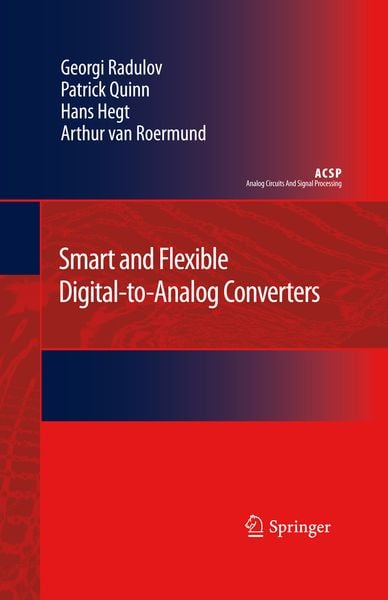
Smart and Flexible Digital-to-Analog Converters

13% sparen

138,99 € UVP 160,49 €

inkl. gesetzl. MwSt., Versandkostenfrei

Lieferung nach Hause

Beschreibung

Produktdetails

Einband

Gebundene Ausgabe

Erscheinungsdatum

15.01.2011

Verlag

Springer Netherland

Seitenzahl

310

Maße (L/B/H)

24,1/16,5/2,8 cm

Gewicht

596 g

Auflage

1. Auflage

Sprache

Englisch

ISBN

978-94-007-0346-9

Beschreibung

Rezension

From the reviews:

“This is a very useful book on the state of the art in the field of digital-to-analog conversion (DAC) methods whose main aim is to advance the existing knowledge on efficient and robust high-performance current-steering DACs, and to investigate the concept of DAC flexibility. The authors focus on the accuracy and they stress DAC correction methods to achieve it and to provide high efficiency. … The list of references contains 94 items, most of them published recently.” (Vladimir Čadež, Zentralblatt MATH, Vol. 1217, 2011)

Zitat

From the reviews:
"This is a very useful book on the state of the art in the field of digital-to-analog conversion (DAC) methods whose main aim is to advance the existing knowledge on efficient and robust high-performance current-steering DACs, and to investigate the concept of DAC flexibility. The authors focus on the accuracy and they stress DAC correction methods to achieve it and to provide high efficiency. ... The list of references contains 94 items, most of them published recently." (Vladimir Cadez, Zentralblatt MATH, Vol. 1217, 2011)

Produktdetails

Einband

Gebundene Ausgabe

Erscheinungsdatum

15.01.2011

Verlag

Springer Netherland

Seitenzahl

310

Maße (L/B/H)

24,1/16,5/2,8 cm

Gewicht

596 g

Auflage

1. Auflage

Sprache

Englisch

ISBN

978-94-007-0346-9

Herstelleradresse

Libri GmbH
Europaallee 1
36244 Bad Hersfeld
DE

Email: [email protected]

Kundinnen und Kunden meinen

0 Bewertungen

Informationen zu Bewertungen

Zur Abgabe einer Bewertung ist eine Anmeldung im Konto notwendig. Die Authentizität der Bewertungen wird von uns nicht überprüft. Wir behalten uns vor, Bewertungstexte, die unseren Richtlinien widersprechen, entsprechend zu kürzen oder zu löschen.

Die Bewertungen sind nach Format, Anzahl Sterne und Datum sortiert.

Verfassen Sie die erste Bewertung zu diesem Artikel

Helfen Sie anderen Kund*innen durch Ihre Meinung

Kundinnen und Kunden meinen

0 Bewertungen filtern

  • Produktbild: Smart and Flexible Digital-to-Analog Converters
  • Produktbild: Smart and Flexible Digital-to-Analog Converters
  • List Of Abbreviations.

    PART I: INTRODUCTION AND BASICS.

    1. INTRODUCTION. 1.1. Modern Micro-Electronics And Flexibility. 1.2. Aims of the Book. 1.3. Scope of the Book. 1.4. Scientific Approach. 1.5. Outline of the Book.

    2. BASICS OF DIGITAL-TO-ANALOG CONVERSION. 2.1. Introduction. 2.2. Functionality and Specifications. 2.3. DAC Resources. 2.4. Segmentation of DAC Analog Resources. 2.5. DAC Implementations. 2.6. Current-Steering DAC Architecture. 2.7. Modern Current-Steering DAC Challenges. 2.8. Summary.

    PART II: STATE-OF-THE-ART CORRECTION METHODS.

    3. ERROR CORRECTION BY DESIGN. 3.1. Introduction. 3.2. Return-To-Zero Output. 3.3. Differential-Quad Switching. 3.4. Cascode Switches With Offset Current. 3.5. Input Data Reshuffling Methods (Dem). 3.6. Discussion. 3.7. Conclusions.

    4. SMART SELF-CORRECTING D/A CONVERTERS. 4.1. Introduction. 4.2. Self-Calibration of DAC Current Cells. 4.3. Mapping. 4.4. Digital Pre-Distortion. 4.5. Discussion. 4.6. Conclusions.

    PART III: NEW MODELING, ANALYSIS, AND CLASSIFICATION.

    5. ERROR MODELING FOR DAC CORRECTION, A BROAD VIEW. 5.1. Introduction. 5.2. A Model of the Step Response of a Current Cell. 5.3. Transistor Mismatch Caused Errors. 5.4. Digital-Switching Errors. 5.5. Discussion. 5.6. Conclusions.

    6. BROWNIAN BRIDGE BASED ANALYSIS AND MODELING OF DAC LINEARITY, AN IN-DEPTH VIEW. 6.1. Introduction. 6.2. New Statistical Analysis of the DAC Static Non-Linearity Based on Brownian Bridge. 6.3. Discussion. 6.4. Conclusions.

    7. CLASSIFICATION OF ERROR CORRECTION METHODS, A BROAD VIEW. 7.1. Introduction. 7.2. Selected Set of DAC Correction Methods And Definitions. 7.3. Error Measurement Category. 7.4. Redundancy Category. 7.5. System Level Category. 7.6. Discussion. 7.7. Conclusion.

    8. ANALYSIS OF SELF-CALIBRATION OF CURRENTS, AN IN-DEPTH VIEW. 8.1. Introduction. 8.2. DAC Currents Self-Calibration Classification. 8.3. Self-Measurement. 8.4. Algorithm. 8.5. Self-Correction. 8.6. Conclusions.

    PART IV: NEW CONCEPTS AND METHODS.

    9. NEW REDUNDANT SEGMENTATION CONCEPT. 9.1. Introduction. 9.2. Abstraction Levels Of Segmentation. 9.3. New Redundant Segmentation. 9.4. Discussion. 9.5. Conclusion.

    10. NEW METHODS FOR SELF-CALIBRATION OF CURRENTS. 10.1. Introduction. 10.2. Self-Calibration Of Unary Currents. 10.3. A Calibration Method For Generic Current-Steering D/A Converters With Optimal Area Solution. 10.4. A Calibration Method For Binary Signal Current Sources. 10.5. Discussion. 10.6. Conclusions.

    11. NEW REDUNDANT DECODER CONCEPT. 11.1. Introduction. 11.2. Conventional ROW-Column Decoder. 11.3. New Decoder With Redundancy. 11.4. Simulation Results. 11.5. Discussion. 11.6. Conclusions.

    12. NEW HIGH-LEVEL MAPPING CONCEPT. 12.1. Introduction. 12.2. Conceptual Idea. 12.3. Illustrative Measurement And Simulation Results For Amplitude Errors Mapping. 12.4. Limitations And Discussion. 12.5. Conclusions.

    13. NEW HARMONIC-DISTORTION-SUPPRESSION METHOD. 13.1. Introduction. 13.2. Theoretical Background. 13.3. Application Area. 13.4. Limitations and Discussion. 13.5. Conclusions.

    14. FLEXIBLE DIGITAL-TO-ANALOG CONVERTERS CONCEPT. 14.1. Introduction. 14.2. Flexible DAC Platform. 14.3. Definitions Of Flexibility. 14.4. Operation Modes. 14.5. The “Missing Code Problem”. 14.6. Conclusions.

    PART V: DESIGN EXAMPLES.

    15. A REDUNDANT BINARY-TO-THERMOMETER DECODER DESIGN. 15.1. Introduction. 15.2. Design Example. 15.3. Measurement Results And Discussion. 15.4. Conclusions.

    16. TWO SELF-CALIBRATING DAC DESIGNS. 16.1. Introduction. 16.2. Unary Currents Self-Calibration In A 250nm DAC. 16.3. Both Unary And Binary Currents Self-Calibration In A 180nm DAC. 16.4. Comparison With State-Of-The-Art DAC Publications. 16.5. Conclusions.

    17. A FUNCTIONAL-SEGMENTATION DAC DESIGN USING HARMONIC DISTORTION SUPPRESSION METHOD. 17.1. Introduction. 17.2. Test Set-Up Design. 17.3. Parallel Virtual Dacs. 17.4. Parallel Real Sub-DACs. 17.5. OFDM (Multi-Tone) System Application. 17.6. Conclusions.

    18. A 14 BIT QUAD CORE FLEXIBLE 180NM DAC PLATFORM. 18.1. Introduction. 18.2. Design. 18.3. Measurements. 18.4. Conclusions.

    19. A 16 BIT 16-CORE FLEXIBLE 40NM DAC PLATFORM. 19.1. Introduction. 19.2. Flexible DAC Platform Based On 16 Core Units. 19.3. Measurements. 19.4. Conclusions.

    PART VI: CONCLUSIONS.

    Summary. Conclusions. Appendix A. Published CMOS Digital-To-Analog Converters From 1986 Until 2009. References.