Gutscheinbedingungen

**Gültig vom 15.06.2026 bis 17.06.2026 | Gültig für nicht preisgebundene fremdsprachige Bücher | Einzelne Artikel können ausgeschlossen sein | Maximaler rabattfähiger Warenkorbwert 500 € | Nicht kombinierbar mit weiteren Aktionen | Nur einmal pro Person einlösbar | Nur solange der Vorrat reicht

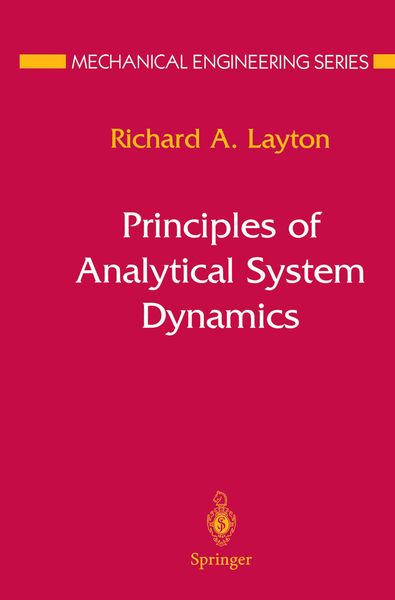
Produktbild: Principles of Analytical System Dynamics
- 13%

Principles of Analytical System Dynamics

13% sparen

92,99 € UVP 106,99 €

inkl. gesetzl. MwSt., Versandkostenfrei

Lieferung nach Hause

Beschreibung

Produktdetails

Einband

Taschenbuch

Erscheinungsdatum

27.09.2012

Verlag

Springer Us

Seitenzahl

157

Maße (L/B/H)

23,5/15,5/1 cm

Gewicht

277 g

Auflage

Softcover reprint of the original 1st ed. 1998

Sprache

Englisch

ISBN

978-1-4612-6832-1

Beschreibung

Produktdetails

Einband

Taschenbuch

Erscheinungsdatum

27.09.2012

Verlag

Springer Us

Seitenzahl

157

Maße (L/B/H)

23,5/15,5/1 cm

Gewicht

277 g

Auflage

Softcover reprint of the original 1st ed. 1998

Sprache

Englisch

ISBN

978-1-4612-6832-1

Herstelleradresse

Springer-Verlag KG
Sachsenplatz 4-6
1201 Wien
AT

Email: ProductSafety@springernature.com

Kundinnen und Kunden meinen

0 Bewertungen

Informationen zu Bewertungen

Zur Abgabe einer Bewertung ist eine Anmeldung im Konto notwendig. Die Authentizität der Bewertungen wird von uns nicht überprüft. Wir behalten uns vor, Bewertungstexte, die unseren Richtlinien widersprechen, entsprechend zu kürzen oder zu löschen.

Die Bewertungen sind nach Format, Anzahl Sterne und Datum sortiert.

Verfassen Sie die erste Bewertung zu diesem Artikel

Helfen Sie anderen Kund*innen durch Ihre Meinung

Kundinnen und Kunden meinen

0 Bewertungen filtern

  • Produktbild: Principles of Analytical System Dynamics
  • 1. Introduction.- 1.1. A Perspective on Physical Systems.- 1.2. What This Book Is About.- 1.3. Background.- 1.4. Overview of Topics.- 1.5. Comments on Notation.- 2. Fundamentals of System Dynamics.- 2.1. A Unified Set of Variables.- 2.2. Classification of Discrete Elements.- 2.2.1. Kinetic Stores.- 2.2.2. Potential Stores.- 2.2.3. Ideal Dissipators.- 2.2.4. Sources.- 2.2.5. Path-Dependent Dissipation.- 2.2.6. Basic 2-Ports.- 2.3. Representation of Motion.- 2.3.1. Variable Pairs.- 2.3.2. Configuration Space and State Space.- 2.3.3. Reduced-Order Coordinates.- 2.4. Constraints.- 2.4.1. Displacement Constraints.- 2.4.2. Flow Constraints.- 2.4.3. Degrees of Freedom.- 2.4.4. Effort Constraints.- 2.4.5. Dynamic Constraints.- 2.5. Variational Concepts.- 2.5.1. Classification of Displacements.- 2.5.2. Virtual Work.- 2.5.3. Lagrange’s Principle.- 2.5.4. Classification of Efforts.- 2.6. Geometry of Constraint.- 2.6.1. Holonomic and Nonholonomic Constraints.- 2.6.2. Effort Constraints and Dynamic Constraints.- 2.6.3. Virtual Momentum.- 3. Lagrangian DAEs of Motion.- 3.1. A Variational Form of the First Law.- 3.2. Lagrange’s Equation.- 3.2.1. Derivation.- 3.2.2. Euler—Lagrange Equation.- 3.3. Lagrangian DAEs.- 3.3.1. Lagrange Multipliers.- 3.3.2. Descriptor Form.- 3.4. Underlying ODEs.- 3.4.1. Holonomic Systems.- 3.4.2. Nonholonomic Systems.- 3.4.3. Discussion.- 3.5. Interpretation of Lagrange’s Equation.- 4. Hamiltonian DAEs of Motion.- 4.1. Legendre Transform.- 4.2. Hamiltonian DAEs.- 4.2.1. Derivation.- 4.2.2. Semiexplicit Form.- 4.3. Underlying ODEs.- 4.3.1. Holonomic Systems.- 4.3.2. Nonholonomic Systems.- 4.3.3. Canonical Form.- 4.3.4. Discussion.- 4.4. Comparison of Two Formulations.- 5. Complementary DAEs of Motion.- 5.1. Fundamentals.- 5.1.1. Representation of Motion.- 5.1.2. Constraints.- 5.1.3. Classification of Flows.- 5.1.4. Work and Energy.- 5.2. Complementary Lagrangian DAEs.- 5.2.1. Derivation.- 5.2.2. Descriptor Form.- 5.2.3. Underlying ODEs.- 5.3. Complementary Hamiltonian DAEs.- 5.3.1. Derivation.- 5.3.2. Semiexplicit Form.- 5.3.3. Underlying ODEs.- 5.4. Comparison of Two Formulations.- 6. Modeling and Simulation.- 6.1. Analysis.- 6.1.1. Schematic.- 6.1.2. Coordinate Selection.- 6.1.3. Energy.- 6.1.4. Constraints.- 6.1.5. Virtual Work.- 6.2. Formulating a Model.- 6.2.1. Function Manipulation.- 6.2.2. Parameters.- 6.2.3. Initial Conditions.- 6.3. Numerical Solution of DAEs.- 6.3.1. Numerical Methods.- 6.3.2. Differential Index.- 6.3.3. Software for DAEs.- 6.4. Automated Modeling and Simulation.- 6.5. Examples.- Afterword.- References.