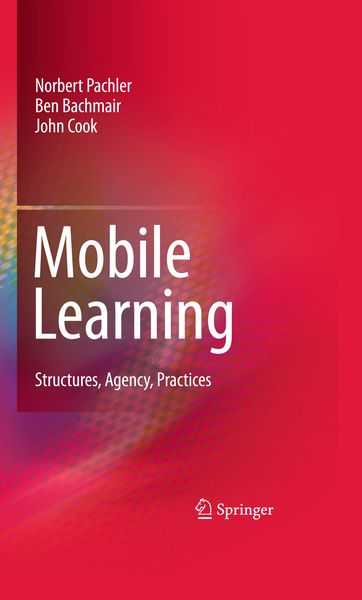
Mobile Learning Structures, Agency, Practices
138,99 €
UVP
160,49 €
inkl. gesetzl. MwSt.,
Beschreibung
Produktdetails
Einband
Gebundene Ausgabe
Erscheinungsdatum
22.12.2009
Abbildungen
XXII, 382 p.
Herausgeber
Gunther KressVerlag
Springer UsSeitenzahl
382
Maße (L/B/H)
23,9/16,3/3 cm
Gewicht
737 g
Sprache
Englisch
ISBN
978-1-4419-0584-0
As with television and computers before it, today’s mobile technology challenges educators to respond and ensure their work is relevant to students. What’s changed is that this portable, cross-contextual way of engaging with the world is driving a more proactive approach to learning on the part of young people.
The first full-length authored treatment of the relationship between the centrality of technological development in daily life and its potential as a means of education, Mobile Learning charts the rapid emergence of new forms of mass communication and their potential for gathering, shaping, and analyzing information, studying their transformative capability and learning potential in the contexts of school and socio-cultural change. The focus is on mobile/cell phones, PDAs, and to a lesser extent gaming devices and music players, not as "the next new thing" but meaningfully integrated into education, without objectifying the devices or technology itself. And the book fully grounds readers by offering theoretical and conceptual models, an analytical framework for understanding the issues, recommendations for specialized resources, and practical examples of mobile learning in formal as well as informal educational settings, particularly with at-risk students. Among the topics covered:
• Core issues in mobile learning
• Mobile devices as educational resources
• Socioeconomic approaches to mobile learning
• Creating situations that promote mobile learning
• Ubiquitous mobility and its implications for pedagogy
• Bridging the digital divide at the policy level
Mobile Learning is a groundbreaking volume, sure to stimulate both discussion and innovation among educational professionals interested in technology in the context of teaching and learning.
Noch keine Bewertungen vorhanden
Verfassen Sie die erste Bewertung zu diesem Artikel
Helfen Sie anderen Kundinnen und Kunden durch Ihre Meinung.
Kurze Frage zu unserer Seite
Vielen Dank für dein Feedback
Wir nutzen dein Feedback, um unsere Produktseiten zu verbessern. Bitte habe Verständnis, dass wir dir keine Rückmeldung geben können. Falls du Kontakt mit uns aufnehmen möchtest, kannst du dich aber gerne an unseren Kund*innenservice wenden.
zum Kundenservice