Gutscheinbedingungen

**Gültig bis 10.06.2026 / Gültig für gebrauchte Bücher / Mindestbestellwert 20,00 € / Einzelne Artikel können ausgeschlossen sein / Online auf www.bücher.de.de / Nicht kombinierbar mit anderen Gutscheinen oder Preisaktionen / Nur einmal pro Einkauf einlösbar / Gutschein wird auf max. 500€ Bestellwert angerechnet / Keine Barauszahlung / Nicht gültig für Versandkosten und Services

  • Produktbild: Structural Reliability
  • Produktbild: Structural Reliability
Band 17 - 12%

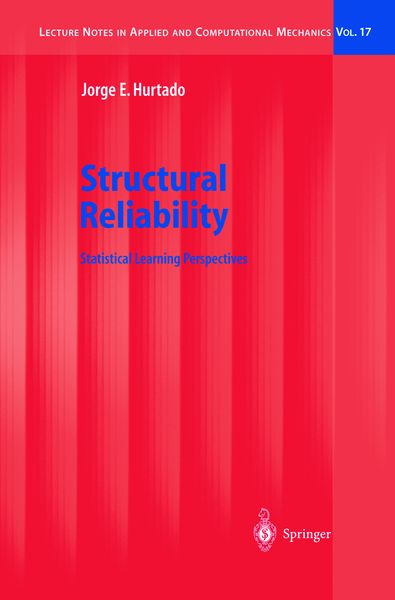
Structural Reliability Statistical Learning Perspectives

12% sparen

139,99 € UVP 160,49 €

inkl. gesetzl. MwSt., Versandkostenfrei

Lieferung nach Hause

Beschreibung

Produktdetails

Einband

Gebundene Ausgabe

Erscheinungsdatum

13.05.2004

Verlag

Springer Berlin

Seitenzahl

257

Maße (L/B/H)

24,1/16/2 cm

Gewicht

504 g

Auflage

2004

Sprache

Englisch

ISBN

978-3-540-21963-7

Beschreibung

Rezension

From the reviews:


"The methods presented and exemplified in the book are what in the statistical world would be called nonlinear and nonparametric regression or pattern recognition techniques … . The book is written from an algorithmic perspective … . the book is a valuable overview of problems and techniques used in structural safety analysis." (Georg Lindgren, Mathematical Reviews, Issue 2006 h)

Produktdetails

Einband

Gebundene Ausgabe

Erscheinungsdatum

13.05.2004

Verlag

Springer Berlin

Seitenzahl

257

Maße (L/B/H)

24,1/16/2 cm

Gewicht

504 g

Auflage

2004

Sprache

Englisch

ISBN

978-3-540-21963-7

Herstelleradresse

Springer-Verlag GmbH
Tiergartenstr. 17
69121 Heidelberg
DE

Email: ProductSafety@springernature.com

Kundinnen und Kunden meinen

0 Bewertungen

Informationen zu Bewertungen

Zur Abgabe einer Bewertung ist eine Anmeldung im Konto notwendig. Die Authentizität der Bewertungen wird von uns nicht überprüft. Wir behalten uns vor, Bewertungstexte, die unseren Richtlinien widersprechen, entsprechend zu kürzen oder zu löschen.

Die Bewertungen sind nach Format, Anzahl Sterne und Datum sortiert.

Verfassen Sie die erste Bewertung zu diesem Artikel

Helfen Sie anderen Kund*innen durch Ihre Meinung

Kundinnen und Kunden meinen

0 Bewertungen filtern

  • Produktbild: Structural Reliability
  • Produktbild: Structural Reliability
  • 1 A Discussion on Structural Reliability Methods.- 1.1 Performance and Limit State Functions.- 1.2 Methods Based on the Limit State Function.- 1.3 Transformation of Basic Variables.- 1.3.1 Normal Variables.- 1.3.2 Normal Translation.- 1.3.3 Rosenblatt Transformation.- 1.3.4 Nataf Transformation.- 1.3.5 Polynomial Chaoses.- 1.4 FORM and SORM.- 1.4.1 Basic Equations.- 1.4.2 Discussion.- 1.5 Monte Carlo Methods.- 1.5.1 Importance Sampling.- 1.5.2 Directional Simulation.- 1.5.3 General Characteristics of Simulation Methods.- 1.6 Solver Surrogate Methods.- 1.6.1 Response Surface Method.- 1.6.2 Neural Networks and Support Vector Machines.- 1.6.3 Characteristics of the Response Surface Method.- 1.7 Regression and Classification.- 1.8 FORM and SORM Approximations with Statistical Learning Devices.- 1.9 Methods Based on the Performance Function.- 1.10 Summary.- 2 Fundamental Concepts of Statistical Learning.- 2.1 Introduction.- 2.2 The Basic Learning Problem.- 2.3 Cost and Risk Functions.- 2.4 The Regularization Principle.- 2.5 Complexity and Vapnik-Chervonenkis Dimension.- 2.6 Error Bounds and Structured Risk Minimization.- 2.7 Risk Bounds for Regression.- 2.8 Stringent and Adaptive Models.- 2.9 The Curse of Dimensionality.- 2.10 Dimensionality Increase.- 2.11 Sample Complexity.- 2.12 Selecting a Learning Method in Reliability Analysis.- 2.12.1 Classification Techniques.- 2.12.2 Remarks on Probability Density Estimation.- 2.12.3 Characteristics of Samples in Structural Reliability.- 2.12.4 A Look from the Viewpoint of Information Theory.- 2.12.5 Recommended Methods.- 3 Dimension Reduction and Data Compression.- 3.1 Introduction.- 3.2 Principal Component Analysis.- 3.3 Kernel PCA.- 3.3.1 Basic Equations.- 3.3.2 Kernel Properties and Construction.- 3.3.3 Example 1: Structure of a Monte Carlo Cloud..- 3.3.4 Example 2: Transformation of Reliability Problems.- 3.4 Karhunen-Loève Expansion.- 3.5 Discrete Wavelet Transform..- 3.6 Data Compression Techniques..- 3.6.1 Vector Quantization.- 3.6.2 Expectation-Maximization..- 4 Classification Methods I — Neural Networks.- 4.1 Introduction.- 4.2 Probabilistic and Euclidean methods.- 4.2.1 Bayesian Classification.- 4.2.2 Classification Trees.- 4.2.3 Concluding Remarks.- 4.3 Multi-Layer Perceptrons..- 4.3.1 Hyperplane Discrimination.- 4.3.2 Polyhedral Discrimination.- 4.4 General Nonlinear Two-Layer Perceptrons.- 4.4.1 Training Algorithms.- 4.4.2 Example.- 4.4.3 Complexity and Dimensionality Issues.- 4.5 Radial Basis Function Networks.- 4.5.1 Approximation Properties.- 4.5.2 A First Comparison of MLP and RBFN.- 4.6 Elements of a General Training Algorithm.- 5 Classification Methods II — Support Vector Machines.- 5.1 Introduction.- 5.2 Support Vector Machines.- 5.2.1 Linearly Separable Classes..- 5.2.2 Nonlinear Separation.- 5.2.3 Solution of the Optimization Problem..- 5.3 A Remark on Polynomial Chaoses.- 5.4 Genetic Algorithm..- 5.4.1 General Considerations..- 5.4.2 Algorithm.- 5.5 Active Learning Algorithms.- 5.5.1 Algorithm Based on Margin Shrinking.- 5.5.2 Algorithm Based on Version Space Shrinking.- 5.6 A Comparison with Neural Classifiers.- 5.7 Complexity, Dimensionality and Induction of SV Machines.- 5.8 Application Examples.- 5.8.1 Parabolic Limit State Function.- 5.8.2 A Linear Limit State Function with Nonlinear Performance Function.- 5.8.3 Two- and Twenty-Dimensional SORM Functions.- 5.8.4 Ten Dimensional Problem.- 5.8.5 An Application of the Version Space Algorithm.- 5.8.6 Bound of the VC Dimension of the SORM Function.- 5.9 An Application to Stochastic Stability.- 5.9.1 Asymptotic Moment Stability.- 5.9.2 Numerical Example.- 5.10 Other Kernel Classification Algorithms.- 6 Regression Methods.- 6.1 Introduction.- 6.2 The Response Surface Method Revisited.- 6.2.1 Dimensionality Problems.- 6.2.2 Performance Function Approximation.- 6.2.3 Naive Inductive Principle.- 6.3 Neural Networks.- 6.3.1 Boosting.- 6.3.2 A Second Comparison of MLP and RBFN.- 6.3.3 Example: Full Probabilistic Analysis with Stochastic Finite Elements.- 6.4 Support Vector Regression.- 6.4.1 Support Vector Approach to Non-Separable Classes.- 6.4.2 Extension to Function Approximation..- 6.4.3 Example: Random Eigenvalues of a Frame.- 6.5 Time-Dependent MLP for Random Vibrations.- 7 Classification Approaches to Reliability Indexation.- 7.1 Introduction.- 7.2 A Discussion on Reliability Indices.- 7.3 A Comparison of Hyperplane Approximations.- 7.4 Secant Hyperplane Reliability Index.- 7.4.1 Index Properties.- 7.5 Volumetric Reliability Index.- 7.5.1 Derivation of the Index.- 7.5.2 Index Properties.- References.- Essential Symbols.