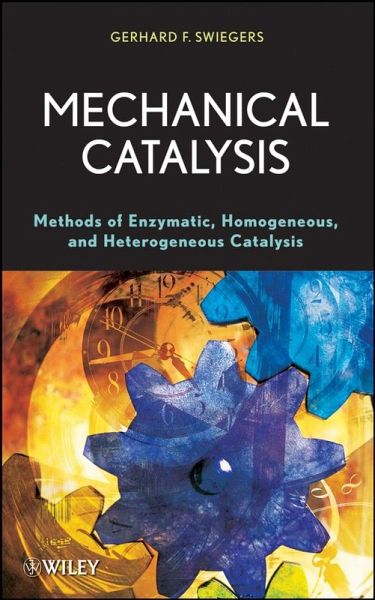
Mechanical Catalysis

PAYBACK Punkte
67 °P sammeln!

The authoritative reference on time-dependent (mechanical) catalysis, as employed by many enzymes and sought in their man-made mimicsThis book examines the principles of mechanics as they apply to chemistry and, more particularly, catalysis. It's a unique, comprehensive resource focusing on unconventional time-dependent (mechanical) catalysis, instead of the more familiar energy-dependent (thermodynamic) catalysis. To help practitioners envision how catalyst-reactant dynamism leads to time-dependent catalysis, it:_ Demonstrates the existence of two fundamentally different forms of "reaction-li...
The authoritative reference on time-dependent (mechanical) catalysis, as employed by many enzymes and sought in their man-made mimics
This book examines the principles of mechanics as they apply to chemistry and, more particularly, catalysis. It's a unique, comprehensive resource focusing on unconventional time-dependent (mechanical) catalysis, instead of the more familiar energy-dependent (thermodynamic) catalysis. To help practitioners envision how catalyst-reactant dynamism leads to time-dependent catalysis, it:
_ Demonstrates the existence of two fundamentally different forms of "reaction-limited" catalysis, namely time-dependent (mechanical) and energy-dependent (thermodynamic) catalysis
_ Describes their physical manifestation in heterogeneous and homogeneous systems
_ Shows how many enzymes use time-dependent catalytic reactions
_ Unravels the mystery of enzymatic catalysis, including: the fundamental processes at work, the origin of its general and physical features, the way it has evolved, and how it relates to catalysis in man-made systems
_ Unifies homogeneous, heterogeneous, and enzymatic catalysis, and explains how the thirty or so general theories of enzymatic catalysis are knit together into a conceptually coherent whole
_ Describes how to authentically mimic the underlying principles of enzymatic catalysis in man-made systems, including: the design requirements for such catalysts, the difficulties in duplicating the natural process, and the approaches that may be used to overcome these challenges
_ Describes the role of catalysis in the emerging field of complex systems science
A key resource for chemists, biochemists, and chemical engineers, this is also a reference for students of complex systems science and researchers in a variety of fields, including economics, evolution, weather forecasting, traffic management, and networking.
This book examines the principles of mechanics as they apply to chemistry and, more particularly, catalysis. It's a unique, comprehensive resource focusing on unconventional time-dependent (mechanical) catalysis, instead of the more familiar energy-dependent (thermodynamic) catalysis. To help practitioners envision how catalyst-reactant dynamism leads to time-dependent catalysis, it:
_ Demonstrates the existence of two fundamentally different forms of "reaction-limited" catalysis, namely time-dependent (mechanical) and energy-dependent (thermodynamic) catalysis
_ Describes their physical manifestation in heterogeneous and homogeneous systems
_ Shows how many enzymes use time-dependent catalytic reactions
_ Unravels the mystery of enzymatic catalysis, including: the fundamental processes at work, the origin of its general and physical features, the way it has evolved, and how it relates to catalysis in man-made systems
_ Unifies homogeneous, heterogeneous, and enzymatic catalysis, and explains how the thirty or so general theories of enzymatic catalysis are knit together into a conceptually coherent whole
_ Describes how to authentically mimic the underlying principles of enzymatic catalysis in man-made systems, including: the design requirements for such catalysts, the difficulties in duplicating the natural process, and the approaches that may be used to overcome these challenges
_ Describes the role of catalysis in the emerging field of complex systems science
A key resource for chemists, biochemists, and chemical engineers, this is also a reference for students of complex systems science and researchers in a variety of fields, including economics, evolution, weather forecasting, traffic management, and networking.
Andere Kunden interessierten sich für