Andere Kunden interessierten sich auch für
 An Introduction to Efficiency and Productivity Analysis108,99 €
 Introduction to Data Envelopment Analysis and Its Uses92,99 €
 Evaluation and Decision Models with Multiple Criteria103,99 €
 Introduction to Intelligent Simulation: The Rao Language182,99 €
 Nonlinear Time Series Analysis of Economic and Financial Data236,99 €
 Evaluation and Decision Models with Multiple Criteria77,99 €
 Data Envelopment Analysis148,99 €
Softcover version of the second edition Hardcover.
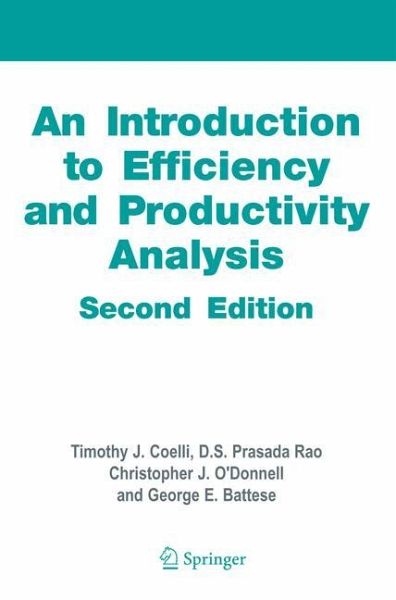
Incorporates a new author, Dr. Chris O'Donnell, who brings considerable expertise to the project in the area of performance measurement.
Numerous topics are being added and more applications using real data, as well as exercises at the end of the chapters.
Data sets, computer codes and software will be available for download from the web to accompany the volume.
The second edition of this book has been written for the same audience as the first edition. It is designed to be a "first port of call" for people wishing to study efficiency and productivity analysis. The book provides an accessible introduction to the four principal methods involved: econometric estimation of average response models; index numbers; data envelopment analysis (DEA); and stochastic firontier analysis (SFA). For each method, we provide a detailed introduction to the basic concepts, give some simple numerical examples, discuss some of the more important extensions to the basic methods, and provide references for further reading. In addition, we provide a number of detailed empirical applications using real-world data. The book can be used as a textbook or as a reference text. As a textbook, it probably contains too much material to cover in a single semester, so most instructors will want to design a course around a subset of chapters. For example, Chapter 2 is devoted to a review of production economics and could probably be skipped in a course for graduate economics majors. However, it should prove useful to undergraduate students and those doing a major in another field, such as business management or health studies.
Incorporates a new author, Dr. Chris O'Donnell, who brings considerable expertise to the project in the area of performance measurement.
Numerous topics are being added and more applications using real data, as well as exercises at the end of the chapters.
Data sets, computer codes and software will be available for download from the web to accompany the volume.
The second edition of this book has been written for the same audience as the first edition. It is designed to be a "first port of call" for people wishing to study efficiency and productivity analysis. The book provides an accessible introduction to the four principal methods involved: econometric estimation of average response models; index numbers; data envelopment analysis (DEA); and stochastic firontier analysis (SFA). For each method, we provide a detailed introduction to the basic concepts, give some simple numerical examples, discuss some of the more important extensions to the basic methods, and provide references for further reading. In addition, we provide a number of detailed empirical applications using real-world data. The book can be used as a textbook or as a reference text. As a textbook, it probably contains too much material to cover in a single semester, so most instructors will want to design a course around a subset of chapters. For example, Chapter 2 is devoted to a review of production economics and could probably be skipped in a course for graduate economics majors. However, it should prove useful to undergraduate students and those doing a major in another field, such as business management or health studies.
From the reviews of the second edition:
"The authors introduce the four major methods economists use to analyze efficiency and productivity: econometric estimation of average response, index numbers, data envelopment analysis (DEA), and stochastic frontier analysis. They intend the book primarily as a text for students in economics and also for students in other disciplines, such as business administration. ... On the whole, I rate the book as excellent ... ." (Jamshed A. Modi, Interfaces, Vol. 37 (2), 2007)
"The authors introduce the four major methods economists use to analyze efficiency and productivity: econometric estimation of average response, index numbers, data envelopment analysis (DEA), and stochastic frontier analysis. They intend the book primarily as a text for students in economics and also for students in other disciplines, such as business administration. ... On the whole, I rate the book as excellent ... ." (Jamshed A. Modi, Interfaces, Vol. 37 (2), 2007)