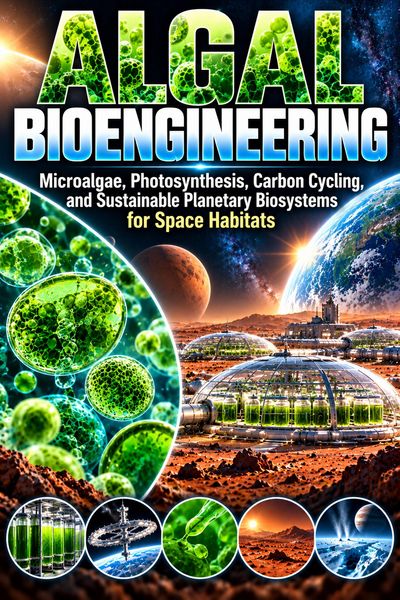
What if microscopic algae could help sustain human life beyond Earth?
Algal Bioengineering: Microalgae, Photosynthesis, Carbon Cycling, and Sustainable Planetary Biosystems for Space Habitats explores how photosynthetic microorganisms could contribute to regenerative life support, resource recycling, and future space settlements.
Microalgae help power Earth's aquatic ecosystems. They capture carbon dioxide, release oxygen, incorporate nutrients into biomass, and support food webs. Their biological diversity and adaptability make them valuable subjects for research into sustainable cultivation, environmental biotechnology, and controlled ecosystems.
Connecting algal biology with the challenges of long-duration space exploration, this book examines how these organisms functionand what it would take to integrate them into reliable habitat systems.
Inside, discover:
- Microalgal biology and diversity: Explore cellular structures, major algal groups, reproduction, evolution, and ecological roles.
- Photosynthesis and energy conversion: Understand light-harvesting pigments, carbon fixation, oxygen production, and the environmental factors that influence productivity.
- Adaptation and stress tolerance: Examine responses to changing light, temperature, salinity, nutrient availability, and other environmental pressures.
- Carbon and nutrient cycling: Follow the movement of carbon, nitrogen, phosphorus, sulfur, and trace elements through biological systems.
- Microbial partnerships: Learn how algae interact with bacteria, biofilms, and other organisms, influencing community stability and resource use.
- Photobioreactors and cultivation: Discover the principles behind lighting, environmental control, biomass production, and efficient use of water and nutrients.
- Renewable biological resources: Examine potential applications in food production, biofuels, nutrient recovery, and circular resource systems.
- Regenerative life support: Explore research into algal oxygen generation, carbon dioxide removal, water treatment, and nutrient recycling.
- Space agriculture: Consider how microalgae could complement hydroponics, controlled-environment crops, and integrated habitat food systems.
- Modeling and monitoring: Investigate how systems biology, biosensors, computational ecology, and artificial intelligence can support cultivation research and habitat management.
The book also considers the environmental challenges of the Moon and Mars, alongside broader questions about habitability, biosignatures, and photosynthetic life on other worlds.
Sustaining a habitat requires more than growing algae. Light and energy demands, nutrient balance, contamination control, harvesting, and biological stability all affect whether a system can operate reliably. This interdisciplinary overview examines those constraints while distinguishing current research from longer-term possibilities.
Written for readers interested in algal biotechnology, microbiology, environmental science, astrobiology, and sustainable space exploration, Algal Bioengineering offers an accessible introduction to the science connecting photosynthetic microorganisms with future life-support systems.
Discover how the organisms that help sustain Earth's biosphere could inform the design of living environments beyond our home planet.