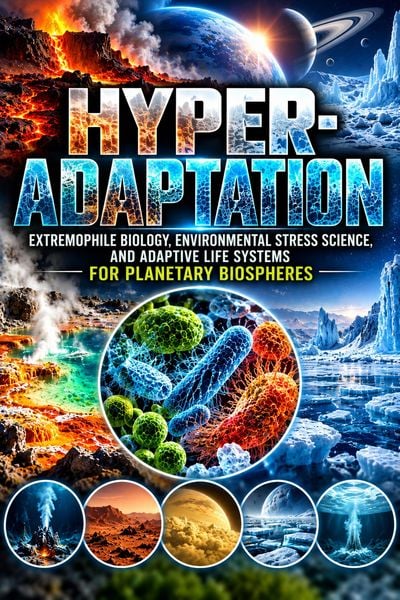
Hyper-Adaptation: Extremophile Biology, Environmental Stress Science, and Adaptive Life Systems for Planetary Biospheres
-
- Einzelkauf Download ausgewählt
-
Sprache:Englisch
8,99 €
inkl. gesetzl. MwSt.Beschreibung
Produktdetails
Format
ePUB
Kopierschutz
Ja
Family Sharing
Ja
Text-to-Speech
Ja
Erscheinungsdatum
14.10.2026
Verlag
Lysander XenobioreSeitenzahl
(Printausgabe)
Dateigröße
610 KB
Sprache
Englisch
EAN
9798237121643
Life survives in places that challenge our understanding of habitabilityfrom hydrothermal vents and acidic hot springs to Antarctic ice and hyper-arid deserts. What allows organisms to endure these conditions, and what can their adaptations reveal about the possibilities for life beyond Earth?
Hyper-Adaptation: Extremophile Biology, Environmental Stress Science, and Adaptive Life Systems for Planetary Biospheres explores the biological mechanisms that help living systems withstand extreme environmental stress. Bringing together microbiology, molecular biology, ecology, biotechnology, and astrobiology, this book connects survival at the cellular level with broader questions about evolution, ecosystem resilience, and planetary habitability.
Begin with the diversity of extremophiles and the distinction between organisms that thrive under extreme conditions and those that merely tolerate them. Explore how proteins, membranes, DNA repair systems, and metabolic pathways function under heat, cold, pressure, salinity, acidity, radiation, and water scarcity. Discover how evolutionary adaptation and immediate stress responses contribute to survivaland why resistance to one stress does not imply resistance to every hostile environment.
Inside, you'll explore:
- Extremophile diversity: Thermophiles, cold-adapted organisms, salt-loving microbes, acidophiles, alkaliphiles, and pressure-adapted life.
- Molecular survival mechanisms: Protein stability, membrane composition, DNA repair, cellular homeostasis, and stress-response networks.
- Radiation and desiccation tolerance: The strategies organisms use to protect cellular structures, endure damage, and recover when conditions improve.
- Energy in extreme environments: Chemotrophy, phototrophy, electron transport, and microbial metabolism where resources are limited.
- Biogeochemical cycling: Microbial contributions to carbon, nitrogen, sulfur, and iron transformations.
- Communities under stress: Biofilms, microbial mats, symbiosis, ecological cooperation, and the factors that support ecosystem resilience.
- Planetary comparisons: How environments on Venus, Mars, Europa, Enceladus, and Titan differ from terrestrial habitats used to study life's limits.
- The search for life: Biosignatures, environmental monitoring, and the challenges of interpreting possible biological evidence.
- Computational research: Comparative genomics, systems biology, metabolic modeling, and applications of artificial intelligence to biological data.
- Future habitat design: Closed ecological systems, resource recycling, and the constraints on maintaining stable biological communities beyond Earth.
Earth's extremophiles offer valuable clues for astrobiology, but they do not establish that other worlds are inhabited or readily habitable. Hyper-Adaptation examines these connections while distinguishing observed biological capabilities from hypotheses about extraterrestrial life and future planetary biospheres.
Written for readers interested in microbiology, environmental science, evolution, and space exploration, the book explains how molecular mechanisms and ecological relationships work together to sustain life under demanding conditions. It also considers how extremophile research can inform biotechnology and the study of environmental change.
Explore the science of life at its limitsand discover how the organisms inhabiting Earth's harshest environments are helping researchers ask sharper questions about adaptation, resilience, and living systems across the cosmos.
Noch keine Bewertungen vorhanden
Verfassen Sie die erste Bewertung zu diesem Artikel
Helfen Sie anderen Kundinnen und Kunden durch Ihre Meinung.
Kurze Frage zu unserer Seite
Vielen Dank für dein Feedback
Wir nutzen dein Feedback, um unsere Produktseiten zu verbessern. Bitte habe Verständnis, dass wir dir keine Rückmeldung geben können. Falls du Kontakt mit uns aufnehmen möchtest, kannst du dich aber gerne an unseren Kund*innenservice wenden.
zum Kundenservice