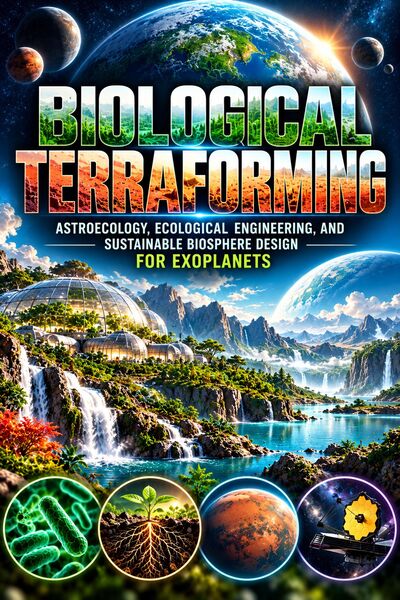
Biological Terraforming: Astroecology, Ecological Engineering, and Sustainable Biosphere Design for Exoplanets
Could living ecosystems help make barren worlds habitable?
Life shapes its environment. Microorganisms recycle nutrients, plants influence atmospheric chemistry, and ecosystems connect soil, water, climate, and geology. Understanding these relationships is central to studying planetary habitabilityand imagining how sustainable habitats might function beyond Earth.
Biological Terraforming explores the science behind these possibilities, bringing together astroecology, astrobiology, ecological engineering, microbiology, and planetary science. It examines how living systems develop, maintain stability, and respond to environmental change, while considering the challenges of applying Earth's ecological principles to unfamiliar worlds.
From microbial communities to planetary biospheres, this book investigates the interactions that sustain life. It connects established ecological processes with questions about closed habitats, engineered ecosystems, and the potential habitability of distant planets, distinguishing current scientific understanding from future possibilities.
Inside, you'll explore:
- Planetary habitability, habitable zones, atmospheric conditions, and the environmental limits of life
- Earth as a reference for studying Mars, ocean worlds, rocky exoplanets, and super-Earths
- Energy flow, biodiversity, ecological succession, and ecosystem resilience
- Carbon, nitrogen, phosphorus, sulfur, and water cycles in natural and closed ecological systems
- Soil microbiomes, biofilms, plant communities, and mycorrhizal relationships
- Symbiosis, mutualism, and the role of biological cooperation in ecosystem stability
- Climate regulation, biosphere feedbacks, and interactions between life and planetary environments
- Biosensors, remote observation, and technologies for monitoring ecological change
- Computational ecology, artificial intelligence, and simulations of complex biological systems
- Resource recycling, regenerative systems, and long-duration space habitats
- Synthetic biology and environmental biotechnology, including their limitations and research challenges
- Planetary protection, environmental ethics, and responsible exploration
The book also considers how ecological models can help researchers investigate ecosystem behavior, assess uncertainty, and study the conditions required for sustainable biospheres. Throughout, the focus remains on the biological, chemical, and physical relationships that make living environments possible.
Designed for curious readers, students, educators, and science enthusiasts, Biological Terraforming offers an accessible exploration of the connections between ecology and space science. Readers interested in exoplanets, biotechnology, sustainability, and the future of space habitats will discover how studying Earth's living systems can inform questions about life beyond our planet.
Explore the science of living worldsand the possibilities, constraints, and unanswered questions surrounding humanity's efforts to sustain life among the stars.