Can life be engineered to survive beyond Earth? How might advances in genome science shape the future of life in space?
The next frontier of exploration will depend on more than rockets and spacecraft. Biology may play an equally important role. Rapid advances in genome engineering, synthetic biology, molecular genetics, bioinformatics, and computational science are transforming our understanding of how living systems function, adapt, and evolve under challenging environmental conditions.
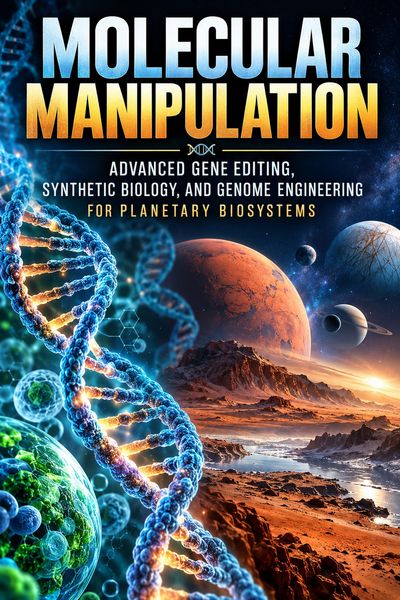
Molecular Manipulation: Advanced Gene Editing, Synthetic Biology, and Genome Engineering for Planetary Biosystems explores the molecular science that could help shape the future of biotechnology and long-term space exploration. Bringing together genetics, genomics, systems biology, astrobiology, evolutionary science, and planetary ecology, this comprehensive guide examines both established scientific principles and emerging research frontiers.
Beginning with the foundations of DNA, genes, chromosomes, and genome organization, the book explores how cells regulate gene expression, produce proteins, maintain genomic stability, and respond to environmental stress. It then examines modern genome engineering concepts, including CRISPR-based research, TALENs, zinc finger nucleases, base editing, prime editing, and other developing approaches to precision genome modification.
Inside, you'll discover:
• DNA structure, genome organization, gene expression, and cellular regulation
• Comparative genomics across microbes, plants, extremophiles, and complex organisms
• CRISPR, TALENs, zinc finger nucleases, base editing, and prime editing
• Functional genomics, systems biology, and computational approaches to biological complexity
• How extremophiles tolerate radiation, extreme temperatures, pressure, salinity, acidity, and other environmental stresses
• Synthetic biology, biological circuits, programmable cells, and synthetic chromosomes
• Population genetics, mutation, adaptation, evolution, and long-term genome stability
• Bioinformatics, artificial intelligence, machine learning, genome simulation, and digital biology
• Biological challenges associated with Mars, Europa, Titan, exoplanets, and other planetary environments
• Planetary protection, biosafety, bioethics, international governance, and responsible biotechnology
The book also explores how biological research could contribute to resilient ecosystems and sustainable biospheres beyond Earth. From engineered microbial communities to computational models of cells and genomes, emerging technologies are providing new ways to study the possibilities and limitations of biological adaptation.
Rather than serving as a laboratory manual or practical gene-engineering handbook, Molecular Manipulation presents a science-focused examination of the concepts, discoveries, challenges, and ethical questions surrounding modern genome research. Complex subjects are explained in an accessible format for students, educators, researchers, technology enthusiasts, and lifelong learners.
Discover how molecular biology is transforming our understanding of lifeand how genetics, synthetic biology, and computational science could influence the future of biotechnology, planetary exploration, and biological systems beyond Earth.