KI-Beratung Beta

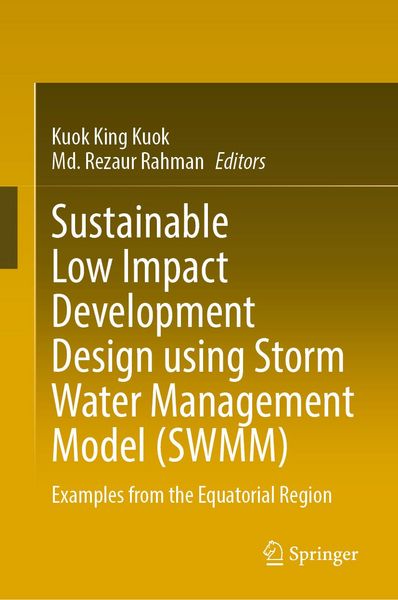
Produktbild: Sustainable Low Impact Development Design using Storm Water Management Model (SWMM)
Vorbesteller Neu

Sustainable Low Impact Development Design using Storm Water Management Model (SWMM) Examples from the Equatorial Region

181,99 €

inkl. gesetzl. MwSt., Versandkostenfrei


Beschreibung

This book allows readers to adopt sustainable design practices that address the current flooding issues and establish the foundation for a more resilient and harmonious urban future using the Storm Water Management Model (SWMM) and will help water engineers explore the potential to reduce the peak water...

Beschreibung

This book allows readers to adopt sustainable design practices that address the current flooding issues and establish the foundation for a more resilient and harmonious urban future using the Storm Water Management Model (SWMM) and will help water engineers explore the potential to reduce the peak water flow and allow their designs to include the knowledge of sustainable stormwater management. Flash floods are occurring more frequently nowadays due to the impact of climate change. One of the solutions is to integrate green infrastructure practices that are readily available in SWMM into the hydrological model to reduce peak runoff through infiltration and retention processes, thus reducing the peak discharges that cause impairment of water bodies. SWMM has been used to evaluate green infrastructure stormwater control strategies and create cost-effective green hybrid stormwater control solutions. SWMM comprises eight green infrastructure practices, and low-impact development (LID) controls, such as bioswales, permeable pavement systems, green roofs, infiltration trenches, rain barrels, rain gardens, rooftop disconnection, and vegetative swales. SWMM can model hydrological elements and structures such as street inlet drains, storage units, flow dividers, pumps, weirs, and orifices. It also allows applying external flows into the hydrological model. This book will share the planning, analyses, simulation, and management of surface runoff by combining various green infrastructure practices at different proportions. This book will be useful to college faculty, graduate students, researchers, and practitioners in hydrology, water science and engineering, water resources management, urban development, hydrometeorology, geosciences, environmental and ecological sciences, and agricultural and forest sciences.

Portrait

Assoc. Prof. Ts. Ir. Dr. Kuok King Kuok received his BEng (Honours) and Ph.D. from Universiti Teknologi Malaysia (UTM), as well as MEng from Universiti Malaysia Sarawak (UNIMAS). He has published more than 65 indexed journal research papers, more than 25 conference proceedings, and 24 book chapters. His research includes flood forecasting using ANNs, imputation of missing data using AI, filter membrane development, impact of climate change, derivation of equatorial soil loss equation, low impact development, sustainable water supply, stormwater module, etc. His second area of research interest is building information modeling, 3D printing, and project management. He has collaborations worldwide (e.g., USA, Australia, New Zealand, Russia, UAE, the Czech Republic, Bangladesh, and Malaysia). Dr Kuok had involved in organizing 18 conferences in different roles. He is also a member of the Editorial Board of the Journal Modern Management Forum, Singapore since 2019, Expert Scientific Editor for Academic Exchange Information Center (AEIC) since 2021, Green Building & Construction Economics since 2022, Tropical Aquatic and Soil Pollution since 2022. Dr Kuok was appointed as panel evaluator for Engineering Accreditation Council (EAC) since 2018. He is a qualified Chartered Professional Engineer in Malaysia, ASEAN, and APEC countries, and a Professional Technologist registered with the Malaysia Board of Technologists (MBOT). Meanwhile, Dr Kuok brings with him ten years industry experience before joining the academic career. Ts. Dr. Md. Rezaur Rahman (co-editor) Associate Professor at Universiti Malaysia Sarawak Md Rezaur Rahman (Editor & Author) is currently working as a Senior Lecturer (Associate Professor) in the Department of Chemical Engineering and Energy Sustainability, Faculty of Engineering, Universiti Malaysia Sarawak (UNIMAS), Malaysia. He has also been a Visiting research fellow at the Faculty of Engineering, Tokushima University, Japan, since June 2012. Previously, he worked as a teaching assistant at the Faculty of Engineering, Bangladesh University of Engineering and Technology (BUET), and as a research project leader supported by the Ministry of Higher Education, Malaysia. He was appointed as an external supervisor for the Faculty of Engineering, Swinburne University of Technology, Melbourne, Australia, in 2015. He received his Ph.D. from the Universiti Malaysia Sarawak, Malaysia. He has more than 12 years of experience in teaching, research, and working with industry. His area of research includes: conducting polymers, Silica/Clay Dispersed elastomeric polymer Nanocomposites, Hybrid Filled loaded Polymer Composites, Advance Materials: Nanocarbon/Graphene/Nanoclay/Fire Retardant, Nanocellulose (cellulose nanocrystals and nano-fibrillar) cellulose Reinforced/Filled Polymer Composites, Chemical Modification and Treatment of Lignocellulosic Fibres including Jute, coir, Sisal, kenaf, hemp and Solid Wood, Nano Composites and Nanocellulose fibers, and Polymer blends. So far, he has published 8 books, 100 book chapters, and more than 300 International journal papers with h-Index 28. Seven PhD and five master's degrees have been awarded through his supervision. He is also an active reviewer for several high-impact ISI journals. He is also listed as the World's Top 2% Scientist by Standford University along with Elsevier.
Produktdetails

Einband

Gebundene Ausgabe

Erscheinungsdatum

06.01.2027

Abbildungen

IV, 191 p. 84 illus. in color.

Herausgeber Kuok King Kuok + weitere

Produktdetails

Einband

Gebundene Ausgabe

Erscheinungsdatum

06.01.2027

Abbildungen

IV, 191 p. 84 illus. in color.

Herausgeber
Verlag Springer
Seitenzahl

191

Maße (B/H)

15,5/23,5 cm

Sprache

Englisch

ISBN

978-3-032-44924-5

Herstelleradresse

Springer Nature Customer Service Center GmbH
Europaplatz 3
69115 Heidelberg
DE
ProductSafety@springernature.com

Noch keine Bewertungen vorhanden

Verfassen Sie die erste Bewertung zu diesem Artikel

Helfen Sie anderen Kundinnen und Kunden durch Ihre Meinung.

Kundinnen und Kunden meinen

Bewertungen (0)

  • Produktbild: Sustainable Low Impact Development Design using Storm Water Management Model (SWMM)
  • Low Impact Development (LID): Principles, Elements, and Technologies.- An Improvement in Drainage Storage Capacity with Green Roof Module.- Modelling a Recreational Field as Underground On-site Detention (OSD) after Heavy Rainfall using SWMM.- Hydrological Assessment and Development of a Detention Drain for Extreme Stormwater Events using SWMM.