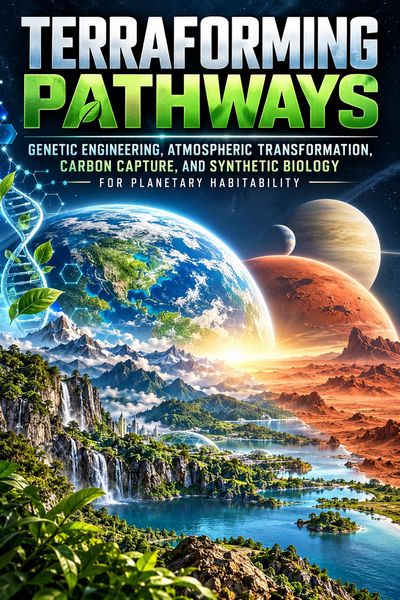
Terraforming Pathways: Genetic Engineering, Atmospheric Transformation, Carbon Capture, and Synthetic Biology for Planetary Habitability
-
- Einzelkauf Download ausgewählt
-
Sprache:Englisch
8,99 €
inkl. gesetzl. MwSt.Beschreibung
Produktdetails
Format
ePUB
Kopierschutz
Ja
Family Sharing
Ja
Text-to-Speech
Ja
Erscheinungsdatum
06.10.2026
Verlag
Lysander XenobioreSeitenzahl
(Printausgabe)
Dateigröße
545 KB
Sprache
Englisch
EAN
9798237788631
What if the future of planetary engineering begins not with massive machines, but with biology?
Long before humans appeared, microscopic organisms transformed Earth. Ancient microbes altered the atmosphere, reshaped global chemical cycles, and helped create environmental conditions that eventually supported complex life. Today, discoveries in synthetic biology, astrobiology, ecology, climate science, and biotechnology are providing new ways to understand how biological systems interact with planetary environments.
Terraforming Pathways: Genetic Engineering, Atmospheric Transformation, Carbon Capture, and Synthetic Biology for Planetary Habitability explores the scientific foundations behind the long-term possibility of using biological processes to influence planetary environments.
Drawing from planetary science, microbiology, systems biology, environmental engineering, climate science, ecology, and biotechnology, this book examines how life interacts with atmospheres, geology, climate, and global biogeochemical cycles. Rather than offering speculative engineering blueprints, it focuses on the scientific principles, emerging research, limitations, and theoretical possibilities underlying biological planetary transformation.
Inside, you'll discover:
- The science of planetary atmospheres, climate regulation, and habitability
- How photosynthesis, chemosynthesis, and microbial ecosystems influence atmospheric chemistry
- Carbon capture, biological carbon sequestration, biomineralization, and long-term carbon storage
- The roles of carbon, nitrogen, and other biogeochemical cycles in planetary environments
- Cyanobacteria, algae, plants, and microbial communities involved in oxygen production and ecosystem development
- Biological feedback loops, ecological resilience, and environmental stability
- Natural biological processes that influence atmospheric chemistry
- Plantmicrobe relationships, mycorrhizal networks, and regenerative ecosystems
- Closed ecological systems and self-sustaining biosphere concepts for future space habitats
- The environmental conditions of Mars, Venus, Titan, exoplanets, and other worlds
- Artificial intelligence, computational modeling, and digital planetary simulations
- Emerging research in synthetic biology, planetary biotechnology, astrobiology, and environmental systems science
Earth itself provides the most powerful example of biological planetary transformation. Over billions of years, interactions among microorganisms, plants, oceans, rocks, and the atmosphere profoundly changed the planet. Understanding these processes offers valuable insight into both Earth's environmental systems and the challenges that would accompany any attempt to establish sustainable ecosystems beyond it.
Written for students, researchers, educators, engineers, space enthusiasts, and scientifically curious readers, Terraforming Pathways connects established science with emerging ideas about the future of planetary habitability.
From microbial metabolism and atmospheric chemistry to carbon cycling, ecological succession, and synthetic biology, this book explores how living systems shape worldsand what those discoveries could mean for humanity's long-term future in space.
For anyone fascinated by terraforming, astrobiology, biotechnology, climate science, planetary engineering, or the search for habitable worlds, Terraforming Pathways offers a scientifically grounded journey into one of the most ambitious frontiers of modern science.
Noch keine Bewertungen vorhanden
Verfassen Sie die erste Bewertung zu diesem Artikel
Helfen Sie anderen Kundinnen und Kunden durch Ihre Meinung.
Kurze Frage zu unserer Seite
Vielen Dank für dein Feedback
Wir nutzen dein Feedback, um unsere Produktseiten zu verbessern. Bitte habe Verständnis, dass wir dir keine Rückmeldung geben können. Falls du Kontakt mit uns aufnehmen möchtest, kannst du dich aber gerne an unseren Kund*innenservice wenden.
zum Kundenservice