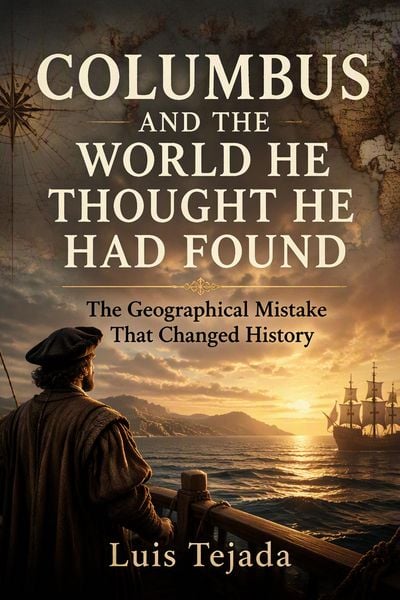
COLUMBUS AND THE WORLD HE THOUGHT HE HAD FOUND The Geographical Mistake That Changed History
-
- Einzelkauf Download ausgewählt
-
Sprache:Englisch
6,49 €
inkl. gesetzl. MwSt.Beschreibung
Produktdetails
Format
ePUB
Kopierschutz
Ja
Family Sharing
Ja
Text-to-Speech
Ja
Erscheinungsdatum
05.10.2026
Verlag
Luis TejadaSeitenzahl
(Printausgabe)
Dateigröße
534 KB
Sprache
Englisch
EAN
9798235822931
For centuries, schoolbooks have offered a simple answer: Christopher Columbus discovered America in 1492.
But history is rarely that simple.
America already existed. Long before Columbus arrived, millions of people lived across the continent. They had built cities, developed agricultural systems, created languages and religions, established trade routes, formed political structures, and accumulated thousands of years of collective memory.
The Norse had reached parts of North America centuries before Columbus. And Columbus himself believed that he had reached Asia. He did not know that he was standing before a continent unknown to Europe.
So why did 1492 become one of the most important dates in world history?
Because Columbus's voyages did something far more consequential than simply reaching a new shore. They helped establish a permanent connection between Europe and America. That connection eventually involved Africa and Asia and transformed the structure of the world.
This book revisits the meaning of "discovering America" and asks questions that are often hidden behind the traditional narrative.
Can you discover a land that is already inhabited? Is arriving the same as discovering? Is exploration the same as conquest? Is encounter the same as equality? Can a European word adequately describe an event experienced so differently by Europeans, Indigenous Americans, Africans, and Asians?
The answers reveal a history far more complex than the traditional story.
The aftermath of 1492 brought exploration and knowledge, but also conquest and colonization. It connected markets and continents, but also accelerated slavery and exploitation. Plants, animals, foods, people, diseases, ideas, and technologies crossed oceans on an unprecedented scale.
The world changedand so did Europe.
But America did not begin in 1492.
This book examines Columbus without reducing him to a simple hero or villain. It explores his geographical misconceptions, his ambitions, the world he encountered, and the consequences of his voyages. Above all, it examines how a single event can acquire radically different meanings depending on who tells the story.
Perhaps the deepest discovery of 1492 was not America itself.
It was the discovery that the world Europeans thought they understood was incomplete.
The map was not the territory.
The world was larger than expected.
And once the Atlantic became a permanent bridge between continents, human history entered a new era from which there was no return.
Noch keine Bewertungen vorhanden
Verfassen Sie die erste Bewertung zu diesem Artikel
Helfen Sie anderen Kundinnen und Kunden durch Ihre Meinung.
Kurze Frage zu unserer Seite
Vielen Dank für dein Feedback
Wir nutzen dein Feedback, um unsere Produktseiten zu verbessern. Bitte habe Verständnis, dass wir dir keine Rückmeldung geben können. Falls du Kontakt mit uns aufnehmen möchtest, kannst du dich aber gerne an unseren Kund*innenservice wenden.
zum Kundenservice