KI-Beratung Beta

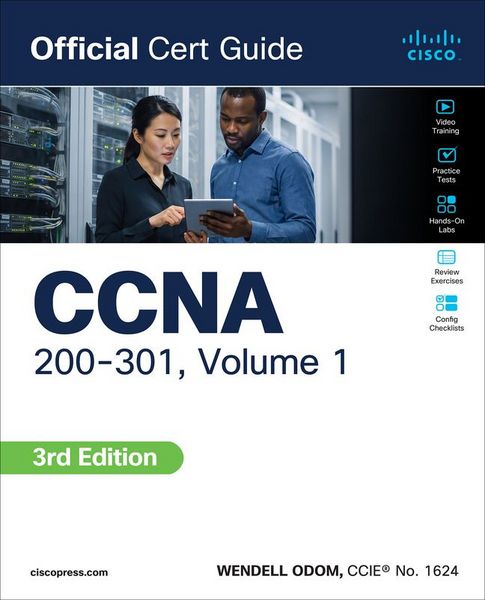
Produktbild: CCNA 200-301 Official Cert Guide, Volume 1
Vorbesteller Neu

CCNA 200-301 Official Cert Guide, Volume 1

54,99 €

inkl. gesetzl. MwSt., Versandkostenfrei


Beschreibung

Trust the best-selling Official Cert Guide series from Cisco Press to help you learn, prepare, and practice for exam success. They are built with the objective of providing assessment, review, and practice to help ensure you are fully prepared for your certification exam.

CCNA 200-301 Official Cert Guide,...

Beschreibung

Trust the best-selling Official Cert Guide series from Cisco Press to help you learn, prepare, and practice for exam success. They are built with the objective of providing assessment, review, and practice to help ensure you are fully prepared for your certification exam.

CCNA 200-301 Official Cert Guide, Volume 1, Third Edition presents you with an organized test-preparation routine using proven series elements and techniques. Do I Know This Already? quizzes open each chapter and enable you to decide how much time you need to spend on each section. Exam topic lists make referencing easy. Chapter-ending Exam Preparation Tasks help you drill on key concepts you must know thoroughly.

  • Master Cisco CCNA 200-301 exam topics
  • Assess your knowledge with chapter-opening quizzes
  • Review key concepts with exam preparation tasks
  • Prepare for certification success with exclusive discounted access to MeasureUps CCNA Practice Tests and Skillable CCNA Hands-On Labs

CCNA 200-301 Official Cert Guide, Volume 1, Third Edition from Cisco Press enables you to succeed on the exam the first time and is the only self-study resource approved by Cisco. Best-selling author and expert instructor Wendell Odom shares preparation hints and test-taking tips, helping you identify areas of weakness and improve both your conceptual knowledge and hands-on skills.

This complete study package includes

  • A test-preparation routine proven to help you pass the exams
  • Do I Know This Already? quizzes, which enable you to decide how much time you need to spend on each section
  • Chapter-ending and part-ending exercises, which help you drill on key concepts you must know thoroughly
  • Discounted six (6) month access to MeasureUp practice exams, which are designed to help certification candidates build confidence and identify knowledge gaps before test day.
  • Discounted six (6) month access to Skillable CCNA Hands-On Labs, which provide command-line access to live Cisco environments where learners can practice configuring, managing, and troubleshooting core CCNA technologies.
  • Links to a series of hands-on config labs developed by the author
  • A final preparation chapter, which guides you through tools and resources to help you craft your review and test-taking strategies
  • Study plan suggestions and templates to help you organize and optimize your study time

Well-regarded for its level of detail, study plans and assessment features, this official study guide helps you master the concepts and techniques that ensure your exam success.

This official study guide has been fully updated to help you master the topics on the latest CCNA 200-301 exam. Volume 1 topic coverage includes

  • Networking fundamentals
  • Implementing Ethernet LANs
  • Implementing VLANs and STP
  • IPv4 addressing and subnetting
  • IPv4 routing
  • Implementing OSPF

Content Update Program

This fully updated third edition includes the latest topics and additional information covering changes to the latest CCNA 200-301 exam.

Companion Website:

The companion website contains study tools, review exercises, a study planner, and more!
Produktdetails

Einband

Taschenbuch

Erscheinungsdatum

23.12.2026

Verlag Pearson Education Limited
Seitenzahl

832

Produktdetails

Einband

Taschenbuch

Erscheinungsdatum

23.12.2026

Verlag Pearson Education Limited
Seitenzahl

832

Auflage

3

Sprache

Englisch

ISBN

978-0-13-617158-4

Herstelleradresse

Pearson Benelux B.V.
St.-Martin-Straße 82
81541 München
DE

Email: salesde@pearson.com

Noch keine Bewertungen vorhanden

Verfassen Sie die erste Bewertung zu diesem Artikel

Helfen Sie anderen Kundinnen und Kunden durch Ihre Meinung.

Kundinnen und Kunden meinen

Bewertungen (0)

  • Produktbild: CCNA 200-301 Official Cert Guide, Volume 1
  • Introduction xxxii

    Your Study Plan 2

    Part I Introduction to Networking 11

    Chapter 1
    Introduction to TCP/IP Networking 12

    Do I Know This Already? Quiz 12

    Foundation Topics 14

    Perspectives on Networking 14

    TCP/IP Networking Model 15

        History Leading to TCP/IP 16

        Overview of the TCP/IP Networking Model 17

        TCP/IP Application Layer 19

        TCP/IP Transport Layer 20

        TCP/IP Network Layer 21

        TCP/IP Data-Link and Physical Layers 25

    Data Encapsulation Terminology 26

        Names of TCP/IP Messages 27

        OSI Networking Model and Terminology 28

    Chapter Review 29

    Chapter 2 Fundamentals of Ethernet LANs 32

    Do I Know This Already? Quiz 32

    Foundation Topics 34

    An Overview of LANs 34

        Typical Enterprise LANs 34

        The Variety of Ethernet Physical Layer Standards 35

        Consistent Behavior over All Links Using the Ethernet Data-Link Layer 36

    Building Physical Ethernet LANs with UTP 37

        Transmitting Data Using Twisted Pairs 37

        Breaking Down a UTP Ethernet Link 38

        UTP Cabling Pinouts for 10BASE-T and 100BASE-T 40

        UTP Cabling Pinouts for 1000BASE-T 43

    Sending Data in Ethernet Networks 44

        Ethernet Data-Link Protocols 44

        Sending Ethernet Frames with Switches and Hubs 48

    Chapter Review 51

    Chapter 3 Fundamentals of WANs and IP Routing 52

    Do I Know This Already? Quiz 52

    Foundation Topics 54

    Wide-Area Networks 54

        Leased-Line WANs 54

        Ethernet as a WAN Technology 58

    IP Routing 61

        Network Layer Routing (Forwarding) Logic 62

        How Network Layer Routing Uses LANs and WANs 63

        How IP Addressing Helps IP Routing 65

        How IP Routing Protocols Help IP Routing 67

    Other Network Layer Features 68

        Using Names and the Domain Name System 69

        The Address Resolution Protocol 70

        ICMP Echo and the ping Command 71

    Chapter Review 71

    Part I Review 74

    Part II Implementing Ethernet LANs 77

    Chapter 4
    Using the Command-Line Interface 78

    Do I Know This Already? Quiz 78

    Foundation Topics 80

    Accessing the Cisco Catalyst Switch CLI 80

        Cisco Catalyst Switches 80

        Accessing the Cisco IOS XE CLI 82

        CLI Help Features 91

        The debug and show Commands 93

    Configuring Cisco IOS Software 93

        Configuration Submodes and Contexts 94

        Storing Switch Configuration Files 96

        Copying and Erasing Configuration Files 98

    Chapter Review 99

    Chapter 5 Analyzing Ethernet LAN Switching 102

    Do I Know This Already? Quiz 102

    Foundation Topics 104

    LAN Switching Concepts 104

        Overview of Switching Logic 105

        Forwarding Known Unicast Frames 106

        Learning MAC Addresses 108

        Flooding Unknown Unicast and Broadcast Frames 109

        Avoiding Loops Using Spanning Tree Protocol 110

        LAN Switching Summary 111

    Verifying and Analyzing Ethernet Switching 111

        Demonstrating MAC Learning 112

        Switch Interfaces 113

        Finding Entries in the MAC Address Table 115

        Managing the MAC Address Table (Aging, Clearing) 116

        MAC Address Tables with Multiple Switches 117

    Chapter Review 118

    Chapter 6 Configuring Basic Switch Management 122

    Do I Know This Already? Quiz 122

    Foundation Topics 124

    Securing the Switch CLI 124

        Securing User Mode and Privileged Mode with Simple Passwords 125

        Securing User Mode Access with Local Usernames and Passwords 129

        Securing User Mode Access with External Authentication Servers 131

        Securing Remote Access with Secure Shell 132

        Enabling and Securing the WebUI 135

    Enabling IPv4 for Remote Access 136

        Host and Switch IP Settings 137

        Configuring IPv4 on a Switch 139

        Configuring a Switch to Learn Its IP Address with DHCP 140

        Verifying IPv4 on a Switch 140

    Miscellaneous Settings Useful in the Lab 141

        History Buffer Commands 141

        The logging synchronous, exec-timeout, and no ip domain-lookup Commands 142

    Chapter Review 143

    Chapter 7 Configuring and Verifying Switch Interfaces 148

    Do I Know This Already? Quiz 148

    Foundation Topics 150

    Configuring Switch Interface Speed and Duplex 150

        IEEE Autonegotiation Concepts 151

        Configuring Autonegotiation, Speed, and Duplex 155

        Using Auto-MDIX on Cisco Switches 160

    Managing Switch Interface Configuration 162

        The Description and Interface Range Commands 162

        Administratively Controlling Interface State with shutdown 164

        Removing Configuration with the no Command 165

    Implementing Power over Ethernet (PoE) 167

        PoE Concepts 167

        PoE Operation 168

        Configuring PoE 169

        Verifying PoE 170

    Chapter Review 172

    Chapter 8 Ethernet Copper and Fiber Cabling 176

    Do I Know This Already? Quiz 177

    Foundation Topics 178

    Building Ethernet Links with Copper Cabling 178

        A Review of the Original Three: 10BASE-T, 100BASE-T, and 1000BASE-T 178

        Ethernet UTP Standards 180

    Building Ethernet Links with Fiber Cabling 184

        Fiber Cabling Transmission Concepts 184

        Ethernet Fiber Standards 186

        Where to Use Each Type of Ethernet 188

    Chapter Review 189

    Chapter 9 Diagnosing Switch Interface Issues 190

    Do I Know This Already? Quiz 191

    Foundation Topics 193

    Diagnosing Interface and Cable Issues 193

        Interface Status Codes 193

        Interface Down: Speed Mismatch 194

        Interface Down: Incorrect Pinouts Without Auto-MDIX 195

        Interface Up but Degraded: Duplex Mismatch 196

        Interface Up but Degraded: Interface Statistics 198

    Troubleshooting Ethernet UTP Links 200

        Time-Domain Reflectometer (TDR) Basics 200

        TDR Tests to Discover Pinout Issues 202

        TDR Tests to Discover Broken Cables 203

    Troubleshooting Ethernet Fiber Links 205

        Ethernet Fiber Interface Optical Attributes and Thresholds 206

        Monitoring for Optical Receive Power Issues 206

    Chapter Review 210

    Part II Review 212

    Part III Implementing VLANs and STP 215

    Chapter 10
    Implementing Ethernet Virtual LANs 216

    Do I Know This Already? Quiz 216

    Foundation Topics 218

    Virtual LAN Concepts 218

        Creating Multiswitch VLANs Using Trunking 220

        Forwarding Data Between VLANs 223

    VLAN and VLAN Trunking Configuration and Verification 224

        Creating VLANs and Assigning Access VLANs to an Interface 224

        VLAN Trunking Protocol 229

        VLAN Trunking Configuration 230

    Troubleshooting VLANs and VLAN Trunks 235

        Confirm the Correct Access VLAN Is Assigned 235

        Access VLANs Undefined or Disabled 236

        Mismatched Trunking Operational States 238

        The Allowed VLAN List on a Trunk 239

        Mismatched Native VLAN on a Trunk 241

    Chapter Review 242

    Chapter 11 Implementing Primary STP Features 246

    Do I Know This Already? Quiz 247

    Foundation Topics 248

    STP and RSTP Concepts 248

        The Need for Spanning Tree 249

        What Spanning Tree Does 251

        How Spanning Tree Works 252

    STP and RSTP Configuration and Verification 259

        The Need for Multiple Spanning Trees 260

        STP Modes and Standards 260

        The Bridge ID and System ID Extension 262

        Identifying Switch Priority and the Root Switch 263

        RSTP (One Tree) and RPVST+ (One Tree Per VLAN) 266

        Identifying Port Cost, Role, and State 267

    Chapter Review 269

    Chapter 12 Implementing Optional STP Features 272

    Do I Know This Already? Quiz 272

    Foundation Topics 274

    Understanding the Benefits of Rapid STP (RSTP) 274

        STP Operations and Convergence 274

        RSTP Operations and Rapid Convergence 278

    PortFast and BPDU Guard 284

        PortFast Concepts 284

        BPDU Guard Concepts 286

        PortFast and BPDU Guard Implementation 287

    Root Guard and Loop Guard 293

        Root Guard Concepts 293

        Root Guard Implementation 294

        Loop Guard Concepts 295

        Loop Guard Implementation 298

    Chapter Review 299

    Chapter 13 Implementing Layer 2 EtherChannels 302

    Do I Know This Already? Quiz 302

    Foundation Topics 304

    EtherChannel Concepts 304

        EtherChannel Forwarding and STP 305

        EtherChannel Load Distribution 306

    Configuring Layer 2 EtherChannel 308

        Configuring a Manual Layer 2 EtherChannel 308

        Configuring Dynamic EtherChannels 312

        Interface Configuration Consistency with EtherChannels 314

    Chapter Review 317

    Chapter 14 Applying Switch Features to Edge Ports 320

    Do I Know This Already? Quiz 321

    Foundation Topics 322

    Defining Edges Host and Related Config 322

        Edge Hosts and Related Terms 322

        Edge Hosts at Access Layer Switches 323

        Types of Edge Hosts and Configuration Options 324

    Edge Hosts as Access (Not Trunk) Ports 325

        Access Ports Without PoE (Desktop, Printer) 325

        Access Ports with PoE (IoT, LWAP) 326

    Edge Hosts as Trunk (Not Access) Ports 329

        Normal VLAN Trunks Without PoE (WLC) 329

        Normal Trunks with PoE (Standalone AP) 331

        Pseudo Trunks to IP Phones (IP Phones) 332

    Edge Hosts with EtherChannel 338

        EtherChannel with Virtualized Hosts 338

        EtherChannel with Network Appliances (Firewall) 339

        Summary: Switch Config for Edge Hosts 342

    Chapter Review 343

    Part III Review 344

    Part IV IPv4 Addressing 347

    Chapter 15
    Perspectives on IPv4 Subnetting 348

    Do I Know This Already? Quiz 348

    Foundation Topics 350

    Introduction to Subnetting 350

        Subnetting Defined Through a Simple Example 350

        Operational View Versus Design View of Subnetting 351

    Analyze Subnetting and Addressing Needs 352

        Rules About Which Hosts Are in Which Subnet 352

        Determining the Number of Subnets 353

        Determining the Number of Hosts per Subnet 355

        One Size Subnet Fits AllOr Not 355

    Make Design Choices 358

        Choose a Classful Network 359

        Choose the Mask 362

        Build a List of All Subnets 366

    Plan the Implementation 367

        Assigning Subnets to Different Locations 367

        Choose Static and Dynamic Ranges per Subnet 368

    Chapter Review 369

    Chapter 16 Analyzing Classful IPv4 Networks 372

    Do I Know This Already? Quiz 372

    Foundation Topics 373

    Classful Network Concepts 373

        Setting the Context of Public Networks and CIDR Blocks 374

        IPv4 Network Classes and Related Facts 376

        Number of Hosts per Network 379

        Deriving the Network ID and Related Numbers 380

        Unusual Network IDs and Network Broadcast Addresses 381

    Practice with Classful Networks 382

        Practice Deriving Key Facts Based on an IP Address 382

        Practice Remembering the Details of Address Classes 383

    Chapter Review 384

    Chapter 17 Analyzing Subnet Masks 388

    Do I Know This Already? Quiz 389

    Foundation Topics 390

    Subnet Mask Conversion 390

        Three Mask Formats 390

        Converting Between Binary and Prefix Masks 391

        Converting Between Binary and DDN Masks 392

        Converting Between Prefix and DDN Masks 394

        Practice Converting Subnet Masks 395

    Identifying Subnet Design Choices Using Masks 395

        Masks Divide the Subnets Addresses into Two Parts 396

        Masks and Class Divide Addresses into Three Parts 397

        Classless and Classful Addressing 398

        Calculations Based on the IPv4 Address Format 399

        Practice Analyzing Subnet Masks 400

        Masks and CIDR Blocks 401

    Chapter Review 402

    Chapter 18 Analyzing Existing Subnets 406

    Do I Know This Already? Quiz 406

    Foundation Topics 408

    Defining a Subnet 408

        An Example with Network 172.16.0.0 and Four Subnets 408

        Subnet ID Concepts 410

        Subnet Broadcast Address 411

        Range of Usable Addresses 411

    Analyzing Existing Subnets: Binary 412

        Finding the Subnet ID: Binary 412

        Finding the Subnet Broadcast Address: Binary 413

        Binary Practice Problems 414

        Shortcut for the Binary Process 415

        A Brief Note About Boolean Math 417

        Finding the Range of Addresses 417

    Analyzing Existing Subnets: Decimal 417

        Analysis with Easy Masks 417

        Predictability in the Interesting Octet 418

        Finding the Subnet ID: Difficult Masks 419

        Finding the Subnet Broadcast Address: Difficult Masks 422

    Practice Analyzing Existing Subnets 423

        A Choice: Memorize or Calculate 423

    Chapter Review 424

    Chapter 19 Understanding IPv4 Subnet Design 428

    Do I Know This Already? Quiz 428

    Foundation Topics 430

    Choosing the Mask(s) to Meet Requirements 430

        Review: Choosing the Minimum Number of Subnet and Host Bits 430

        No Masks Meet Requirements 431

        One Mask Meets Requirements 432

        Multiple Masks Meet Requirements 433

        The Formal Process 435

        Practice Choosing Subnet Masks 436

    Finding All Subnet IDs 436

        First Subnet ID: The Zero Subnet 437

        Finding the Pattern Using the Magic Number 438

        A Formal Process with Fewer Than 8 Subnet Bits 439

        Finding All Subnets with Exactly 8 Subnet Bits 443

        Finding All Subnets with More Than 8 Subnet Bits 443

        Practice Finding All Subnet IDs 446

    Chapter Review 446

    Part IV Review 452

    Part V IPv4 Routing 455

    Chapter 20
    Operating Cisco Routers 456

    Do I Know This Already? Quiz 456

    Foundation Topics 458

    Installing Cisco Routers 458

        Installing Enterprise Routers 458

    Enabling IPv4 Support on Cisco Router Interfaces 463

        Accessing the Router CLI 463

        Router Interfaces 465

    Chapter Review 473

    Chapter 21 Troubleshooting IPv4 Addresses and Static Routes 476

    Do I Know This Already? Quiz 477

    Foundation Topics 478

    IP Routing 478

        IPv4 Routing Process Reference 479

        An Example of IP Routing 481

    Configuring IP Addresses and Connected Routes 486

        Connected Routes and the ip address Command 486

        Troubleshooting the ip address Subcommand 488

        The ARP Table on a Cisco Router 490

    Configuring Static Routes 491

        Static Network Routes 491

        Static Default Routes 494

        Static Host Routes 496

        Floating Static Routes 497

    Troubleshooting Static Routes 499

        Incorrect Subnet/Mask Values in the ip route Configuration Command 499

        Incorrect Static Routes That Appear in the IP Routing Table 500

        The Static Route Does Not Appear in the IP Routing Table 500

        The Correct Static Route Appears but Works Poorly 501

    Chapter Review 502

    Chapter 22 Routing IPv4 in the LAN 504

    Do I Know This Already? Quiz 505

    Foundation Topics 507

    VLAN Routing with Router 802.1Q Trunks 507

        Configuring ROAS 508

        Verifying ROAS 511

        Troubleshooting ROAS 513

    VLAN Routing with Layer 3 Switch SVIs 514

        Configuring Routing Using Switch SVIs 514

        Verifying Routing with SVIs 516

        Troubleshooting Routing with SVIs 517

    VLAN Routing with Layer 3 Switch Routed Ports 519

        Implementing Routed Interfaces on Switches 520

        Implementing Layer 3 EtherChannels 522

        Troubleshooting Layer 3 EtherChannels 526

    VLAN Routing on a Routers LAN Switch Ports 527

        Configuring Routing for Embedded Switch Ports 528

        Verifying Routing for Embedded Switch Ports 530

        Identifying Switched Ports in Routers 531

    Chapter Review 532

    Chapter 23 Troubleshooting DHCP Client, Server, and Relay 536

    Do I Know This Already? Quiz 537

    Foundation Topics 538

    Dynamic Host Configuration Protocol Concepts 538

        DHCP Concepts 539

    Configuring DHCP Features on Routers and Switches 544

        Configuring DHCP Relay 544

        Configuring a Switch as DHCP Client 544

        Configuring a Router as DHCP Client 546

        Configuring IOS DHCP Server on Routers 547

        IOS DHCP Server Verification 549

    Troubleshooting DHCP Services 551

        DHCP Relay Agent Configuration Mistakes and Symptoms 551

        IOS DHCP Server Configuration Mistakes and Symptoms 552

        DHCP and Connectivity Issues 553

        DHCP Operational Issues 555

        Summary of DHCP Troubleshooting 557

    Chapter Review 558

    Chapter 24 Troubleshooting IP Host Addressing 560

    Do I Know This Already? Quiz 561

    Foundation Topics 563

    Identifying Host IPv4 Settings 563

        Host Settings for IPv4 564

        Host IP Settings on Windows 565

        Host IP Settings on macOS 569

        Host IP Settings on Linux 571

    Troubleshooting Host IPv4 Settings 572

        A Working Windows Host with Static IP Configuration 573

        A Failed Windows DHCP Client Due to IP Connectivity Issues 574

        A Working Windows DHCP Client with Incorrect Settings 575

    Chapter Review 576

    Part V Review 578

    Part VI OSPF 581

    Chapter 25
    Understanding OSPF Concepts 582

    Do I Know This Already? Quiz 582

    Foundation Topics 584

    Comparing Dynamic Routing Protocol Features 584

        Routing Protocol Functions 584

        Interior and Exterior Routing Protocols 585

        Comparing IGPs 587

    OSPF Concepts and Operation 589

        OSPF Overview 589

        Becoming OSPF Neighbors 591

        Exchanging the LSDB Between Neighbors 593

        Calculating the Best Routes with SPF 597

    OSPF Areas and LSAs 598

        OSPF Areas 599

        How Areas Reduce SPF Calculation Time 600

         (OSPFv2) Link-State Advertisements 601

    Chapter Review 604

    Chapter 26 Implementing Basic OSPF Features 606

    Do I Know This Already? Quiz 606

    Foundation Topics 608

    Implementing OSPFv2 Using network Commands 608

        OSPF Single-Area Configuration 609

        Wildcard Matching with the network Command 610

        Verifying OSPF Operation 613

        Verifying OSPF Configuration 616

        Configuring the OSPF Router ID 618

        Implementing Multiarea OSPF 619

    Implementing OSPFv2 Using Interface Subcommands 620

        OSPF Interface Configuration Example 620

        Verifying OSPF Interface Configuration 622

    Chapter Review 624

    Chapter 27 Implementing Optional OSPF Features 628

    Do I Know This Already? Quiz 628

    Foundation Topics 630

    OSPF Network Types 630

        The OSPF Broadcast Network Type 631

        The OSPF Point-to-Point Network Type 636

    Additional Optional OSPFv2 Features 638

        OSPF Passive Interfaces 638

        OSPF Default Routes 641

        OSPF Metrics (Cost) 643

        OSPF Hello and Dead Intervals 646

    Chapter Review 648

    Chapter 28 OSPF Neighbors and Route Selection 652

    Do I Know This Already? Quiz 652

    Foundation Topics 655

    OSPF Neighbor Relationships 655

        OSPF Neighbor Requirements 655

        Issues That Prevent Neighbor Adjacencies 656

        Issues That Allow Neighbors but Prevent IP Routes 662

    Route Selection 665

        Equal-Cost Multipath OSPF Routes 665

        Multiple Routes Learned from Competing Sources 666

        IP Forwarding with the Longest Prefix Match 669

    Chapter Review 674

    Part VI Review 678

    Part VII Appendices 681

    Appendix A Numeric Reference Tables 683

    Appendix B CCNA 200-301 Official Cert Guide, Volume 1, Third Edition Exam Updates 689

    Appendix C Exam Topics Cross-Reference 695

    Appendix D Answers to the Do I Know This Already? Quizzes 705

    Glossary 733

    Part VIII: Online Appendices

    E Practice for Chapter 16: Analyzing Classful IPv4 Networks

    F Practice for Chapter 17: Analyzing Subnet Masks

    G Practice for Chapter 18: Analyzing Existing Subnets

    H Practice for Chapter 19: Understanding IPv4 Subnet Design

    I Variable-Length Subnet Masks

    J Study Planner


    9780136171584    TOC    11/13/2026