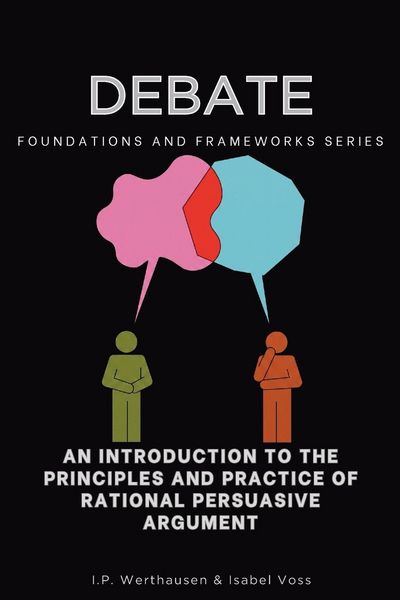
Debate, Foundations and Frameworks Series An Introduction to the Principles and Practice of Rational Persuasive Argument
-
- Englisch ausgewählt
19,99 €
inkl. gesetzl. MwSt.,
Beschreibung
Produktdetails
Einband
Taschenbuch
Erscheinungsdatum
02.09.2026
Verlag
Publishdrive Inc.Seitenzahl
162
Maße (L/B/H)
22,9/15,2/0,9 cm
Gewicht
227 g
Sprache
Englisch
EAN
9798900421353
Debate rewards anyone who understands how an argument is actually built. This book takes arguments apart piece by piece, names every working component, and shows you how to assemble one that holds up under pressure.
Nine chapters move from the smallest unit of reasoning to full competitive rounds, and each builds on the one before it. Real cases carry the material: the Morton Thiokol engineers who were right about the Challenger O-rings and still could not make the case, the seven Lincoln-Douglas debates of 1858, and courtroom cross-examinations that lost the verdict and won the record. Each chapter closes with questions that ask you to apply what you just read.
The chapters cover:
- Claims, reasons, and warrants, plus the gap between validity and soundness
- Categorical syllogisms, conditional reasoning, and why confusing necessary with sufficient conditions collapses so many public arguments
- Ethos, pathos, and logos, with practical guidance on reading a room and adjusting to it, because the case that convinces an engineering team will fall flat at a city council meeting
- Primary versus secondary sources, credibility tests, and the point where statistics stop telling the truth, including what a margin of error does and does not cover
- Six fallacies you will start hearing in meetings within a week
- Contention-based case construction, resolution framing, and weighing mechanisms
- Cross-examination sequencing, catching a logical gap while someone is still talking, and turning an opponent's own argument in your direction
- Policy, Lincoln-Douglas, Public Forum, and Parliamentary formats, with the speech structure and specific demands of each
- Cognitive bias, the line between persuading and manipulating, and intellectual honesty as a working habit
Written for:
- Competitive debaters preparing for a tournament
- Students in argumentation, rhetoric, logic, or composition courses
- Teachers and coaches building a semester of instruction
- Professionals who present cases to boards, clients, juries, or committees
- Readers who want to stop being moved by reasoning they cannot examine
The back matter carries the book past a single read. A history section traces persuasive argument across the Athenian assembly, Roman courts, medieval disputation, Enlightenment pamphlets, and televised debate. Worked answers to every end-of-chapter question let you check your reasoning against a modeled response. A glossary defines every technical term in the text, including enthymeme, modus tollens, kritik, and number needed to treat.
Roughly ninety percent of the arguments aimed at you were built by someone who wants something from you. Once you can see the machinery, the weak ones stop working. A statistic quoted without a sample size looks different. A politician answering a question nobody asked becomes obvious. Read the book once to learn construction. Keep it for defense.
Noch keine Bewertungen vorhanden
Verfassen Sie die erste Bewertung zu diesem Artikel
Helfen Sie anderen Kundinnen und Kunden durch Ihre Meinung.
Kurze Frage zu unserer Seite
Vielen Dank für dein Feedback
Wir nutzen dein Feedback, um unsere Produktseiten zu verbessern. Bitte habe Verständnis, dass wir dir keine Rückmeldung geben können. Falls du Kontakt mit uns aufnehmen möchtest, kannst du dich aber gerne an unseren Kund*innenservice wenden.
zum Kundenservice