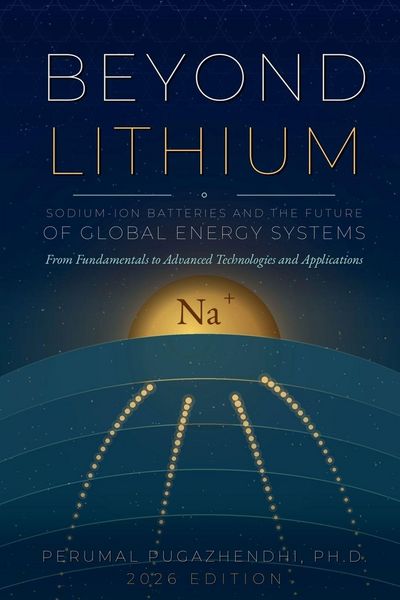
BEYOND LITHIUM Sodium-Ion Batteries and the Future of Global Energy Systems
-
- Englisch ausgewählt
53,99 €
inkl. gesetzl. MwSt.,
Beschreibung
Produktdetails
Einband
Taschenbuch
Erscheinungsdatum
31.07.2026
Verlag
Perumal PugazhendhiSeitenzahl
226
Maße (L/B/H)
22,9/15,2/1,3 cm
Gewicht
374 g
Sprache
Englisch
EAN
9798235733602
Energy is the quiet foundation beneath modern life. It moves through the devices in our pockets, the vehicles on our roads, and the vast machinery of cities, industries, and economies. As the world turns toward renewable power and electrification, a single question has moved to the center of the twenty-first century's most important engineering project: how do we store energy safely, affordably, and at a scale large enough to matter? For three decades, the lithium-ion battery has been the default answer. It earned that position honestly, powering the mobile revolution and now the electric car. Yet its very success has exposed its limits. Lithium is geographically concentrated, its price is volatile, and the cobalt and nickel that accompany it in high-performance cells carry real economic, ethical, and environmental costs. When the goal shifts from powering a phone to stabilizing a national grid, the calculus changes. At that scale, abundance, safety, and cost can matter more than squeezing out the last watt-hour per kilogram. This is the opening that sodium has stepped into. Sodium sits directly below lithium in the periodic table, shares much of its chemistry, and is one of the most abundant elements on Earth - dissolved in every ocean and spread through the crust of every continent. For years, sodium-ion batteries were treated as a scientific curiosity, always promising and never quite ready. That has changed. The reason this is a 2026 edition, and not simply a reprint, is that the field crossed a threshold while this book was being written. In the span of two years, sodium-ion moved out of the laboratory and onto the grid. China brought the world's first large sodium-ion storage stations online, measured not in kilowatts but in tens of megawatts and hundreds of megawatt-hours. In June 2026, the world's largest battery maker unveiled a field-validated sodium-ion storage system rated above thirty megawatt-hours per unit, and a research community that once debated whether sodium could ever be practical now debates how quickly it will scale. Independent observers also began treating sodium-ion as an industrial option rather than a distant research prospect, while the wider 2026 energy debate shifted toward everything-to-grid systems that depend on safe, durable, and diversified storage. This book was written to explain how that happened, why it matters, and what comes next. The aim throughout is to be genuinely useful to a reader who wants to understand sodium-ion batteries deeply, not just admire them from a distance. The chapters move deliberately from the ground up - from the behavior of a single ion, through the materials that host it, the cells that contain it, and the factories that will build it, out to the markets and energy systems it will reshape. The science is presented in full, but it is presented as a story, because that is how understanding actually forms. Equations appear where they clarify rather than decorate, real numbers ground the discussion, and each idea is connected to the ones before and after it. The book is written for a wide readership. Students will find a firm foundation in electrochemistry and materials science, built up patiently and without assuming prior expertise. Researchers will find the current state of the art, from hard-carbon anodes to Prussian-blue cathodes to solid-state concepts. Engineers and industry professionals will find the practical concerns of manufacturing, scale-up, and system integration. And the general reader with a serious curiosity about the energy transition will find, I hope, a clear and honest account of one of its most consequential technologies. The future of energy storage is not yet written. But through science, engineering, and collaboration, it is being built today - and sodium, the sixth most abundant element in the Earth's crust, has become an unlikely and compelling part of that story.
Noch keine Bewertungen vorhanden
Verfassen Sie die erste Bewertung zu diesem Artikel
Helfen Sie anderen Kundinnen und Kunden durch Ihre Meinung.
Kurze Frage zu unserer Seite
Vielen Dank für dein Feedback
Wir nutzen dein Feedback, um unsere Produktseiten zu verbessern. Bitte habe Verständnis, dass wir dir keine Rückmeldung geben können. Falls du Kontakt mit uns aufnehmen möchtest, kannst du dich aber gerne an unseren Kund*innenservice wenden.
zum Kundenservice