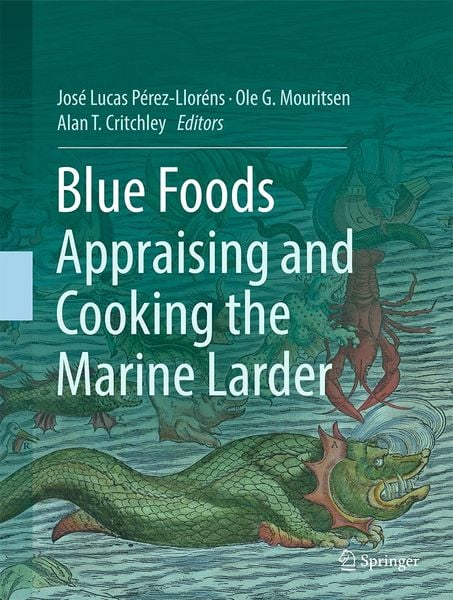
Produktbild: Blue Foods: Appraising and Cooking the Marine Larder
Vorbesteller Neu

Blue Foods: Appraising and Cooking the Marine Larder

235,99 €

inkl. gesetzl. MwSt., Versandkostenfrei


Beschreibung

Produktdetails

Einband

Gebundene Ausgabe

Erscheinungsdatum

15.12.2026

Abbildungen

Approx. 810 p.

Herausgeber

José Lucas Pérez-Lloréns + weitere

Verlag

Springer

Seitenzahl

768

Maße (B/H)

21/27,9 cm

Sprache

Englisch

ISBN

978-3-032-39439-2

Beschreibung

Portrait

José Lucas Pérez-Lloréns is a Full Professor of Ecology at the University of Cádiz (UCA), Spain. Born in Alcoy (Alicante, Spain), he earned his PhD in Biology from the University of Málaga in 1991. His academic career includes research stays at NIOO-CEME (The Netherlands), Deakin University (Australia), and the University of Belfast, where he focused on the ecology and ecophysiology of seagrasses and seaweeds. A highly cited researcher, Prof. Pérez-Lloréns has been ranked among the top 2% of scientists worldwide in Marine and Food Sciences (Stanford Ranking 2023, 2024). He has authored more than 100 scientific publications and co-edited the monograph Underwater Light and Algal Photobiology (1996). His leadership roles include serving as Head of the Department of Biology at UCA; as a member of the Spanish Global Change Committee (IGBP-Spain); Head the Natural Resources area of the Andalusian Knowledge Agency; and currently serving as President of the Spanish Phycological Society (SEF). He has a strong interest in food anthropology, culinary history and gastronomy, and actively engages in science communication, bridging marine biology and gastronomy. He is the author of Flora marina del litoral gaditano (Marine Flora of the Cádiz Coast, 2012), which received the UNE National Award for Best Scientific Monograph. His subsequent books, Las algas se comen? (2016) and Those Curious and Delicious Seaweeds (2018), have received widespread international acclaim, earning multiple World Gourmand Cookbook Awards between 2017 and 2025, including ‘Best of the World’ (2017), ‘Best of the Best’ (2025) and ‘Best of the Best’ on the 30th anniversary of the awards, in the categories of ‘Best Spanish Gastronomy Book’ and ‘Best Seafood Book in the World’. Active in the culinary world, he was awarded first prize in the 7th Spanish Literature and Gastronomy Contest (UNED) in 2020 for his recipe Merluza a la gallega… reinterpretada (Galician hake… reinterpreted). Lucas lectures in the Master’s Programme in Gastronomic Management and Innovation, actively participates in the CEIMAR Blue Food Lab – Centre for Culinary Culture and Marine Gastronomic Innovation. Additionally, he has served as scientific advisor to the three-Michelin-starred restaurant Aponiente, contributing to the ‘sea rice’ project, that won the National Gastronomic Innovation Award in 2021.  

Ole G. Mouritsen, PhD, DSc, dr.h.c., FRS-DK, is a physical chemist and professor emeritus of gastrophysics and culinary food innovation at the University of Copenhagen, Denmark. He holds an honorary professorship with the University of Melbourne, Australia, and an honorary doctorate from the University of Cádiz. His scientific work has focused on basic sciences and their applications within the fields of physical chemistry, biophysics, biomedicine, and food, including marine foods like seaweeds, molluscs, cephalopods, shellfish, and roe. He is the recipient of numerous prizes for his research work and for research communication. His extensive list of publications includes nine monographs that integrate scientific insights with culinary perspectives and have been nominated several times for Gourmand Best in the World Awards. He is the president of The Danish Gastronomical Academy and past director and founder of the national Danish centre Taste for Life. For many years, Ole has been passionate about seafood and fascinated with the Japanese culinary arts and explaining the extent to which their techniques and taste elements can be adapted for the Western kitchen. He has received a range on national and international prizes and awards for his research and science communication. He is appointed Japanese Cuisine Goodwill Ambassador by The Japanese Ministry of Agriculture, Forestry, and Fisheries, and The Order of the Rising Sun, Gold Rays with Neck Ribbon has been bestowed upon him by the Emperor of Japan for his communication work on Japanese cuisine and food culture    

Alan T. Critchley PhD Portsmouth Univ., UK (1981), in marine ecology, studying the invasion of the brown seaweed Sargassum muticum . Royal Society European Postdoctoral Fellowship at the Delta Institute, Yerseke, the Netherlands, moved to South Africa as Lecturer in Cryptogamic Botany in the Botany Department of the University of KwaZulu-Natal, Pietermaritzburg, and on to the University of the Witwatersrand, Johannesburg. He researched subtropical seaweeds to the east and cold-water, upwelling-influenced species to the west and developed a much keener interest in the benefits of seaweeds and their applications. He collaborated with Professor M. Ohno of Kochi University, Usa, Japan, to co-edit volumes of Seaweed Cultivation and Marine Ranching and Seaweed Resources of the World. In 1998, Alan moved to the University of Namibia, Windhoek where seaweeds and their uses were at the centre of attention. In 2001, he transitioned from academia to the commercial world. The call of alginate- and carrageenan-bearing seaweeds took him to a commercial processor in Normandy, France. It was there his passion for the Kappaphycus and Eucheuma spp. seaweeds, their biology, production, utilization, and socio-economic importance was fostered. A common goal led Hurtado, Neish and Critchley to co-edit Tropical Seaweed Farming (2017) and Tropical Phyconomy Coalition Development (TPCD): Focus on Eucheumatoid Seaweeds (2024) both for Springer. As a continuation project: Advances in Temperate Phyconomy Pts I and II were co-edited for Springer, published in January and July 2026, respectively in Developments in Applied Phycology, Vols 15 and 16. He assisted the Global Seafood Alliance publish its first standard on seaweed cultivation in 2023. He is an Associate Editor of the Journal of Applied Phycology. Alan is greatly honoured to work with Lucas and Ole on this book! 

Produktdetails

Einband

Gebundene Ausgabe

Erscheinungsdatum

15.12.2026

Abbildungen

Approx. 810 p.

Herausgeber

Verlag

Springer

Seitenzahl

768

Maße (B/H)

21/27,9 cm

Sprache

Englisch

ISBN

978-3-032-39439-2

Herstelleradresse

Springer International Publishing AG
Gewerbestr. 11
6330 Cham
Schweiz
Url: www.springer.com

Noch keine Bewertungen vorhanden

Verfassen Sie die erste Bewertung zu diesem Artikel

Helfen Sie anderen Kundinnen und Kunden durch Ihre Meinung.

Kundinnen und Kunden meinen

Bewertungen (0)

Weitere Artikel findest du in

  • Produktbild: Blue Foods: Appraising and Cooking the Marine Larder
  • CHAPTER 1. Oceans of Edibles: A Scientific and Gastronomic Appreciation of Blue Foods.- CHAPTER 2. Seafood in Human Evolution and for Human and Planetary Health.- CHAPTER 3. Fishing and Feasting: A Culinary and Cultural History of Seafood in Sumer, Egypt, Greece, and Rome.- CHAPTER 4. Marine Algae: Curious, Delicious, and Sustainable.- CHAPTER 5. Seagrasses and Coastal Greens: Edible True Plants of the Sea.- CHAPTER 6. A Consumer’s Guide: The Case of Jellyfish.- CHAPTER 7. Protected by Spines: Sea Urchins, Yet Oh So delicious – One of the Strongest Tasting Sea Snacks, Highly Worthy of the Effort!...- CHAPTER 8. Not to Everyone’s Taste: Sea Cucumbers.- CHAPTER 9. Served in Their Shells: A Bevy of Delicious Bivalves – Clams, Mussels, Scallops, and Oysters.- CHAPTER 10. Crabs, Shrimps, and Lobsters: Creepy Crawlies – But Oh So Delicious!.- CHAPTER 11. Ancient Organisms on the Plate: Preparation of Cephalopods.- CHAPTER 12. From Myth to Table, Sharks and Rays in Culture and Cuisine.- CHAPTER 13. Better One Good Cod Than a Hundred Slim Fish.- CHAPTER 14. One Fish, Many Stories: Exploring the European Hake from Biology to Culinary Culture.- CHAPTER 15. Life With Both Eyes on the Same Side: Flatfish.- CHAPTER 16. Once Upon a Time, the Red Mullet: A Timeless Gastronomic Delight.- CHAPTER 17. Groupers: Masters of Temperate-Tropical Seas and Kings of Cuisine.- CHAPTER 18. Have Your Omega-3 and Eat It: Sardines, Anchovies, and Mackerel as Tasty, Healthy, and Nutritional Bombs.- CHAPTER 19. Catching the Wave: Seafood for One Health. The Case of Delicious Seabream, Seabass, and Amberjack.- CHAPTER 20. The Atlantic Bluefin Tuna: History, Science, and Gastronomic Culture.- CHAPTER 21. From Subsistence Use to Controversial Food: Marine Mammals and Reptiles in Traditional and Contemporary Diets.- CHAPTER 22. It Might Not be Caviar, Yet Roe Can Grow on You.- CHAPTER 23. Maximizing the Sea: Food Uses for Marine By-Products and Nose-to-Tail Cooking.- CHAPTER 24. Maritime Gardens for Community Building, Public Outreach, and Education.