KI-Beratung Beta

Gutscheinbedingungen

**Gültig vom 05.10.2026 bis 07.10.2026 | Gültig für nicht preisgebundene fremdsprachige Bücher | Einzelne Artikel können ausgeschlossen sein | Online auf www.bücher.de einlösbar | Click & Collect nur mit Online-Zahlung (Paypal/Kreditkarte) vorab | Nicht kombinierbar mit anderen Gutscheinen oder Preisaktionen | Nur einmal pro Einkauf einlösbar | Gutschein wird auf max. 500€ Bestellwert angerechnet | Keine Barauszahlung | Nicht gültig für Versandkosten und Services

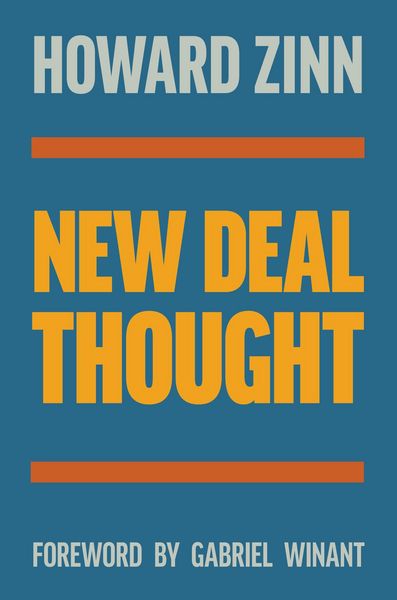
Produktbild: New Deal Thought (Expanded Edition)
Vorbesteller Neu

New Deal Thought (Expanded Edition) (Expanded Edition)

56,99 €

inkl. gesetzl. MwSt., Versandkostenfrei


Beschreibung

Produktdetails

Einband

Gebundene Ausgabe

Erscheinungsdatum

10.08.2027

Herausgeber

Howard Zinn

Verlag

Ingram Publishers Services

Seitenzahl

472

Maße (L/B)

20,3/12,7 cm

Sprache

Englisch

EAN

9798888907344

Beschreibung

Portrait

Howard Zinn (1922–2010) was a historian, author, professor, playwright, and activist. His life’s work focused on a wide range of issues including race, class, war, and history, and touched the lives of countless people. His writing celebrated the accomplishments of social movements and ordinary people, and challenged readers to question the myths that justify war and inequality. Zinn’s influence lives on in millions of people who have read his work and have been inspired by his actions. Zinn’s best-known work is A People’s History of the United States, which has sold more than five million copies.

Produktdetails

Einband

Gebundene Ausgabe

Erscheinungsdatum

10.08.2027

Herausgeber

Howard Zinn

Verlag

Ingram Publishers Services

Seitenzahl

472

Maße (L/B)

20,3/12,7 cm

Sprache

Englisch

EAN

9798888907344

Herstelleradresse

Libri GmbH
Europaallee 1
36244 Bad Hersfeld
DE

Email: gpsr@libri.de

Noch keine Bewertungen vorhanden

Verfassen Sie die erste Bewertung zu diesem Artikel

Helfen Sie anderen Kundinnen und Kunden durch Ihre Meinung.

Kundinnen und Kunden meinen

Bewertungen (0)

  • Produktbild: New Deal Thought (Expanded Edition)
  • Foreword by Gabe Winant
    Introduction
    Acknowledgments
    Chronology
    Selected Bibliography

    Part One: Philosophic Setting
    Charles A. Beard: The Myth of Rugged American Individualism (1931)
    Upton Sinclair: Production for Use (1933)
    Reinhold Niebuhr: After Capitalism-What? (1933)
    Stuart Chase: The Age of Distribution (1934)
    John Dewey: The Future of Liberalism (1935)
    Thurman Arnold: A Philosophy for Politicians (1935)

    Part Two: Expectations
    Franklin D. Roosevelt: Every Man Has a Right to Life (1932)
    Paul H. Douglas: The Roosevelt Program and Organization of the Weak (1933)
    Robert M. MacIver: The Ambiguity of the New Deal (1934)
    Edward A. Filene: Business Needs the New Deal (1934)
    Henry A. Wallace: We Need a Declaration of Interdependence (1936)

    Part Three: National Economic Planning
    Franklin D. Roosevelt: Bold, Persistent Experimentation (1932)
    Rexford Guy Tugwell: Planning Must Replace Laissez Faire (1932)
    Gerard Swope: A Business Approach to Economic Planning (1934)
    Walter Lippman: Planning Will Lead to Oligarchy (1937)
    David E. Lilienthal: Planning Step by Step (1944)

    Part Four: Giantism in Business
    Ernest Gruening: Controlling the Giant Corporation (1933)
    William O. Douglas: How Effective Is Securities Regulation? (1934)
    Franklin D. Roosevelt: Stop Collectivism in Business (1938)
    Thurman Arnold: The Rule of Reason in Antitrust Action (1939)
    Raymond Moley: Roosevelt's Refusal to Make a Choice (1939)
    Temporary National Economic Committee: The Concentration of Economic Power (1941)

    Part Five: Public Enterprise
    Harry L. Hopkins: The War on Distress (1933)
    Nathan Straus: End the Slums (1938)
    Lewis Mumford: The Government Should Support Art (1936)
    Hallie Flanagan: The Drama of the Federal Theater Project (1939)
    Max Lerner: A TVA "Yardstick" for the Opinion Industries (1939)
    Alvin Hansen: The Need for Long-Range Public Investment (1939)

    Part Six: Organizing Labor
    The Wagner Act: Unions of Their Own Choosing (1935)
    Heywood Broun: Why Exclude Domestic Workers? (1935)
    John L. Lewis: Industrial Democracy in Steel (1936)
    Liberals Disagree on the Sit-Down Strike (1937)
    Robert Morss Lovett: A G.M. Stockholder Visits Flint
    Oswald Garrison Villard: A Letter F.D.R. Ought to Write
    Philip Murray: How the NLRB Changed "Little Siberia" (1939)

    Part Seven: The Farmer
    Fiorello La Guardia: Urban Support for the Farmer (1933)
    Henry A. Wallace: A Defense of the New Deal Farm Program (1938)
    William R. Amberson: Damn the Whole Tenant System (1935)
    John Steinbeck: The Torment of Migrant Workers in California (1936)
    Carey McWilliams: Farm Workers and "Dirt Farmers" Need Power (1942)

    Part Eight: Minimum Security
    Hugo Black: For a Thirty-Hour Work Week (1933)
    Stuart Chase: The Consumer Must Be Permitted to Consume (1933)
    Frances Perkins: The Principles of Social Security (1935)
    Henry Ellenbogen: The Social Security Act Is Only a Beginning (1935)
    Franklin D. Roosevelt: A Fair Day's Pay for a Fair Day's Work (1937)
    Samuel Lubell and Walter Everett: The Breakdown of Relief (1938)
    Henry E. Sigerist: Government Should Also Protect "The Right to Health" (1938)

    Part Nine: The Negro
    Guy B. Johnson: Does the South Owe the Negro a New Deal? (1934)
    John P. Davis: The New Deal: Slogans for the Same Raw Deal (1935)
    Robert C. Weaver: The New Deal Is for the Negro (1935)
    Walter White: U.S. Department of (White) Justice (1935)
    Harold L. Ickes: Not "Special Consideration" But a "New Social Order for All" (1936)
    W. E. B. Du Bois: Can Federal Action Change the South? (1940)

    Part Ten: The Constitution and Social Progress
    Felix Frankfurter: Social Issues Before the Supreme Court (1933)
    Morris R. Cohen: Fallacies About the Court (1935)
    Franklin D. Roosevelt: The Court Needs "New and Younger Blood" (1937)
    The Supreme Court Retreats: Minimum-Wage Laws Are Constitutional (1937)

    Part Eleven: Critiques and Perspectives
    Francis Perkins: FDR Was "A Little Left of Center" (1946)
    Benjamin Stolberg and Warren J. Vinton: The New Deal "Moves in Every Direction at Once" (1935)
    Floyd B. Olson: A New Party to Challenge Capitalism (1935)
    Norman Thomas: Socialism, Not Roosevelt's Pale Pink Pills (1936)
    John Maynard Keynes: The Maintenance of Prosperity Is Extremely Difficult (1938)
    John Dewey: The Old Problems Are Unsolved (1939)
    The New Republic: "Extraordinary Accomplishments" and "Failure in the Central Problem" (1940)

    Index