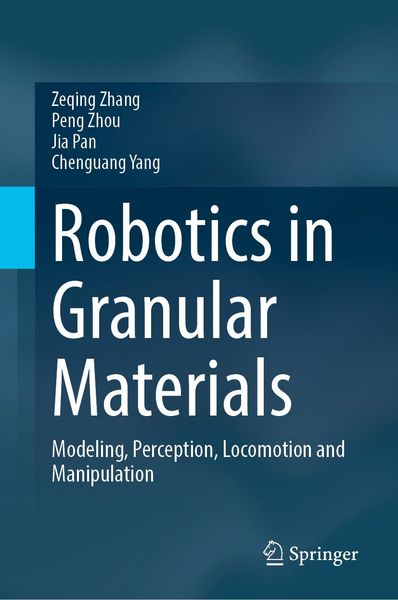
Robotics in Granular Materials Modeling, Perception, Locomotion and Manipulation
-
- Englisch ausgewählt
164,99 €
inkl. gesetzl. MwSt.,
Beschreibung
Produktdetails
Einband
Gebundene Ausgabe
Erscheinungsdatum
22.01.2027
Abbildungen
XIV, 150 p. 17 illus., 15 illus. in color.
Verlag
Springer SingaporeSeitenzahl
150
Maße (B/H)
15,5/23,5 cm
Sprache
Englisch
ISBN
978-981-9255-28-3
Granular materials such as sand, soil, gravel, regolith, powders, and grains are central to planetary surfaces, agricultural fields, construction sites, mines, food-processing systems, and disaster-response environments. For robots, these media are both common and unusually difficult: they deform, compact, flow, jam, collapse, and shift between solid-like and fluid-like behavior. Understanding how robots interact with granular environments is therefore essential for advancing autonomy beyond structured and predictable settings.
This book provides a systematic review of robotics in and around granular media, organized around a four-pillar framework that connects modeling, sensing, locomotion, and manipulation. It introduces key foundations including terradynamics, resistive force theory, discrete element methods, continuum modeling, multi-body simulation, differentiable physics, and data-driven simulators. It then examines subsurface sensing, media identification, buried object localization, wheeled and tracked mobility, legged locomotion, burrowing, hybrid mechanisms, excavation, retrieval, granular handling, and task-oriented manipulation. The final parts synthesize dominant methodologies, identify bottlenecks in scalability, standardization, real-time control, and sim-to-real transfer, and outline future directions such as physics-grounded AI models, adaptive autonomy, multi-fidelity simulation, neuromorphic sensing, and shared benchmarking protocols.
The book is intended for researchers, engineers, graduate students, and practitioners working in robotics, granular physics, terramechanics, field robotics, planetary exploration, agricultural automation, construction robotics, disaster response, and industrial material handling. By combining foundational theory with recent robotic systems and computational methods, it offers both a rigorous reference and a forward-looking roadmap for those seeking to understand and advance robotic autonomy in complex granular environments.
Noch keine Bewertungen vorhanden
Verfassen Sie die erste Bewertung zu diesem Artikel
Helfen Sie anderen Kundinnen und Kunden durch Ihre Meinung.
Kurze Frage zu unserer Seite
Vielen Dank für dein Feedback
Wir nutzen dein Feedback, um unsere Produktseiten zu verbessern. Bitte habe Verständnis, dass wir dir keine Rückmeldung geben können. Falls du Kontakt mit uns aufnehmen möchtest, kannst du dich aber gerne an unseren Kund*innenservice wenden.
zum Kundenservice