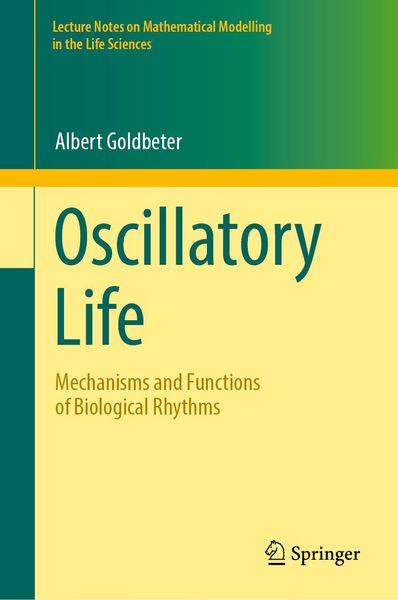
Oscillatory Life Mechanisms and Functions of Biological Rhythms
-
- Englisch ausgewählt
62,99 €
inkl. gesetzl. MwSt.,
Beschreibung
Produktdetails
Einband
Gebundene Ausgabe
Erscheinungsdatum
11.11.2026
Abbildungen
XVIII, 327 p.
Verlag
SpringerSeitenzahl
327
Maße (B/H)
15,5/23,5 cm
Sprache
Englisch
ISBN
978-3-032-37388-5
This book presents the main rhythms of life and delves into their underlying regulatory mechanisms. Heartbeat, breathing, sleep-wake cycle, ovarian cycle, animal migration, plant flowering : life is rhythm. Numerous other periodic processes are engaged in cells, often imperceptibly. Thus, a biochemical clock controls cell division cycles, brain activity is underpinned by a variety of neural rhythms, and many hormones are secreted in pulses. Oscillations occur in metabolic and signalling pathways, and control pattern formation in embryogenesis. Some diseases, such as bipolar disorder, possess a cyclical nature.
Among the many rhythms that regulate organisms and their physiology, some are linked to the environment: circadian rhythms, which follow a 24-hour pattern, allow the organisms to adapt to the alternation of day and night. The circadian clock impacts all aspects of our physiology and the timing of drug delivery. Other rhythms are linked to the yearly seasonal cycle: flowering, hibernation, migrations, and reproduction in numerous species.
The period of biological rhythms can vary from a fraction of a second to decades. Where do these multiple rhythms come from? What functions do they serve? Why are periodic phenomena so common in biological systems? How do periodic oscillations become complex or chaotic?
This book offers the first synthesis of existing knowledge on the oscillations observed at different levels of biological organisation. Drawing on experimental data and the results of mathematical modelling, it highlights the origin and the dynamical properties of rhythms that constitute an essential aspect of life.
Written in a style accessible to a broad audience, this book examines the many types of biological rhythms and shows what unites them, beyond their period, specific mechanism, and function.
Noch keine Bewertungen vorhanden
Verfassen Sie die erste Bewertung zu diesem Artikel
Helfen Sie anderen Kundinnen und Kunden durch Ihre Meinung.
Kurze Frage zu unserer Seite
Vielen Dank für dein Feedback
Wir nutzen dein Feedback, um unsere Produktseiten zu verbessern. Bitte habe Verständnis, dass wir dir keine Rückmeldung geben können. Falls du Kontakt mit uns aufnehmen möchtest, kannst du dich aber gerne an unseren Kund*innenservice wenden.
zum Kundenservice