KI-Beratung Beta

Gutscheinbedingungen

**Gültig vom 23.11. bis 30.11.2026 | Gültig für nicht preisgebundene fremdsprachige Bücher | Einzelne Artikel können ausgeschlossen sein | Online auf www.bücher.de einlösbar | Click & Collect nur mit Online-Zahlung (Paypal/Kreditkarte) vorab | Nicht kombinierbar mit anderen Gutscheinen oder Preisaktionen | Nur einmal pro Einkauf einlösbar | Gutschein wird auf max. 500€ Bestellwert angerechnet | Keine Barauszahlung | Nicht gültig für Versandkosten und Services

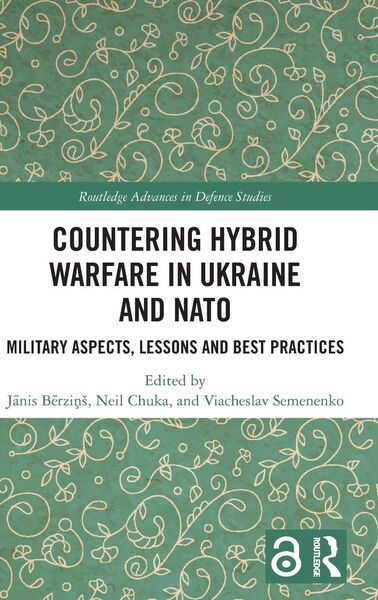
Produktbild: Countering Hybrid Warfare in Ukraine and NATO
Neu

Countering Hybrid Warfare in Ukraine and NATO Military Aspects, Lessons and Best Practices

219,99 €

inkl. gesetzl. MwSt., Versandkostenfrei


Beschreibung

This edited volume examines how states counter Russian hybrid warfare, through the dual lenses of Ukraine's experience and broader international responses.

Building on research conducted within the NATO Science and Technology Organization, this work brings together scholars and military practitioners...

Beschreibung

This edited volume examines how states counter Russian hybrid warfare, through the dual lenses of Ukraine's experience and broader international responses.

Building on research conducted within the NATO Science and Technology Organization, this work brings together scholars and military practitioners from Ukraine, the Baltic states, the UK, Scandinavia, Central Europe, and the Western Balkans, to critically analyse Russia's use of hybrid warfare tools - including information operations, military signalling, legal manipulation, and strategic influence - across multiple domains and regions. This volume is structured in two parts: Part I presents primary¿source accounts from Ukrainian defence professionals who built and adapted institutions under sustained Russian hybrid pressure from 2014 onwards, covering legal frameworks, information security, strategic communications, territorial defence, scenario planning, and maritime operations. Part II offers comparative case studies spanning NATO's Enhanced Forward Presence in Estonia, Russian military exercises in the Baltic Sea, hybrid warfare and resilience in the Baltic States, political and intelligence penetration of the Czech Republic, narrative shaping in Kosovo, and energy coercion across Croatia and the Western Balkans. This volume applies net assessment and military effectiveness as its analytical framework, asking what hybrid instruments Russia employs, how targeted states adapt, and whether those adaptations transfer to other contexts.

This book will be of much interest to students of hybrid warfare, military and strategic studies, and foreign policy and security studies, and will also be of relevance to defence professionals, NATO policymakers, and security analysts.

Portrait

J¿nis B¿rzi¿š is a senior researcher at the National Defence Academy of Latvia and teaches at the UL FinTech Business School.

Neil Chuka is a defence scientist, strategic analyst at Defence Research and Development Canada.

Viacheslav Semenenko is a professor at the Military Academy of Ukraine named after Yevhenii Bereznyak.

Produktdetails

Einband

Gebundene Ausgabe

Erscheinungsdatum

04.11.2026

Abbildungen

schwarz-weiss Illustrationen, Raster,schwarz-weiss, Tabellen, schwarz-weiss

Herausgeber Janis Berzins + weitere

Produktdetails

Einband

Gebundene Ausgabe

Erscheinungsdatum

04.11.2026

Abbildungen

schwarz-weiss Illustrationen, Raster,schwarz-weiss, Tabellen, schwarz-weiss

Herausgeber
Verlag Taylor and Francis
Seitenzahl

230

Maße (L/B/H)

24,1/16/2,1 cm

Gewicht

528 g

Sprache

Englisch

ISBN

978-1-04-125155-2

Herstelleradresse

Libri GmbH
Europaallee 1
36244 Bad Hersfeld
DE

Email: gpsr@libri.de

Noch keine Bewertungen vorhanden

Verfassen Sie die erste Bewertung zu diesem Artikel

Helfen Sie anderen Kundinnen und Kunden durch Ihre Meinung.

Kundinnen und Kunden meinen

Bewertungen (0)

  • Produktbild: Countering Hybrid Warfare in Ukraine and NATO
  • Part I: Ukraine's Experience and Adaptation Chapter 1. Introduction: Hybrid Warfare and Military Effectiveness, J¿nis B¿rzi¿š and Neil Chuka Chapter 2. The Legal Basis for Countering Russian Aggression, 2014¿2020, O. Kotlyarenko Chapter 3. Information Security and Cyber Defence in Countering Russian Aggression, P. Snitsarenko and Yu. Sarychev Chapter 4. Strategic Communications, Internal Communications, and Civil-Military Cooperation in Countering the Hybrid Aggression, O. Salnikova, I. Sivokha, V. Semenenko, A. Ivashchenko; V. Shkolyarenko, I. Rudnytsky Chapter 5. Organisation of Territorial Defence of Ukraine under the Hybrid War with Russia, V. S. Frolov and V. M. Semenenko Chapter 6. Informational Aspects of Russian Aggression: The Use of Scenarios in Planning Activities, V. Bashynskyi, H. Pievtsov, P. Open'ko, and A. Salii Chapter 7. Fundamentals of the Comprehensive Use of Military and Non-Military Forces and Means to Counter Hybrid Aggression, A. Syrotenko, A. Pavlikovskyi, O. Dublyan, and V. Bogdanovych Chapter 8. Peculiarities of the Use of Troops (Forces) for Countering the Armed Aggression of the Russian Federation in the East of Ukraine, M. Lobko Chapter 9. Countering Russian Hybrid Warfare in the Maritime Domain: Lessons and Prospects, S. Yakymiak Chapter 10. SOF Support to Counter Hybrid Warfare: The NATO-Ukrainian SOF Development Project, Byron Harper Part II: Regional and Comparative Case Studies Chapter 11. Military Aspects of Hybrid Warfare: UK Experiences from Operation CABRIT, The Defence Science and Technology Laboratory (Dstl) Chapter 12. Russian Military Exercises in the Baltic Sea Area: Strategic Narratives and Actions, Linda Jarl Chapter 13. Russia's Hybrid Warfare and Resilience in the Baltic States, J¿nis B¿rzi¿š Chapter 14. Russian Hybrid Activities in the Czech Republic: Influence and Resilience, Jan Bren and Petr Matouš Chapter 15. Russia and Kosovo: Shaping Narratives in the Western Balkans, Dorthe Bach Nyemann Chapter 16. Monopolising Power: Russia's Energy Strategy in Central Europe and the Balkans, Gordan Akrap, Ivica Mandi¿, and Dragan Mišeti¿ Chapter 17. Conclusions: Military Implications for NATO and Partners, J¿nis B¿rzi¿š and Neil Chuka