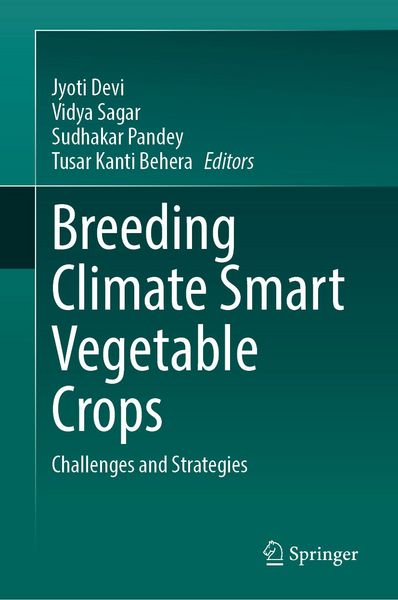
Produktbild: Breeding Climate Smart Vegetable Crops
Vorbesteller Neu

Breeding Climate Smart Vegetable Crops Challenges and Strategies

213,99 €

inkl. gesetzl. MwSt., Versandkostenfrei


Beschreibung

Produktdetails

Einband

Gebundene Ausgabe

Erscheinungsdatum

27.11.2026

Abbildungen

XX, 656 p. 43 illus., 42 illus. in color.

Herausgeber

Jyoti Devi + weitere

Verlag

Springer Singapore

Seitenzahl

656

Maße (L/B)

23,5/15,5 cm

Sprache

Englisch

ISBN

978-981-9239-15-3

Beschreibung

Portrait

Dr. Jyoti Devi has over 12 years of research experience in legume breeding, particularly in peas and underutilized crops, and has contributed to the development of nine vegetable varieties and the registration of five unique germplasm lines with the National Bureau of Plant Genetic Resources, New Delhi. Her research focuses on identifying 50 trait-specific vegetable genotypes for high yield, earliness, stress tolerance and nutritional quality. She is actively engaged in germplasm conservation and management, maintenance breeding of pea and French bean varieties, breeder seed production, and varietal promotion, resulting in the successful commercialization and licensing of multiple cultivars. Dr. Jyoti has published over 45 research papers, 20 book chapters, and numerous extension articles. She serves as Editor for Vegetable Science and is a recognized reviewer for many reputed journals. Her contributions have been recognized through several prestigious honors & fellowships, including NAAS Associate, UPAAS Fellow, the ISHRD Young Scientist Award, and the DST INSPIRE Fellowship.

Dr. Vidya Sagar has over nine years of research experience in vegetable breeding, focusing on okra, leafy vegetables, peas, and cucurbits. He has developed 10 varieties along with registration of a unique sponge gourd genotype. He has identified around 45 trait-specific genotypes, including disease-resistant cucumber and okra, delayed bolting in amaranth and mustard green, low betalain in Basella, and regular flowering in moringa. He is currently leading multiple projects funded by ICAR, NASF, ANRF, and PPVFRA. Dr. Sagar has augmented over 2500 genotypes and distributed around 500 germplasm. His contributions include 50 research papers, 17 book chapters and several popular articles. He has received several prestigious awards, including ICAR, CSIR-JRF, DST INSPIRE Fellowship, SHRD Young Scientist Award and ICAR Best Thesis Award.

Dr. Sudhakar Pandey currently serving as Assistant Director General (Flowers, Vegetables, Spices & Medicinal Plants) and is a renowned vegetable breeder with significant contributions to cucurbit improvement. He has developed 25 improved varieties across pumpkin, ash gourd, sponge gourd, muskmelon, bottle gourd, and cucumber. His key achievements include the development of processing varieties in ash gourd, carotene-rich varieties/genetic stocks in pumpkin and cucumber, and downy mildew-resistant snapmelon lines. He also identified SSR markers and QTLs for powdery mildew resistance and parthenocarpy in cucumber, and contributed to DUS guidelines for several vegetable crops. He has published over 100 research papers, books, manuals, and bulletins. A Fellow of NAAS, UPAAS, ISVS, and ISHRD, he serves as Convener of the NAAS Varanasi Chapter, Associate Editor of Progressive Horticulture, and has received several prestigious awards.

Dr. T. K. Behera has over 27 years of expertise in vegetable breeding, contributing significantly to crop improvement. He has developed more than 30 varieties and registered six trait-specific breeding lines. He pioneered the isolation of gynoecious lines in bitter gourd from feral sources and successfully introgressed the gy-1 gene into commercial cultivars, identifying a 1.31 Mb genomic region on chromosome 1 associated with gynoecy. He also developed the first chromosome-level genome assembly of Momordica balsamina using advanced sequencing technologies. His research identified CsCLV3 as a candidate gene for carpel number variation and SHORT HYPOCOTYL1 (SH1) regulating UV-B–mediated hypocotyl elongation in cucumber. Dr. Behera has guided 11 Ph.D. and 2 M.Sc. students and published over 130 research papers, along with books and reviews. He is a Fellow of reputed societies and recipient of several prestigious awards.

Produktdetails

Einband

Gebundene Ausgabe

Erscheinungsdatum

27.11.2026

Abbildungen

XX, 656 p. 43 illus., 42 illus. in color.

Herausgeber

Verlag

Springer Singapore

Seitenzahl

656

Maße (L/B)

23,5/15,5 cm

Sprache

Englisch

ISBN

978-981-9239-15-3

Herstelleradresse

Libri GmbH
Europaallee 1
36244 Bad Hersfeld
DE

Email: gpsr@libri.de

Noch keine Bewertungen vorhanden

Verfassen Sie die erste Bewertung zu diesem Artikel

Helfen Sie anderen Kundinnen und Kunden durch Ihre Meinung.

Kundinnen und Kunden meinen

Bewertungen (0)

  • Produktbild: Breeding Climate Smart Vegetable Crops
  • Chapter 1. Abiotic Stresses: Emerging Constraints in Vegetable Production Worldwide.- Chapter 2. Morphological, Physiological, And Biochemical Adaptations in Abiotic Stress Response Mechanisms of Vegetable Crops.- Chapter 3. Impact Of Abiotic Stresses on Production and Nutritional Aspects in Vegetable Crops.- Chapter 4. Breeding Vegetables for Moisture Stress (Drought and Excess Moisture) Environments: Understanding Impacts, Identifying Traits, And Implementing Strategies for Resilience.- Chapter 5. Innovative Breeding Strategies for Enhancing Temperature Resilience (Low and High Temp) in Vegetable Crops.- Chapter 6. Breeding Vegetables for Salt Tolerance and Heavy Metal Stress.- Chapter 7. From Phenotyping to Phenomics: Advancements in Screening Techniques for Abiotic Stress-Tolerant Vegetable Crops.- Chapter 8. Potato Breeding for the Future: Tackling Environmental Challenges with Resilient Varieties.- Chapter 9. Traditional and Genomic Assisted Breeding for Abiotic Stresses in Tomato .- Chapter 10. Abiotic Stress Breeding in Brinjal: Recent Advances and Innovations.- Chapter 11. Surviving External Adversity: A Comprehensive Review of Legume Breeding Strategies for Abiotic Stress Resilience.- Chapter 12. Abiotic Stresses and Breeding Strategies for Root Vegetable Production.- Chapter 13. Abiotic Stress Mechanisms and Breeding Strategies in Cole Crops (Brassica oleracea L.).- Chapter 14. Abiotic Stresses and Breeding Strategies for Onion Improvement.- Chapter 15. Wild Relatives as Source of Abiotic Stress Tolerance in Vegetable Crops.- Chapter 16. Development of Abiotic Stress Tolerance in Vegetable Crops Through Genome Editing Approaches.- Chapter 17. Mapping and Introgression of Genomic Loci Governing Abiotic Stress Tolerance in Vegetable Crops.- Chapter 18. Healing the Rhizosphere: Role of Plant Growth Promoting Rhizobacteria in Mitigating Abiotic Stress in Vegetable Crops.- Chapter 19. Rootstock Breeding for Various Abiotic Stresses in Vegetable Crops.- Chapter 20. The Changing Face of Insect Pest Populations in Response to Climate Change.- Chapter 21. Climate Smart and Resilient Management Practices to Improve Vegetable Productivity Under Abiotic Stresses.- Chapter 22. Soil-Water-Plant-Relationship and Soil Management Under Various Abiotic Stresses.