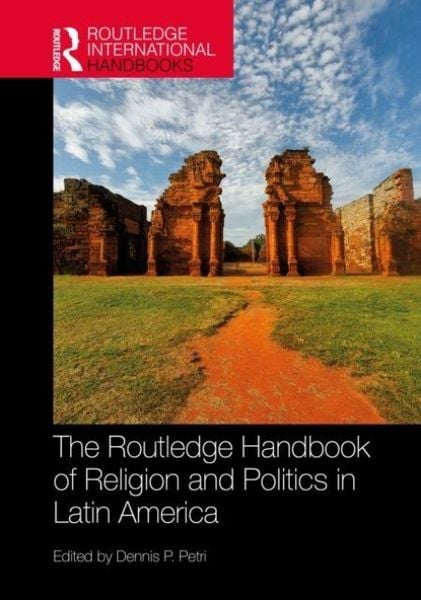
The Routledge Handbook of Religion and Politics in Latin America
-
- Englisch ausgewählt
322,99 €
inkl. gesetzl. MwSt.,
Lieferung nach Hause
Beschreibung
Produktdetails
Einband
Gebundene Ausgabe
Erscheinungsdatum
17.11.2026
Abbildungen
farbige Illustrationen, Raster, farbig, Zeichnungen, farbig, Tabellen, schwarz-weiss
Herausgeber
Dennis P. PetriVerlag
Taylor and FrancisSeitenzahl
664
Maße (L/B)
24,6/17,4 cm
Sprache
Englisch
ISBN
978-1-03-296467-6
The Routledge Handbook of Religion and Politics in Latin America offers a state of the art of the academic and multidisciplinary reflection on the main aspects of the relationships between religion, politics, and society in Latin America.
The book provides insights from leading scholars in the fields of religious studies and political science, from the historical roots of religious pluralism to contemporary debates on religious freedom, democratization, and civic engagement, each chapter delves into a different aspect of this multifaceted topic. Special emphasis is given to the need to overcome the dominant reductionist approaches to the study of religion and politics in Latin America which focus too narrowly on church-state relations and ignore the sometimes contentious political and societal implications of the growing religious pluralism in the region. The handbook also aims to build bridges between the often isolated disciplines of religious studies and political science, as well as between Latin American and Western scholars. The first section provides an overview of the political perspectives of Latin American worldviews. The second section looks at the interface of religion and the public sphere. The third section delves into the multiple dimensions of religious freedom. Section four examines the complex relationship between religion and democratization. Section five explores religious civic engagement and its impact on development. Finally, section six offers several country case studies to illustrate points made in earlier sections and go more in-depth into particularities of each country.
The Routledge Handbook of Religion and Politics in Latin America will appeal to students and scholars of politics, religious studies, and Latin America, providing a valuable resource for understanding the forces shaping Latin American societies.
.
Noch keine Bewertungen vorhanden
Verfassen Sie die erste Bewertung zu diesem Artikel
Helfen Sie anderen Kundinnen und Kunden durch Ihre Meinung.
Kurze Frage zu unserer Seite
Vielen Dank für dein Feedback
Wir nutzen dein Feedback, um unsere Produktseiten zu verbessern. Bitte habe Verständnis, dass wir dir keine Rückmeldung geben können. Falls du Kontakt mit uns aufnehmen möchtest, kannst du dich aber gerne an unseren Kund*innenservice wenden.
zum Kundenservice