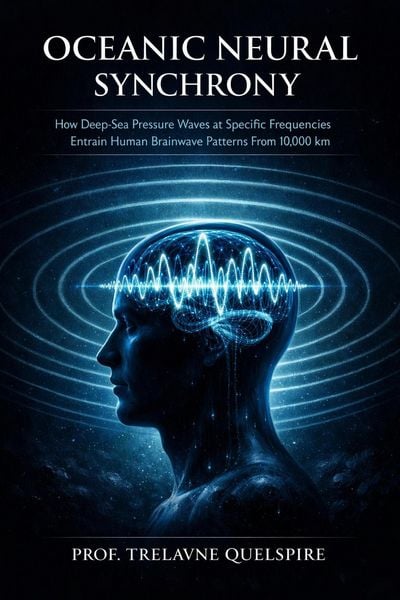
Oceanic Neural Synchrony: How Deep-Sea Pressure Waves at Specific Frequencies Entrain Human Brainwave Patterns From 10,000 km
-
- Einzelkauf Download ausgewählt
-
Sprache:Englisch
8,99 €
inkl. gesetzl. MwSt.Beschreibung
Produktdetails
Format
ePUB
Kopierschutz
Ja
Family Sharing
Ja
Text-to-Speech
Ja
Erscheinungsdatum
29.05.2026
Verlag
UmarSeitenzahl
(Printausgabe)
Dateigröße
107 KB
Sprache
Englisch
EAN
9798235213821
OCEANIC NEURAL SYNCHRONY How Deep-Sea Pressure Waves at Specific Frequencies
The ocean is doing something to your brain right now.
Not metaphorically. Not poetically. Physically, measurably, through mechanisms that physics and neuroscience can describe with precision. At this moment, pressure waves generated by storm systems thousands of kilometres away are propagating through the Earth's crust, through the atmosphere, through the ground beneath your feet, and arriving at your nervous system at a specific frequency: 0.1 Hz. That same frequency governs the slow oscillation in your blood pressure that cardiologists call the Mayer wave. It governs the infra-slow electrical rhythm that neuroscientists have identified as the master regulator of your brain's entire oscillatory architecture. It is the frequency at which your cerebrospinal fluid pulses around your brain.
The ocean has been broadcasting at this frequency for four billion years. Your nervous system has been tuned to receive it for hundreds of millions.
Prof. Trelvane Quelspire spent two decades studying the acoustic properties of the deep ocean before a single offhand remark from a neuroscience colleague stopped him cold. What followed was years of research across disciplines that rarely speak to each other: acoustic oceanography, seismology, neurophysiology, cardiovascular medicine, and evolutionary biology. What he found was a convergence of evidence so consistent, so numerically precise, and so physically grounded that ignoring it became scientifically indefensible.
This book is the result.
Oceanic Neural Synchrony takes readers from the wartime discovery of the SOFAR channel, the ocean's own intercontinental acoustic highway, through the extraordinary physics of how pressure waves cross entire ocean basins without losing their essential character. It moves into the electrical architecture of the human brain, where Hans Berger's century-old discovery of brainwave oscillations has matured into a precise understanding of how external rhythms drive internal ones. It presents the clinical evidence, including MIT's landmark 2019 research demonstrating that acoustic entrainment at specific frequencies can physically reduce the protein aggregates responsible for Alzheimer's disease, proving beyond doubt that sound shapes biology at the deepest level.
Then it asks the question no one had previously thought to ask: what has the loudest, most consistent, most globally distributed acoustic source on the planet been doing to the nervous systems of organisms that evolved in its shadow for half a billion years?
The answers are not comfortable. They suggest that the well-documented mental health benefits of coastal living are not about scenery or fresh air. They suggest that the ancient medical prescription of sea air for nervous disorders was accidentally correct for reasons its practitioners could not have imagined. They suggest that the growing distance between modern human populations and natural acoustic environments may carry neurological consequences we have not yet learned to measure.
Written for the intellectually curious reader who demands real science and refuses easy answers, this book does not speculate where evidence is absent and does not retreat into caution where evidence is strong. It is a work of synthesis across fields that have each, independently, been building toward a conclusion that only becomes visible when you see all the pieces together.
The ocean is not background. It is not scenery. It is the most powerful acoustic instrument on Earth, and it has been playing the same frequency into your nervous system since before your ancestors had ears to hear it.
You have always been listening. This book explains what you have been hearing.
Kundinnen und Kunden meinen
Verfassen Sie die erste Bewertung zu diesem Artikel
Helfen Sie anderen Kund*innen durch Ihre Meinung
Kurze Frage zu unserer Seite
Vielen Dank für dein Feedback
Wir nutzen dein Feedback, um unsere Produktseiten zu verbessern. Bitte habe Verständnis, dass wir dir keine Rückmeldung geben können. Falls du Kontakt mit uns aufnehmen möchtest, kannst du dich aber gerne an unseren Kund*innenservice wenden.
zum Kundenservice