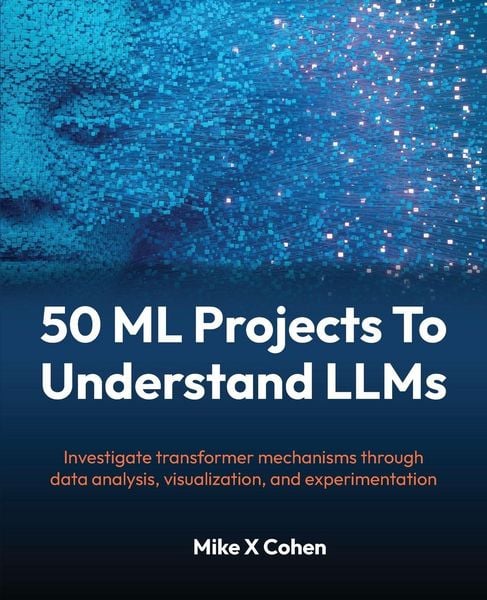
50 ML Projects To Understand LLMs Investigate transformer mechanisms through data analysis, visualization, and experimentation
-
- Englisch ausgewählt
116,99 €
inkl. gesetzl. MwSt.,
Lieferung nach Hause
Beschreibung
Produktdetails
Einband
Taschenbuch
Erscheinungsdatum
29.05.2026
Verlag
Packt PublishingSeitenzahl
566
Maße (L/B/H)
23,5/19,1/3 cm
Gewicht
1043 g
Sprache
Englisch
ISBN
978-1-80808-255-9
Most books teach you how to build LLMs from scratch or deploy them via APIs. This book uses guided machine learning projects to teach you how to understand, visualize, and investigate LLMs including GPT and BERT. Key Features: - Each project is built around three learning goals: machine learning techniques, LLM mechanisms, and Python coding with data visualization. - This is not a dense theoretical textbook; it's hands-on, practical, and project-oriented. - You will learn how to measure, visualize, and manipulate the internal components of LLMs directly. Book Description: Through 50 hands-on, guided projects solved in Python, you will investigate the internal mechanisms of large language models by treating their hidden states, attention patterns, and embeddings as data to analyze. Rather than accepting LLMs as black boxes, you will open them up, examine what's inside, and run experiments to understand why they behave the way they do. All projects are based on Python (using libraries such as NumPy, PyTorch, statsmodels, scikit-learn, Matplotlib, Pandas, and Seaborn) and come with full solutions and partial solution notebook files, so you can practice and improve your skills in data science, deep learning, data visualization, and scientific and statistical coding. What You Will Learn: - Tokenization schemes and their statistical properties - Embedding spaces: cosine similarity, semantic axes, and analogy vectors - Output logits, softmax distributions, perplexity, and language biases - Layer-by-layer transformer dynamics and dimensionality - Attention mechanisms: QKV weights, attention scores, head ablation, and activation patching - MLP subblocks: neuron tuning, mutual information, subspace analysis, and statistics-based causal manipulations - Logit lens, indirect object identification, and causal tracing Who this book is for: This book is for data scientists, ML engineers, and researchers who want to go beyond surface-level understanding of LLMs. Prior Python experience is required. Familiarity with machine learning or deep learning is helpful but not required - techniques are introduced as they arise throughout the projects. Table of Contents - Introductions - Tokenization - Embeddings - Output logits - Transformer outputs - Attention - MLP
Kundinnen und Kunden meinen
Verfassen Sie die erste Bewertung zu diesem Artikel
Helfen Sie anderen Kund*innen durch Ihre Meinung
Kurze Frage zu unserer Seite
Vielen Dank für dein Feedback
Wir nutzen dein Feedback, um unsere Produktseiten zu verbessern. Bitte habe Verständnis, dass wir dir keine Rückmeldung geben können. Falls du Kontakt mit uns aufnehmen möchtest, kannst du dich aber gerne an unseren Kund*innenservice wenden.
zum Kundenservice