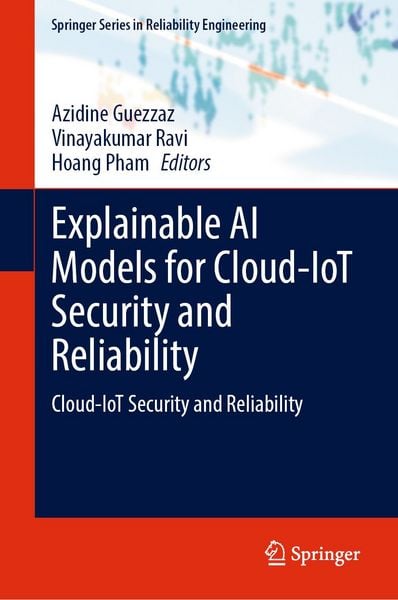
Produktbild: Explainable AI Models for Cloud-IoT Security and Reliability
Vorbesteller Neu

Explainable AI Models for Cloud-IoT Security and Reliability Cloud-IoT Security and Reliability

196,99 €

inkl. gesetzl. MwSt., Versandkostenfrei

Lieferung nach Hause

Beschreibung

Produktdetails

Einband

Gebundene Ausgabe

Erscheinungsdatum

06.09.2026

Abbildungen

Approx. 75 illus., 15 illus. in color., farbige Illustrationen, schwarz-weiss Illustrationen

Herausgeber

Azidine Guezzaz + weitere

Verlag

Springer

Seitenzahl

307

Maße (L/B)

23,5/15,5 cm

Sprache

Englisch

ISBN

978-3-032-30937-2

Beschreibung

Portrait

Azidine Guezzaz is currently an associate professor of computer science and mathematics at Technology Higher School Essaouira at Cadi Ayyad Marrakech University Morocco. He is a member in Laboratory Mathematics, Computer Science, and Modeling of Complex Systems (MIMSC). He received his Ph.D. from IbnZohr University Agadir, Morocco, in 2018. His research interest is computer security, cryptography, artificial intelligence, intrusion detection, and smart cities. He is also a reviewer of various scientific journals. Cyber security, big data analytics, Network Security Computer, Networking, Network Architecture, Cryptography, Routing, Intrusion Detection Intrusion Prevention, Applied Artificial Intelligence, Data Mining, Data Warehouse, Advanced Machine Learning, Business Intelligence.

Vinayakumar Ravi is an assistant research professor at Center for Artificial Intelligence, Prince Mohammad Bin Fahd University, Khobar, Saudi Arabia. His previous position was a postdoctoral research fellow in developing and implementing novel computational and machine learning algorithms and applications for big data integration and data mining with Cincinnati Children’s Hospital Medical Center, Cincinnati, OH, USA. His current research interests include applications of data mining, artificial intelligence, machine learning (including deep learning) for biomedical informatics, cyber security, image processing, and natural language processing. He has more than 100 research publications in reputed IEEE conferences, IEEE Transactions and Journals. His publications include prestigious conferences in the area of cyber security, like IEEE S&P and IEEE Infocom. Dr. Ravi has received a full scholarship to attend Machine Learning Summer School (MLSS) 2019, London. 

Hoang Pham (fellow, IEEE) received the M.S. degree in statistics from the University of Illinois at Urbana-Champaign, Champaign, IL, USA, in 1984, and the Ph.D. degree in industrial engineering from The State University of New York at Buffalo, Buffalo, NY, USA, in 1989. He is currently a distinguished professor and the former chairman of the Department of Industrial and Systems Engineering, Rutgers University, Piscataway, NJ, USA. He was a senior engineering specialist with the Idaho National Engineering Laboratory in Idaho Falls, and a senior specialist engineer with Boeing, Seattle, WA, USA.  He was the recipient of numerous awards, including the 2009 IEEE Reliability Society Engineer of the Year Award. He is a fellow of the IISE.

Produktdetails

Einband

Gebundene Ausgabe

Erscheinungsdatum

06.09.2026

Abbildungen

Approx. 75 illus., 15 illus. in color., farbige Illustrationen, schwarz-weiss Illustrationen

Herausgeber

Verlag

Springer

Seitenzahl

307

Maße (L/B)

23,5/15,5 cm

Sprache

Englisch

ISBN

978-3-032-30937-2

Herstelleradresse

Springer Nature Customer Service Center GmbH
Europaplatz 3
69115 Heidelberg
DE
ProductSafety@springernature.com

Kundinnen und Kunden meinen

0 Bewertungen

Informationen zu Bewertungen

Zur Abgabe einer Bewertung ist eine Anmeldung im Konto notwendig. Die Authentizität der Bewertungen wird von uns nicht überprüft. Wir behalten uns vor, Bewertungstexte, die unseren Richtlinien widersprechen, entsprechend zu kürzen oder zu löschen.

Die Bewertungen sind nach Format, Anzahl Sterne und Datum sortiert.

Verfassen Sie die erste Bewertung zu diesem Artikel

Helfen Sie anderen Kund*innen durch Ihre Meinung

Kundinnen und Kunden meinen

0 Bewertungen filtern

  • Produktbild: Explainable AI Models for Cloud-IoT Security and Reliability
  • Hybrid deep learning model for intrusion detection in IoT networks using the CICIoT2023 dataset.- AI-attack efficacy in cryptanalysis: SVM classification of block ciphers across diverse datasets.- An ECC-based lightweight authentication protocol for secure IoT communications.- Towards a hybrid approach combining CNN and LSTM for brute-force attack detection in cybersecurity.- BFIDS: Blockchain-federated learning for privacy-preserving intrusion detection in IoMT.- Detection of cyber attacks using hardware in the loop and process invariants for plant control systems.- Machine learning for enhanced firewall behavior defense.- An unsupervised learning approach for anomaly detection using only normal data in healthcare systems.- Genetic algorithm–based wrapper feature selection for enhancing machine learning intrusion detection systems.- LLoT systems security: Study of layered technologies and communication protocols.- A practical stream cipher based on the learning with errors problem.- A blockchain-enabled federated learning–based intrusion detection system for secure communication within a cyber physical system.- Lightweight machine learning for IoT intrusion detection: A data-efficient approach with multi-dataset validation.- A comparative security analysis of android and iOS operating systems.- Explainable detection and localization of stealthy false data injection attacks in smart grids.- Enhancing IoT network security: ML, blockchain and IPFS for botnet attacks detection.- Kolmogorov–Arnold networks with generative oversampling for credit fraud detection.- Investigating disparities between SCADA and traditional IT network traffic: Implications for industrial control systems.- Digital twin enriched survival modeling for heart failure using invasive and non-invasive measurements.- Machine learning framework for ARP spoofing detection in IoT and IIoT networks: A comparative analysis of classical and neural network approaches.