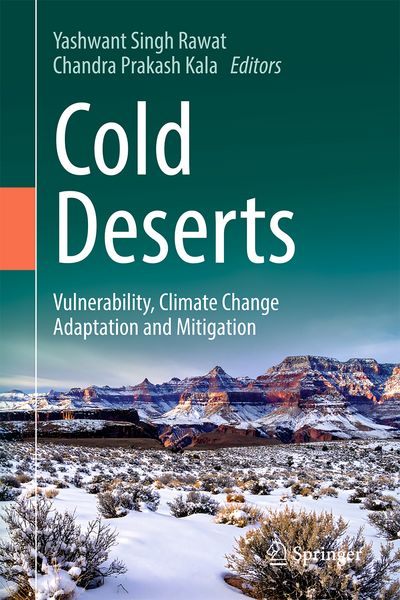
Produktbild: Cold Deserts
Neu

Cold Deserts Vulnerability, Climate Change Adaptation and Mitigation

135,99 €

inkl. gesetzl. MwSt., Versandkostenfrei

Lieferung nach Hause

Beschreibung

Produktdetails

Einband

Gebundene Ausgabe

Erscheinungsdatum

06.09.2026

Abbildungen

X, 34 illus., 31 illus. in color., farbige Illustrationen, schwarz-weiss Illustrationen

Herausgeber

Yashwant Singh Rawat + weitere

Verlag

Springer

Seitenzahl

322

Maße (L/B)

23,5/15,5 cm

Sprache

Englisch

ISBN

978-3-032-29118-9

Beschreibung

Portrait

Yashwant Singh Rawat earned his MS and PhD in Forestry from HNB Garhwal University (a Central University), Uttarakhand, India. His doctoral research was conducted at the GB Pant National Institute of Himalayan Environment (NIHE), Uttarakhand, India, and its Himachal Regional Centre in Kullu, Himachal Pradesh—an autonomous institute under the Ministry of Environment, Forest and Climate Change, Government of India. Dr. Rawat has served in various academic and research capacities at the Uttaranchal (PG) College of Bio-medical Sciences, Dehradun (affiliated with HNB Garhwal University), NIHE, Nelson Mandela University (South Africa), the University of KwaZulu-Natal (South Africa), and the United Nations University (Japan). With over 19 years of professional experience following his PhD, Dr. Rawat has published extensively in international peer-reviewed journals, with more than 60 research papers and scholarly articles. He has contributed significantly to the academic community through editorial and peer-review service for leading journals and publishers such as Elsevier, Springer Nature, Frontiers, PLOS, Wiley, Taylor & Francis, and MDPI. Dr. Rawat is a recipient of several prestigious competitive fellowships and research support from India and abroad, including the CSIR Senior Research Fellowship (Government of India) and the United Nations University–Institute for the Advanced Study of Sustainability (UNU-IAS), Japan. He is currently a faculty member at the Federal Technical and Vocational Training Institute (TVTI), Addis Ababa, Ethiopia. His research interests include forestry, ecology, biodiversity and ecosystem services, environmental sustainability, sustainable energy, and resource-use.   Chandra Prakash Kala earned his MS degree in Botany from HNB Garhwal University, and PhD in Forestry from the Forest Research Institute (Deemed University), Dehradun, India. He worked at the Wildlife Institute of India, GB Pant National Institute of Himalayan Environment, and the National Medicinal Plants Board with various capacities. His decade long research study on the ‘Valley of Flowers’ in India laid the foundation stone for tagging it in the list of World Heritage Sites by UNESCO. With over 32 years of professional experience, he has published >200 research papers and articles having over 8,700 citations. His area of interest is plant ecology, biodiversity conservation, natural resource management, and he has contributed significantly to policy initiatives, and capacity building. He is on the editorial and advisory board of many national and international scientific journals, including Journal of Ethnobiology and Ethnomedicine, PLoS Sustainability and Transformation, and PLoS Ecosystems. He is an elected member of the National Academy of Sciences in India (NASI), and also the recipient of prestigious ICFRE Award for Excellence in the Forest Conservation (Biodiversity and Ecology) in 2005. He has been a visiting scholar at the Pennsylvania State University, in the United States and the University of Ljubljana in Slovenia. At present, he is a faculty member at the Indian Institute of Forest Management, Bhopal, and he has been ranked among the top 2% of the world’s academicians/scientists by the Stanford University.

Produktdetails

Einband

Gebundene Ausgabe

Erscheinungsdatum

06.09.2026

Abbildungen

X, 34 illus., 31 illus. in color., farbige Illustrationen, schwarz-weiss Illustrationen

Herausgeber

Verlag

Springer

Seitenzahl

322

Maße (L/B)

23,5/15,5 cm

Sprache

Englisch

ISBN

978-3-032-29118-9

Herstelleradresse

Springer Nature Customer Service Center GmbH
Europaplatz 3
69115 Heidelberg
DE
ProductSafety@springernature.com

Kundinnen und Kunden meinen

0 Bewertungen

Informationen zu Bewertungen

Zur Abgabe einer Bewertung ist eine Anmeldung im Konto notwendig. Die Authentizität der Bewertungen wird von uns nicht überprüft. Wir behalten uns vor, Bewertungstexte, die unseren Richtlinien widersprechen, entsprechend zu kürzen oder zu löschen.

Die Bewertungen sind nach Format, Anzahl Sterne und Datum sortiert.

Verfassen Sie die erste Bewertung zu diesem Artikel

Helfen Sie anderen Kund*innen durch Ihre Meinung

Kundinnen und Kunden meinen

0 Bewertungen filtern

  • Produktbild: Cold Deserts
  • Chapter 1: The Cold Desert Ecosystem of Ladakh: Vulnerabilities, Adaptations And Pathways Towards Sustainable Development.- Chapter 2: Human Ecology, Vulnerability And Adaptation To Climate Change In Cold Desert Landscape of Johar Valley Of Pithoragarh District In Uttarakhand Himalaya.- Chapter 3: Impacts of Climate Change On Agriculture In Indian Cold Deserts - Mitigation And Adaption.- Chapter 4: Climate Change Impacts On Indian Cold Deserts Vegetation And Conservation Implications.- Chapter 5: Plant Life And Adaptations In High Mountainous Regions.- Chapter 6: The Use of Remote Sensing And Geographic Information Systems (GIS) For The Mapping of Cold Deserts’ Bio-Resources.- Chapter 7: Effects of Primary and Secondary Umbels In The Germination Behaviour of Heraclium candicans Wall. ex. DC. and Selinum tenuifolium Wall ex C.B. Clarke, The High Altitude Umbellifers.- Chapter 8: Sustaining Livelihoods And Mitigating Climate Change Impacts Through Cold Desert Agroforestry Systems In The Lahaul Valley of North Western Himalaya, India.- Chapter 9: Community-Led Forestry And Landscape Restoration For Climate Change Mitigation And Adaption In Cold Desert, Northwestern Himalaya, India.- Chapter 10: Agroforestry For Land Management, Climate Change Mitigation And Adaptation In Cold Desert Ecosystems.- Chapter 11: Diversity, Traditional Knowledge And Vulnerability of Medicinal Plants To Climate Change In Cold Desert Areas Of Indian Himalaya.- Chapter 12: Ethnobotany And Conservation Challenges In The Cold Desert Ecosystems of Uttarakhand, India.- Chapter 13: Biogeochemical Dynamics of Ladakh's High-Altitude Permafrost.- Chapter 14: Hydrology And Water Governance In Cold Deserts: Glacial Dynamics, Resource Management And Natural Disaster Resilience.- Chapter 15: Transformation In Pastoral Practices And Changing Climate In Cold Desert Areas of India.- Chapter 16: Building Psychological Resilience For Sustainable Adaptation In Cold Desert Regions.