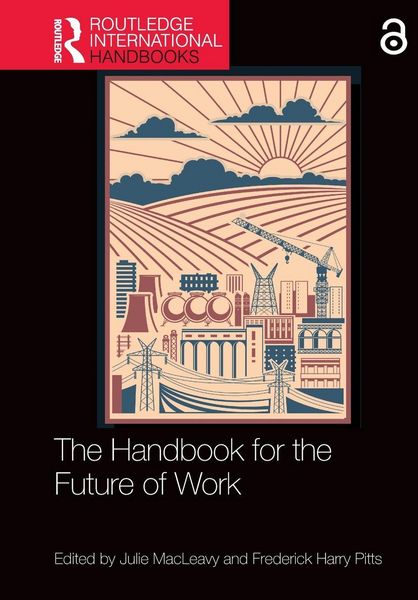
The Handbook for the Future of Work
-
- Hardcover
- Taschenbuch ausgewählt
- eBook
-
Sprache:Englisch
75,99 €
inkl. gesetzl. MwSt.,
Lieferung nach Hause
Portrait
Julie MacLeavy is a Professor of Economic Geography at the University of Bristol, UK specialising in feminist political economy, economic transformations and new forms of work. She is the Theme Lead for the 'Innovation, Transition, Change' challenge within the new Academic Research Hub for the Prevention of Gambling Harms at the University of Bristol, co-Editor-in-Chief of Geoforum and Treasurer of the Royal Geographical Society (with the Institute of British Geographers) Economic Geography Research Group. Julie is the co-editor of The Handbook of Neoliberalism (Routledge) and author of Enduring Austerity: The Uneven Geographies of the Post-Welfare State (University of Bristol Press), which examines how austerity policies create an uneven landscape of work and welfare opportunities across different communities.
Frederick Harry Pitts is a Senior Lecturer in Politics at the University of Exeter's Cornwall Campus in his hometown of Penryn, where he is also the Director of Business Engagement and Innovation for Humanities and Social Sciences. He is a Co-Investigator of the Economic and Social Research Council Centre for Sociodigital Futures, a Fellow of the Institute for the Future of Work, Secretary of the British Universities Industrial Relations Association and an Honorary Senior Research Fellow at University of Bristol Business School. He is the author or coauthor of five previous books, most recently Marx in Management and Organisation Studies: Rethinking Value, Labour and Class Struggles (Routledge).
Produktdetails
Einband
Taschenbuch
Erscheinungsdatum
22.06.2026
Abbildungen
schwarz-weiss Illustrationen, Raster, schwarz-weiss, Zeichnungen, schwarz-weiss, Tabellen, schwarz-weiss
Herausgeber
MacLeavy Julie + weitereVerlag
Taylor and FrancisSeitenzahl
424
Maße (L/B/H)
24,4/17/2,3 cm
Gewicht
712 g
Sprache
Englisch
ISBN
978-1-03-235591-7
Julie MacLeavy is a Professor of Economic Geography at the University of Bristol, UK specialising in feminist political economy, economic transformations and new forms of work. She is the Theme Lead for the 'Innovation, Transition, Change' challenge within the new Academic Research Hub for the Prevention of Gambling Harms at the University of Bristol, co-Editor-in-Chief of Geoforum and Treasurer of the Royal Geographical Society (with the Institute of British Geographers) Economic Geography Research Group. Julie is the co-editor of The Handbook of Neoliberalism (Routledge) and author of Enduring Austerity: The Uneven Geographies of the Post-Welfare State (University of Bristol Press), which examines how austerity policies create an uneven landscape of work and welfare opportunities across different communities.
Frederick Harry Pitts is a Senior Lecturer in Politics at the University of Exeter's Cornwall Campus in his hometown of Penryn, where he is also the Director of Business Engagement and Innovation for Humanities and Social Sciences. He is a Co-Investigator of the Economic and Social Research Council Centre for Sociodigital Futures, a Fellow of the Institute for the Future of Work, Secretary of the British Universities Industrial Relations Association and an Honorary Senior Research Fellow at University of Bristol Business School. He is the author or coauthor of five previous books, most recently Marx in Management and Organisation Studies: Rethinking Value, Labour and Class Struggles (Routledge).
Kundinnen und Kunden meinen
Verfassen Sie die erste Bewertung zu diesem Artikel
Helfen Sie anderen Kund*innen durch Ihre Meinung
Kurze Frage zu unserer Seite
Vielen Dank für dein Feedback
Wir nutzen dein Feedback, um unsere Produktseiten zu verbessern. Bitte habe Verständnis, dass wir dir keine Rückmeldung geben können. Falls du Kontakt mit uns aufnehmen möchtest, kannst du dich aber gerne an unseren Kund*innenservice wenden.
zum Kundenservice