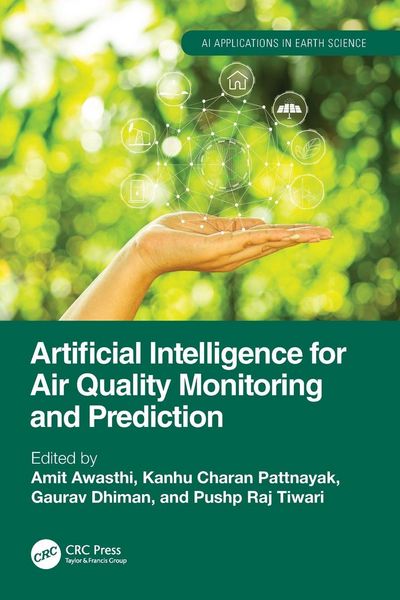
Artificial Intelligence for Air Quality Monitoring and Prediction
-
- Englisch ausgewählt
78,99 €
inkl. gesetzl. MwSt.,
Lieferung nach Hause
Portrait
Amit Awasthi is Associate Professor at the University of Petroleum and Energy Studies, Dehradun, India. He completed his PhD at Thapar University, Patiala, in 2011, and has over 18 years of professional experience in the areas of research and development, teaching, and allied functions with reputed educational institutions and universities, offering research experience in atmosphere and environmental sciences including air monitoring, exposure studies, extreme events, water quality, climate change. He has the merit of receiving International Fellowship from National Science Council-Taiwan as Postdoc Fellow. He has published 4 textbooks and more than 60 research papers in reputed journals of atmospheric/environment sciences/climate change with an h-index 17 and citation ~ 1300 and impact factor ~200. He has received several research grants from national and international organizations in the areas of aerosol and water quality measurements. He has edited several books with reputed publishers such as Taylor & Francis, Elsevier, Springer.
Kanhu Charan Pattnayak is Senior Climate Impact Scientist at the National Environmental Agency, Singapore, with over 17 years of experience in climate impact research and climate modeling. He has a Ph.D. in Climate Science from the Indian Institute of Technology Delhi and has held research positions at the University of Leeds, the National Environment Agency of Singapore, and the NCMRWF. He has published over 25 research papers in top-tier journals and has served as a reviewer for the Sixth Assessment Report of the United Nations Intergovernmental Panel on Climate Change.
Gaurav Dhiman is Assistant Professor in the School of Sciences and Emerging Technologies at Jagat Guru Nanak Dev Punjab State Open University, Patiala, India. He holds a Ph.D. in Computer Engineering from Thapar Institute of Engineering & Technology, Patiala. He is recognized as one of the world's top researchers in Stanford University's list of the world's top 2% of scientists, prepared by Elsevier. He is a Senior Member at IEEE; Research Faculty at Lebanese American University, Lebanon; and Research Scientist at Universidad Internacional Iberoamericana, Mexico. He has authored over 300 peer-reviewed research papers and 10 books. He is currently serving as a guest editor for more than 40 special issues in various peer-reviewed journals. He is an Editor-in-Chief of the International Journal of Modern Research (IJMORE), and Co-Editor-in-Chief of the International Journal of Electronics and Communications Systems (IJECS) and International Journal of Ubiquitous Technology and Management (IJUTM). He is an Associate Editor of IEEE Transactions on Industrial Informatics, IET Software (Wiley), Expert Systems (Wiley), IEEE Systems, Man, and Cybernetics Magazine, Spatial Information Research (Springer), and more.
Pushp Raj Tiwari is a climate scientist and Fellow of UK's Higher Education Academy (FHEA), and specializes in climate change, big data, and earth system modelling. A former RCUK-ECR Fellow, he now leads a research group on Climate Change Modelling and Applications. His work focuses on aerosol-cloud-climate interaction and reducing the associated uncertainties related to them in climate models.
Produktdetails
Einband
Taschenbuch
Erscheinungsdatum
22.06.2026
Abbildungen
schwarz-weiss Illustrationen, farbige Illustrationen, Raster, schwarz-weiss, Zeichnungen, schwarz-weiss, Zeichnungen, farbig, Tabellen, schwarz-weiss
Herausgeber
Amit Awasthi + weitereVerlag
Taylor and FrancisSeitenzahl
301
Maße (L/B/H)
23,4/15,6/1,6 cm
Gewicht
426 g
Sprache
Englisch
ISBN
978-1-03-268382-9
Amit Awasthi is Associate Professor at the University of Petroleum and Energy Studies, Dehradun, India. He completed his PhD at Thapar University, Patiala, in 2011, and has over 18 years of professional experience in the areas of research and development, teaching, and allied functions with reputed educational institutions and universities, offering research experience in atmosphere and environmental sciences including air monitoring, exposure studies, extreme events, water quality, climate change. He has the merit of receiving International Fellowship from National Science Council-Taiwan as Postdoc Fellow. He has published 4 textbooks and more than 60 research papers in reputed journals of atmospheric/environment sciences/climate change with an h-index 17 and citation ~ 1300 and impact factor ~200. He has received several research grants from national and international organizations in the areas of aerosol and water quality measurements. He has edited several books with reputed publishers such as Taylor & Francis, Elsevier, Springer.
Kanhu Charan Pattnayak is Senior Climate Impact Scientist at the National Environmental Agency, Singapore, with over 17 years of experience in climate impact research and climate modeling. He has a Ph.D. in Climate Science from the Indian Institute of Technology Delhi and has held research positions at the University of Leeds, the National Environment Agency of Singapore, and the NCMRWF. He has published over 25 research papers in top-tier journals and has served as a reviewer for the Sixth Assessment Report of the United Nations Intergovernmental Panel on Climate Change.
Gaurav Dhiman is Assistant Professor in the School of Sciences and Emerging Technologies at Jagat Guru Nanak Dev Punjab State Open University, Patiala, India. He holds a Ph.D. in Computer Engineering from Thapar Institute of Engineering & Technology, Patiala. He is recognized as one of the world's top researchers in Stanford University's list of the world's top 2% of scientists, prepared by Elsevier. He is a Senior Member at IEEE; Research Faculty at Lebanese American University, Lebanon; and Research Scientist at Universidad Internacional Iberoamericana, Mexico. He has authored over 300 peer-reviewed research papers and 10 books. He is currently serving as a guest editor for more than 40 special issues in various peer-reviewed journals. He is an Editor-in-Chief of the International Journal of Modern Research (IJMORE), and Co-Editor-in-Chief of the International Journal of Electronics and Communications Systems (IJECS) and International Journal of Ubiquitous Technology and Management (IJUTM). He is an Associate Editor of IEEE Transactions on Industrial Informatics, IET Software (Wiley), Expert Systems (Wiley), IEEE Systems, Man, and Cybernetics Magazine, Spatial Information Research (Springer), and more.
Pushp Raj Tiwari is a climate scientist and Fellow of UK's Higher Education Academy (FHEA), and specializes in climate change, big data, and earth system modelling. A former RCUK-ECR Fellow, he now leads a research group on Climate Change Modelling and Applications. His work focuses on aerosol-cloud-climate interaction and reducing the associated uncertainties related to them in climate models.
Kundinnen und Kunden meinen
Verfassen Sie die erste Bewertung zu diesem Artikel
Helfen Sie anderen Kund*innen durch Ihre Meinung
Kurze Frage zu unserer Seite
Vielen Dank für dein Feedback
Wir nutzen dein Feedback, um unsere Produktseiten zu verbessern. Bitte habe Verständnis, dass wir dir keine Rückmeldung geben können. Falls du Kontakt mit uns aufnehmen möchtest, kannst du dich aber gerne an unseren Kund*innenservice wenden.
zum Kundenservice