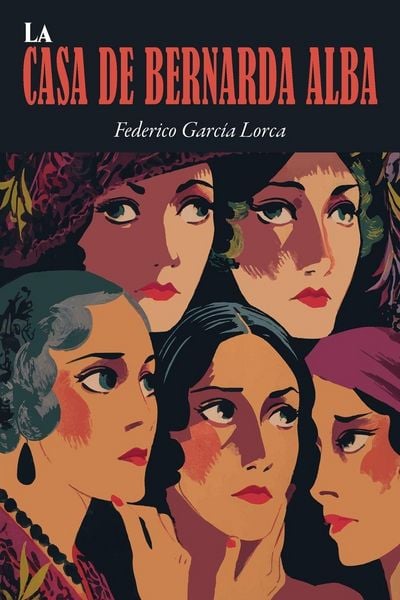

La Casa de Bernarda Alba
-
- Hardcover
- Taschenbuch ausgewählt
- eBook
-
Sprache:Spanisch
- Englisch 21,99 €
- Spanisch 13,99 € ausgewählt
- Italienisch 16,99 €
-
Verlag:Martino Fine Books
- Debolsillo 12,99 €
- Universidad Internacional de Andalucía 22,99 €
- Editorial Luis Vives (Edelvives) 22,99 €
- Alianza Editorial 19,99 €
- Catedra, M. 16,99 €
- EPOCA 12,99 €
- La Galera, SAU 15,99 €
- Anaya Educación 19,99 €
- Linkgua ediciones 15,99 €
- Martino Fine Books 13,99 € ausgewählt
- Bubok Publishing, S.L. 21,99 €
- Espasa Libros, S.L. 14,99 €
- Ediciones SM 18,99 €
- Editorial Comares 9,99 €
- Santillana Educación, S.L. 21,99 €
- Grupo EDEBÉ 19,99 €
- Castalia Ediciones 9,99 €
13,99 €
inkl. gesetzl. MwSt.,
Beschreibung
Produktdetails
Einband
Taschenbuch
Erscheinungsdatum
09.04.2026
Verlag
Martino Fine BooksSeitenzahl
124
Maße (L/B/H)
22,9/15,2/0,8 cm
Gewicht
214 g
Sprache
Spanisch
EAN
9798898780494
In the sweltering heat of an Andalusian summer, behind whitewashed walls and locked doors, five daughters are entombed alive. Their mother, Bernarda Alba - iron-willed, imperious, suffocating - has decreed eight years of mourning following the death of her second husband. No man may enter. No daughter may leave. The outside world, with its music, its desire, its dangerous freedom, is sealed away behind bolts and propriety and the crushing weight of what the neighbors might say. But desire does not obey decrees. First performed in 1936, just weeks before García Lorca's assassination at the hands of Francoist forces, La Casa de Bernarda Alba stands as one of the twentieth century's most shattering theatrical masterpieces - and one of its most prophetic. The play pulses with everything that was about to be extinguished in Spain: passion, individuality, the rights of women to live and love on their own terms. Bernarda is not merely a tyrannical mother. She is the face of repression itself - of a society that sacrifices its most vital members on the altar of honor, appearance, and control. The five daughters - Angustias, Magdalena, Amelia, Martirio, and the youngest, Adela - are not simply characters. They are a spectrum of responses to captivity: resignation, bitterness, envy, conspiracy, and finally, blazing, fatal rebellion. At the center of the drama burns the figure of Pepe el Romano, never seen on stage but felt in every room of the house like a lit fuse - desired by all, promised to one, and the instrument of destruction for another. García Lorca wrote entirely in women's voices, and did so with extraordinary psychological precision. Every line carries the compressed tension of a household in which everything important is unsaid, every glance carries consequence, and the walls themselves seem to press inward. The play's three acts build with the inevitability of classical tragedy toward a conclusion that is both shocking and absolutely foreordained. La Casa de Bernarda Alba speaks directly to every generation that has known what it is to have freedom denied - by family, by society, by ideology, by fear. It is a play about women, but it is equally a play about power - who holds it, how it is maintained, and what it costs those who dare to resist it. This is García Lorca at the full height of his powers - stripped of the poetry and surrealism of his earlier work, brutal in its realism, unflinching in its gaze. It is theater with the force of an accusation.
Noch keine Bewertungen vorhanden
Verfassen Sie die erste Bewertung zu diesem Artikel
Helfen Sie anderen Kundinnen und Kunden durch Ihre Meinung.
Kurze Frage zu unserer Seite
Vielen Dank für dein Feedback
Wir nutzen dein Feedback, um unsere Produktseiten zu verbessern. Bitte habe Verständnis, dass wir dir keine Rückmeldung geben können. Falls du Kontakt mit uns aufnehmen möchtest, kannst du dich aber gerne an unseren Kund*innenservice wenden.
zum Kundenservice