Beschreibung
Produktdetails
Einband
Taschenbuch
Erscheinungsdatum
06.04.2026
Verlag
NBM HouseSeitenzahl
104
Maße (L/B/H)
21,6/14/0,7 cm
Gewicht
143 g
Sprache
Englisch
EAN
9798232064716
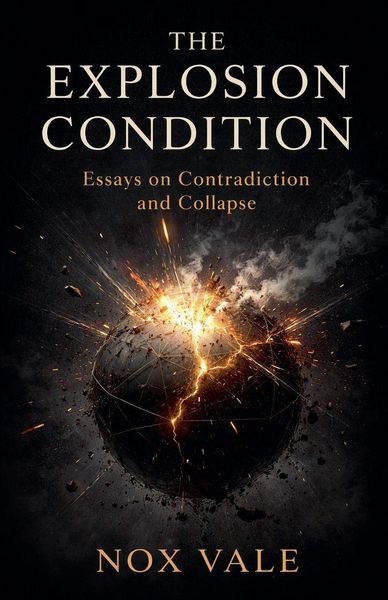
What happens when a system can no longer contain what it generates? In formal logic, a single contradiction detonates into arbitrary conclusions (the principle of explosion). In intellectual history, paradigms rupture under accumulated anomalies, releasing new conceptual landscapes. In existential experience, the self-a fragile project of relating to itself-breaks down in despair or anxiety, revealing groundlessness. In our era, data, machine intelligence, and systemic complexity grow faster than any framework can interpret them, fracturing shared meaning. These are not isolated failures. Across domains, the same deep dynamics appear: boundaries that define a system also generate internal tension through its own productive activity; tension accumulates until containment fails discontinuously and nonlinearly; the aftermath depends on what was genuinely organized inside when the boundary broke. The first four essays explore this pattern in distinct registers-from paraconsistent logic and dialetheism (Graham Priest territory) to Kuhnian paradigm shifts, Kierkegaard/Sartre/Heidegger-style existential breakdown, and the contemporary information overload that outpaces sense-making. The fifth essay synthesizes them into a general theory of explosive systems, drawing on self-organized criticality, dissipative structures, and fracture mechanics to argue that explosion is a structural feature of all organized complexity maintained far from equilibrium. Lucid, rigorous, and philosophically ambitious, this sequence moves from the most formal to the most synthetic, offering tools for understanding crises in reasoning, knowledge, identity, and civilization. It is neither celebration nor lament but a clear-eyed anatomy of how containers form, strain, and ultimately fail-and what survives. Ideal for readers who enjoyed Thomas Kuhn's The Structure of Scientific Revolutions, Graham Priest's work on contradictions, or broader reflections on complexity, technology, and modernity (think echoes of Nietzsche, Hegel, and contemporary thinkers on information overload). Whether you find the homology compelling or treat the essays as independent probes, The Explosion Condition reframes how we see rupture, residue, and reorganization.
Kundinnen und Kunden meinen
Verfassen Sie die erste Bewertung zu diesem Artikel
Helfen Sie anderen Kund*innen durch Ihre Meinung
Kurze Frage zu unserer Seite
Vielen Dank für dein Feedback
Wir nutzen dein Feedback, um unsere Produktseiten zu verbessern. Bitte habe Verständnis, dass wir dir keine Rückmeldung geben können. Falls du Kontakt mit uns aufnehmen möchtest, kannst du dich aber gerne an unseren Kund*innenservice wenden.
zum Kundenservice