Gutscheinbedingungen

**Gültig vom 07.09.2026 bis 09.09.2026 | Gültig für nicht preisgebundene fremdsprachige Bücher | Einzelne Artikel können ausgeschlossen sein | Online auf www.bücher.de einlösbar | Click & Collect nur mit Online-Zahlung (Paypal/Kreditkarte) vorab | Nicht kombinierbar mit anderen Gutscheinen oder Preisaktionen | Nur einmal pro Einkauf einlösbar | Gutschein wird auf max. 500€ Bestellwert angerechnet | Keine Barauszahlung | Nicht gültig für Versandkosten und Services

Produktbild: Precision Technologies for Digital Agriculture
Vorbesteller Neu

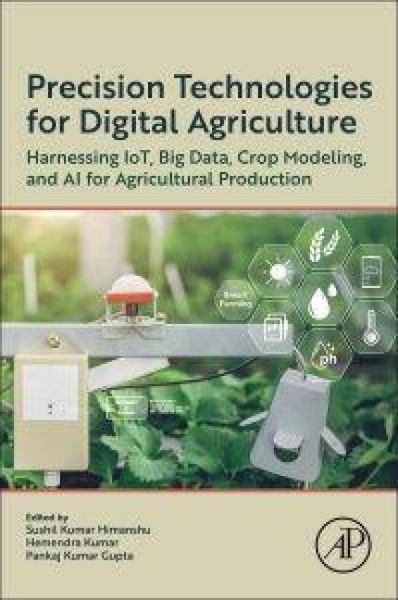
Precision Technologies for Digital Agriculture Harnessing Iot, Big Data, Crop Modeling, and AI for Agricultural Production

184,99 €

inkl. gesetzl. MwSt., Versandkostenfrei


Beschreibung

Produktdetails

Einband

Taschenbuch

Erscheinungsdatum

18.09.2026

Herausgeber

Sushil Kumar Himanshu + weitere

Verlag

Elsevier

Seitenzahl

436

Maße (L/B)

22,9/15,2 cm

Gewicht

449 g

Sprache

Englisch

ISBN

978-0-443-40513-6

Beschreibung

Portrait

Dr. Sushil Kumar Himanshu is an Associate Professor and Deputy Dean at the Faculty of Food, Agriculture, and Natural Resources, Asian Institute of Technology (AIT), Thailand. He obtained his M.Tech in Hydrology and PhD in Water Resources Development and Management from the Indian Institute of Technology (IIT) Roorkee and conducted postdoctoral research at Texas A&M University. Dr. Himanshu’s research focuses on the applications of generative AI, remote sensing, and modeling applications for climate-smart water management. His research has been funded by ADB, World Bank, UN-FAO, USDA, and other agencies to support agricultural and aquacultural sustainability, food security, and water security. He is a co-editor of the Elsevier book Advances in Remediation Techniques for Polluted Soils and Groundwater.

Dr. Hemendra Kumar is a precision agriculture specialist at the College of Agriculture and Natural Resources, University of Maryland College Park. His extensive experience and international exposure have profoundly influenced his innovative approaches to precision agricultural research and advanced irrigation water management. Dr. Kumar's work focuses on optimizing irrigation timing and thresholds through data collected from fields. His innovative methods include optimizing variable rate irrigation scheduling based on management zones. His research spans precision water management, smart agricultural technologies, climate-smart irrigation management, soil moisture optimization, agricultural water management, digital agriculture, hydrology, water quality, and surface and subsurface hydrologic modeling. Central to his work is the utilization of sensors, technologies, and data-driven artificial intelligence and machine learning methodologies to enhance water management in agriculture, including precision irrigation and drainage water management.

Dr. Pankaj Kumar Gupta is a Ramanujan fellow ​at the Indian Institute of Technology (I.I.T.) Delhi, India and post-doctoral fellow in the faculty of environment, University of Waterloo, Canada. His current research focuses on investigating the behavior of pollutants in peatlands (Canada) and mineral aquifers (India) under dynamically fluctuating groundwater table conditions. Majority of his works focus on two areas: (1) understanding the occurrence of bio-geo-chemical interactions when pollutants migrate into groundwater systems; and (2) developing remediation strategies. Dr. Gupta hsa in-depth experience in incorporating novel technologies to map soil-water systems in more than 30sites in India. He is passionate about interdisciplinary research and teaching to understand multi-scale interactions between different components of the subsurface environment, especially the soil- groundwater-pollutant-microbes system.

Produktdetails

Einband

Taschenbuch

Erscheinungsdatum

18.09.2026

Herausgeber

Verlag

Elsevier

Seitenzahl

436

Maße (L/B)

22,9/15,2 cm

Gewicht

449 g

Sprache

Englisch

ISBN

978-0-443-40513-6

Herstelleradresse

Libri GmbH
Europaallee 1
36244 Bad Hersfeld
DE

Email: gpsr@libri.de

Noch keine Bewertungen vorhanden

Verfassen Sie die erste Bewertung zu diesem Artikel

Helfen Sie anderen Kundinnen und Kunden durch Ihre Meinung.

Kundinnen und Kunden meinen

Bewertungen (0)

  • Produktbild: Precision Technologies for Digital Agriculture
  • Section I: Smart precision technologies for digital agriculture
    1. Smart agricultural technologies: Challenges and opportunities from today's fields to the future
    2. Advancements in agricultural automation: Smart greenhouses and controlled environment agriculture
    3. Data sharing, privacy, management strategies, and security protocols for smart agricultural systems
    4. Trustworthy artificial intelligence for digital agriculture
    5. Precision farming with the Internet of Everything

    Section II: Computer vision, digital tools, and sensing technologies for modern agriculture
    6. Harnessing remote sensing and geographic information systems in precision and digital agriculture
    7. Integration of computer vision for smart agriculture: Fundamentals and applications
    8. Emergence and application of internet of living things in precision farming
    9. Enhancing crop management with digital twin technology
    10. Predicting crop yield and nutrient needs using explainable artificial intelligence

    Section III: Deployment of smart agricultural technologies for informed decision-making
    11. Physics-based crop modeling for climate- and water-smart irrigation management
    12. Metagenomics: A next-generation tool for monitoring soil microbial communities and managing soil health
    13. Next-gen data-driven precision irrigation: Application of artificial intelligence with in-situ and remote sensing measurements for management zones and variable-rate irrigation technologies
    14. Optimizing unmanned aerial vehicles spray application for pesticide deposition in watermelon production systems in the Mid-Atlantic
    15. Real-world applications of smart technologies in protected farming

    Section IV: Case studies and economic analysis of smart agricultural solutions
    16. Integrating climate-informed crop modeling to optimize planting dates for sustainable productivity of mustard (Brassica juncea)
    17. Assessment of the benefits, costs, and factors affecting the adoption of traceability systems in rice
    18. Smart agriculture technologies in Bangladesh: Current status, adoption, and policy implications
    19. Prioritization of erosion-prone areas for conservation treatments using the sediment yield index: A case study of the Lower Subansiri Dam project
    20. Leveraging drone technology for agri-chemical spraying and locust control: Policy insights from the Vidarbha region of Maharashtra, India