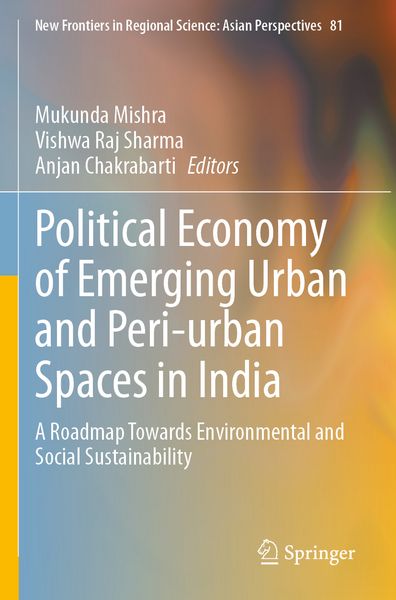
Political Economy of Emerging Urban and Peri-urban Spaces in India A Roadmap Towards Environmental and Social Sustainability
-
- Hardcover
- Taschenbuch ausgewählt
- eBook
-
Sprache:Englisch
214,99 €
inkl. gesetzl. MwSt.,
Beschreibung
Produktdetails
Einband
Taschenbuch
Erscheinungsdatum
31.01.2026
Abbildungen
XXX, 256 p. 46 illus., 41 illus. in color.
Herausgeber
Mukunda Mishra + weitereVerlag
Springer SingaporeSeitenzahl
256
Maße (L/B/H)
23,5/15,5/1,6 cm
Gewicht
441 g
Auflage
1. Auflage
Sprache
Englisch
ISBN
978-981-9788-74-3
This book addresses the “urban” and “peri-urban” spaces in India within a single frame. The reasoning is that while the former is studied for its transformation towards more value addition in terms of power and neoliberal economic viabilities, the latter is the land of visible transformation of the built environment. It acquaints readers with how the processes of circulation of migrant labour, the shift in occupations of landowning groups, and the residential cohabitation of diverse social groups contribute to re-scripting social relations, green spaces, and the forging of new subjectivities. The chapters of the book speak of the need to create sustainable cities for uncertain futures, with a quest to reverse global climate change and make an effort to halt urbanization at the cost of the natural ecosystem, all of which have become more urgent in the post-pandemic years. The book addresses different aspects of the evolutionary urban and peri-urban spaces in India amidst the conflict of the environmental and social sustainability agendas with the neo-liberal ascendancy. The integration of urban and peri-urban areas with emerging political and economic equations and the involvement of multiple disciplines to work in tandem for a deep insight into the complex phenomena incorporating diverse actors validate the need for such a volume.
This edited volume seeks to record how all these stakeholders—state agencies, political leaders, businessmen, workers, investors, households, builders, real estate intermediaries, business owners, migrants, and many more with their varying capacities to influence outcomes on the ground—interact with one another. It also shows how multiple power relationships are calibrated and recalibrated to produce urban and peri-urban spaces in diverse ways in many parts of India.
Noch keine Bewertungen vorhanden
Verfassen Sie die erste Bewertung zu diesem Artikel
Helfen Sie anderen Kundinnen und Kunden durch Ihre Meinung.
Kurze Frage zu unserer Seite
Vielen Dank für dein Feedback
Wir nutzen dein Feedback, um unsere Produktseiten zu verbessern. Bitte habe Verständnis, dass wir dir keine Rückmeldung geben können. Falls du Kontakt mit uns aufnehmen möchtest, kannst du dich aber gerne an unseren Kund*innenservice wenden.
zum Kundenservice