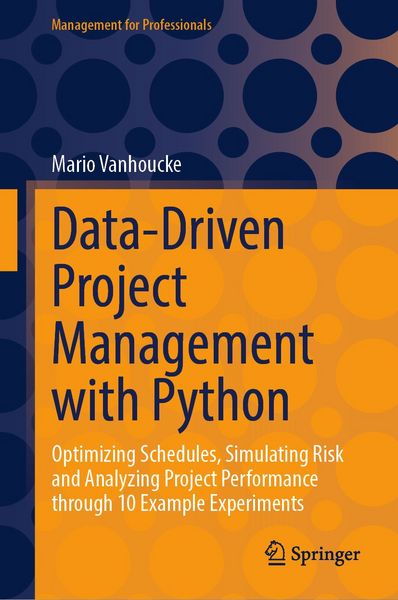
Data-Driven Project Management with Python Optimizing Schedules, Simulating Risk and Analyzing Project Performance through 10 Example Experiments
59,99 €
inkl. gesetzl. MwSt.,
Beschreibung
Produktdetails
Einband
Gebundene Ausgabe
Erscheinungsdatum
04.08.2026
Abbildungen
XXI, 156 p. 40 illus., 38 illus. in color.
Verlag
SpringerSeitenzahl
156
Maße (L/B/H)
24,1/16/1,6 cm
Gewicht
390 g
Sprache
Englisch
ISBN
978-3-032-24555-7
This book explores how project scheduling, risk analysis and control can be understood, tested and taught through data-driven experimentation. It presents 10 Python-based example experiments that guide readers from fundamental scheduling techniques to advanced project control methods. All project data and code are provided, allowing readers to reproduce, modify, and extend every analysis.
The first part introduces the Critical Path Method as the foundation for structured scheduling and extends it to time–cost optimization and resource-constrained scheduling through heuristics and integer programming. The second part employs Monte Carlo simulation to capture schedule uncertainty and to measure activity sensitivity for both unconstrained and resource-limited projects. The third part focuses on project control, using Earned Value Management (EVM) to replicate forecasting accuracy studies from academic literature.
The book’s distinctive contribution lies in linking theoretical scheduling principles with executable Python models, enabling a transparent exploration of how data can drive project decisions. It raises questions about the adequacy and complexity of project data, the measurement of uncertainty and the balance between simplicity and realism, offering both conceptual insight and a practical laboratory for data-driven project management.The book offers an educational yet forward-looking approach, combining clear explanations with ten reproducible Python-based experiments. Readers are encouraged not only to understand, but to experiment, i.e. test and extend the models themselves. By bridging theory and practice, it provides a hands-on and reproducible framework to explore how data shapes scheduling, risk analysis, and project control. The book is particularly suited for use in courses on project management, operations research or decision analytics, as well as for self-learners eager to build technical and analytical data-driven project management skills in a structured way.
Noch keine Bewertungen vorhanden
Verfassen Sie die erste Bewertung zu diesem Artikel
Helfen Sie anderen Kundinnen und Kunden durch Ihre Meinung.
Kurze Frage zu unserer Seite
Vielen Dank für dein Feedback
Wir nutzen dein Feedback, um unsere Produktseiten zu verbessern. Bitte habe Verständnis, dass wir dir keine Rückmeldung geben können. Falls du Kontakt mit uns aufnehmen möchtest, kannst du dich aber gerne an unseren Kund*innenservice wenden.
zum Kundenservice