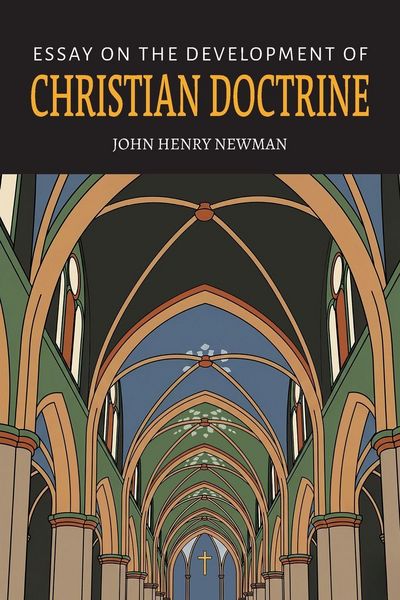
An Essay on the Development of Christian Doctrine
-
- Hardcover
- Taschenbuch ausgewählt
- eBook
-
Sprache:Englisch
-
Verlag:Martino Fine Books
- Digireads.com 17,99 €
- Creative Media Partners, LLC 25,99 €
- Outlook 36,90 €
- Cambridge Academic 73,99 €
- Alpha Editions 29,99 €
- Wipf and Stock 45,99 €
- Hansebooks 31,90 €
- Kessinger Publishing, LLC 38,99 €
- University Of Notre Dame Press 45,99 €
- Martino Fine Books 29,99 € ausgewählt
- Double 9 Books 22,99 €
29,99 €
inkl. gesetzl. MwSt.,
Beschreibung
Produktdetails
Einband
Taschenbuch
Erscheinungsdatum
04.02.2026
Verlag
Martino Fine BooksSeitenzahl
334
Maße (L/B/H)
22,9/15,2/2 cm
Gewicht
544 g
Sprache
Englisch
EAN
9798898780333
John Henry Newman's An Essay on the Development of Christian Doctrine stands as a revolutionary milestone in theological history. Written during the pivotal moment of a transition between traditions, the work addresses the fundamental tension between the perceived static nature of divine revelation and the undeniable changes in church practice and dogma over centuries. The author argues that for a living idea to remain faithful to its essence, it must grow and adapt to new contexts, famously positing that to live is to change and to be perfect is to have changed often. The core of the essay introduces a system of seven tests for distinguishing authentic doctrinal development from mere corruption. By examining criteria such as the preservation of a core type, the continuity of principles, and the presence of a logical sequence, the work provides a framework to explain how simple early confessions evolved into the complex structures of the modern era. This methodology suggests that later doctrines are actually the organic maturation of seeds planted in the apostolic age, much like a grown man retains the identity of the child he once was. Beyond its historical implications, the book transformed the way thinkers understand the intersection of faith and time. By integrating a sense of historical consciousness into religious thought, it moved away from a rigid view of the past toward a dynamic, evolutionary understanding of truth. The work remains essential for anyone exploring the philosophy of history, the nature of institutional growth, and the intellectual foundations that eventually informed significant modernizing movements within the church.
Noch keine Bewertungen vorhanden
Verfassen Sie die erste Bewertung zu diesem Artikel
Helfen Sie anderen Kundinnen und Kunden durch Ihre Meinung.
Kurze Frage zu unserer Seite
Vielen Dank für dein Feedback
Wir nutzen dein Feedback, um unsere Produktseiten zu verbessern. Bitte habe Verständnis, dass wir dir keine Rückmeldung geben können. Falls du Kontakt mit uns aufnehmen möchtest, kannst du dich aber gerne an unseren Kund*innenservice wenden.
zum Kundenservice