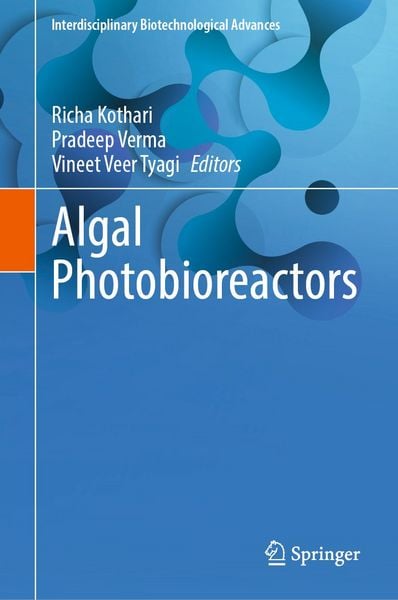
Produktbild: Algal Photobioreactors
- 10%

Algal Photobioreactors

10% sparen

171,99 € UVP 192,59 €

inkl. gesetzl. MwSt., Versandkostenfrei

Lieferung nach Hause

Beschreibung

Produktdetails

Einband

Gebundene Ausgabe

Erscheinungsdatum

26.05.2026

Abbildungen

XI, 75 illus., 72 illus. in color., schwarz-weiss Illustrationen, farbige Illustrationen

Herausgeber

Richa Kothari + weitere

Verlag

Springer Singapore

Seitenzahl

568

Maße (L/B/H)

24,1/16/3,7 cm

Gewicht

1025 g

Auflage

1. Auflage

Sprache

Englisch

ISBN

978-981-9584-30-7

Beschreibung

Portrait


Dr. Richa Kothari
Department of Environmental Sciences, Samba, Central University of Jammu, India
Dr. Richa Kothari (FWARI, FISEB), who holds an M.Phil. and Ph.D. in Energy & Environment, is working as a Professor in the Department of Environmental Sciences at the Central University of Jammu, Samba (J&K), India. She is the recipient of the Women’s Achievers Award from ASSOCHAM (2023) and the Women Scientist Award (2025) from the Central University of Rajasthan, Ajmer, India. She is a WARI Fellow (2017) at the Robert B. Daugherty Water for Food Institute, University of Nebraska–Lincoln, USA. She has more than 20 years of teaching and research experience at various reputed Universities in India and having more than 10000 citations with H-index of 45. She has been listed among the world’s top 2% scientists by Stanford University, USA, for significant academic and research contributions since 2020. Her research focuses on algal-based biofuel production, biohydrogen production, and the utilization of renewable energy for wastewater treatment. She has also been awarded prestigious research fellowships from MNRE and CSIR.
 
Prof. Pradeep Verma
Department of Microbiology, School of Life Sciences, Central University of Rajasthan, India
Prof. Pradeep Verma completed his Ph.D. at Sardar Patel University, Gujarat, India, in 2002. The same year, he began his international research career as a UNESCO Fellow at the Czech Academy of Sciences, Prague, followed by a Postdoctoral Fellowship at Charles University. In 2004, he served as a Visiting Scientist at the UFZ Centre for Environmental Research, Halle, Germany, and later received the prestigious DFG Fellowship for postdoctoral research at the University of Göttingen. In 2007, he returned to India and joined Reliance Life Sciences, Mumbai, where his pioneering work on biobutanol production led to several international patents. He subsequently received the JSPS Postdoctoral Fellowship for research at the Laboratory of Biomass Conversion, Kyoto University, Japan. Prof. Verma joined Assam University in 2009 as a Reader and Founder Head of the Department, and in 2011 moved to Guru Ghasidas Vishwavidyalaya as Associate Professor. Since 2013, he has been Professor in the Department of Microbiology, Central University of Rajasthan, where he has also served as Dean and Head. His expertise includes microbial diversity, bioremediation, bioprocess development, and biomass-based biorefineries and having 10055 citations, with an h-index of 52. He has received several honors, including Fellowships of IAWS (2024), MSI (2020), BRSI (2020), and AMI (2021), as well as the P.C. Jain Memorial Award and the Prof. YSRK Sharma Memorial Award (2025). In 2022, he received the JSPS Bridge Fellowship for further collaboration with Kyoto University.
 
Dr. Vineet Veer Tyagi,
Department of Physics, Shri Mata Vaishno Devi University, India
Dr. Vineet V. Tyagi is working as an Associate Professor in the School of Physics and as Head of the School of Energy Management at Shri Mata Vaishno Devi University, Katra, J&K, India. He is actively engaged in research in the areas of solar thermal energy storage systems, phase change materials development and applications, energy policy, PV/thermal hybrid systems, and solar-energy-based wastewater treatment systems. He has achieved a remarkable distinction by being featured in the global top 2% scientist ranking by Stanford University for five consecutive years (2020–2024) and having citation more than 22000 and H-index of 72 as per scopus database. He has worked as a Postdoctoral Research Fellow at three institutions: UMPEDAC, University of Malaya, Kuala Lumpur, Malaysia; the Centre for Energy Studies, Indian Institute of Technology Delhi, New Delhi; and the National Institute of Solar Energy (NISE), Ministry of New and Renewable Energy, Government of India.

Produktdetails

Einband

Gebundene Ausgabe

Erscheinungsdatum

26.05.2026

Abbildungen

XI, 75 illus., 72 illus. in color., schwarz-weiss Illustrationen, farbige Illustrationen

Herausgeber

Verlag

Springer Singapore

Seitenzahl

568

Maße (L/B/H)

24,1/16/3,7 cm

Gewicht

1025 g

Auflage

1. Auflage

Sprache

Englisch

ISBN

978-981-9584-30-7

Herstelleradresse

Springer-Verlag GmbH
Tiergartenstr. 17
69121 Heidelberg
DE

Email: ProductSafety@springernature.com

Kundinnen und Kunden meinen

0 Bewertungen

Informationen zu Bewertungen

Zur Abgabe einer Bewertung ist eine Anmeldung im Konto notwendig. Die Authentizität der Bewertungen wird von uns nicht überprüft. Wir behalten uns vor, Bewertungstexte, die unseren Richtlinien widersprechen, entsprechend zu kürzen oder zu löschen.

Die Bewertungen sind nach Format, Anzahl Sterne und Datum sortiert.

Verfassen Sie die erste Bewertung zu diesem Artikel

Helfen Sie anderen Kund*innen durch Ihre Meinung

Kundinnen und Kunden meinen

0 Bewertungen filtern

  • Produktbild: Algal Photobioreactors
  • Chapter 1. Overview of bioreactors for algal biomass harvesting.- Chapter 2. Carbon Sequestration through Valorization of Microalgae Biomass in Bioreactors for Biofuels and High-Value Products.- Chapter 3. Upstream Processing of Algal Biorefinery: Current Scenario, Opportunities, and Challenges.- Chapter 4. Downstream processing of algal biorefinery: Current scenario, opportunities and challenges.- Chapter 5. Membrane bioreactors for bio-energy production and resource recovery.- Chapter 6. Sustainability assessment of open bioreactors for algal biomass with modelling.- Chapter 7. Sustainability assessment of closed bioreactors for algal biomass with modelling.- Chapter 8. Integrated algal engineering approaches for bioremediation, bioenergy and industrial applications: Current scenario and future directions.- Chapter 9. Basics of algal photobioreactors: Design and engineering aspect for algal cultivation.- Chapter 10. Construction materials and influencing parameters for closed photobioreactors on an industrial scale.- Chapter 11. Open photobioreactor design and operational strategies for algae cultivation: Challenges and solutions.- Chapter 12. Addressing challenges in harvesting algal biomass  for pharmaceutical applications.- Chapter 13. Harnessing bioactive compounds from microalgae and its harvesting techniques.- Chapter 14. Indian perspectives of algal biofuels from wastewaters: Opportunities and challenges.- Chapter 15. Fundamentals and advances of algae- based processes in fuel, feed and fertilizer (3F).- Chapter 16. Role of nanotechnology in improving algal biomass production and biofuel yield with wastewater treatment.- Chapter 17. Life Cycle Assessment of biodiesel production from algal biomass with algal bioreactor.- Chapter 18. Green and renewable energy, humanistic culture and environmental impact of government policies and initiatives.- Chapter 19. Algal biorefinery: Implications of global policy trends.- Chapter 20. Circular economy meets artificial intelligence: Unlocking algal bio refinery potential.