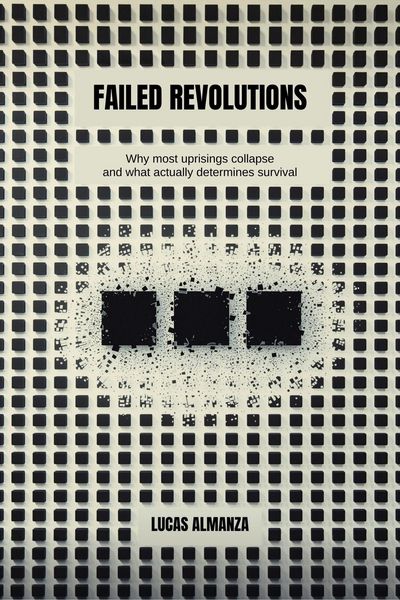
Failed Revolutions: Why most uprisings collapse - and what actually determines survival
-
- Einzelkauf Download ausgewählt
-
Sprache:Englisch
4,49 €
inkl. gesetzl. MwSt.Beschreibung
Produktdetails
Format
ePUB
Kopierschutz
Ja
Family Sharing
Ja
Text-to-Speech
Ja
Erscheinungsdatum
23.01.2026
Verlag
Lucas AlmanzaSeitenzahl
(Printausgabe)
Dateigröße
326 KB
Sprache
Englisch
EAN
9798233314933
"Revolutions rarely fail because people lack courage. They fail because power structures survive shock." We live in an era of unprecedented global mobilization, yet most uprisings today end not in liberation, but in restoration, repression, or state collapse. In Failed Revolutions, Lucas Almanza provides a cold, unsensational, and structural re-examination of why the energy of the street so rarely dismantles the systems beneath. Moving beyond the romantic myths of "People Power," Almanza argues that a revolution is not an explosion of angerit is a transfer of authorityand history is moved not by crowds alone, but by whoever controls the administrative machinery once the square empties.
Moving with the analytical clarity of a Caspian Report briefing and the historical weight of The Anatomy of Revolution, this book dismantles the "Romance of Spontaneity." Almanza investigates the "Protest Trap" of the 21st century, revealing how modern surveillance and preemptive repression allow states to see uprisings forming before they even arrive. Through a forensic look at the "Elite Defection Threshold," he explains why the security servicesnot the protestersare the ultimate arbiters of change. If the guns don't change sides and the bureaucracy doesn't shift its loyalty, the regime will almost always absorb the chaos.
Failed Revolutions is a vital roadmap for anyone trying to understand the disconnect between visibility and power. Almanza explores why "leaderless" movements are genetically incapable of seizing a state and why the most successful revolutions are, ironically, the most conservative in their preservation of institutions. From the frozen conflicts of the Middle East to the burnout cycles of modern activism, this investigation reveals that hope alone cannot defeat structure. This is an essential inquiry for those ready to confront the sober truth: the state remains long after the protest ends, and only those who understand its architecture can hope to change it.
Noch keine Bewertungen vorhanden
Verfassen Sie die erste Bewertung zu diesem Artikel
Helfen Sie anderen Kundinnen und Kunden durch Ihre Meinung.
Kurze Frage zu unserer Seite
Vielen Dank für dein Feedback
Wir nutzen dein Feedback, um unsere Produktseiten zu verbessern. Bitte habe Verständnis, dass wir dir keine Rückmeldung geben können. Falls du Kontakt mit uns aufnehmen möchtest, kannst du dich aber gerne an unseren Kund*innenservice wenden.
zum Kundenservice