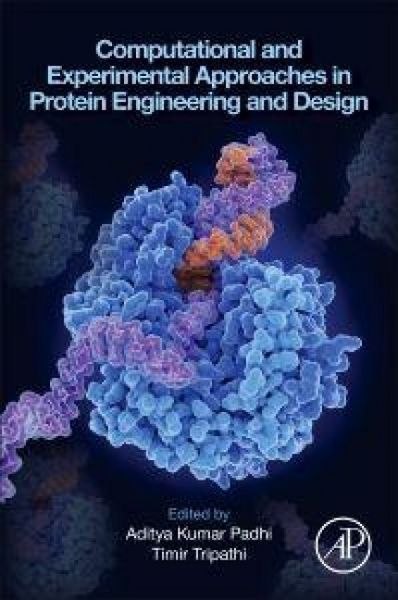
Produktbild: Computational and Experimental Approaches in Protein Engineering and Design
Vorbesteller Neu

Computational and Experimental Approaches in Protein Engineering and Design

294,99 €

inkl. gesetzl. MwSt., Versandkostenfrei


Beschreibung

Produktdetails

Einband

Taschenbuch

Erscheinungsdatum

01.10.2026

Herausgeber

Aditya Kumar Padhi + weitere

Verlag

Elsevier

Seitenzahl

600

Maße (L/B)

22,9/15,2 cm

Gewicht

450 g

Sprache

Englisch

ISBN

978-0-443-44536-1

Beschreibung

Portrait

Dr Aditya Kumar Padhi is an Assistant Professor at the School of Biochemical Engineering, Indian Institute of Technology (IIT-BHU), Varanasi, India. He earned his Ph.D. from the Indian Institute of Technology, Delhi (IIT Delhi) in 2015 and currently leads the Laboratory for Computational Biology and Biomolecular Design (LCBD) at IIT-BHU. His lab specializes in Computational Biology, Protein Design, Structural and Translational Informatics, Computational Biophysics, Antimicrobial Resistance, Predictive Modelling, Biomolecular Simulations, Conformational Analyses, Machine Learning, and Disease Mechanisms

Professor Timir Tripathi is a Professor of Molecular Biology, School of Life Sciences, North-Eastern Hill University, Shillong, India. Earlier, he served as the Regional Director of Indira Gandhi National Open University. His previous role was Senior Assistant Professor and Principal Investigator at the Department of Biochemistry, NEHU, Shillong. He holds a Ph.D. from Jawaharlal Nehru University, New Delhi. His primary research focus is studying the conformational dynamics, interaction, and stabilization of the complexes formed by intrinsically disordered neuropathological protein aggregates, their properties of liquid-liquid phase separation, interaction, and roles in nucleocytoplasmic transport in neurodegenerative diseases. Professor Tripathi is an Associate Fellow of the Indian National Science Academy, New Delhi, and an elected member of the National Academy of Sciences, India, the Royal Society of Chemistry, and the Royal Society of Biology, UK

Produktdetails

Einband

Taschenbuch

Erscheinungsdatum

01.10.2026

Herausgeber

Verlag

Elsevier

Seitenzahl

600

Maße (L/B)

22,9/15,2 cm

Gewicht

450 g

Sprache

Englisch

ISBN

978-0-443-44536-1

Herstelleradresse

Libri GmbH
Europaallee 1
36244 Bad Hersfeld
DE

Email: gpsr@libri.de

Noch keine Bewertungen vorhanden

Verfassen Sie die erste Bewertung zu diesem Artikel

Helfen Sie anderen Kundinnen und Kunden durch Ihre Meinung.

Kundinnen und Kunden meinen

Bewertungen (0)

  • Produktbild: Computational and Experimental Approaches in Protein Engineering and Design
  • 1. Fundamentals of protein structure and function
    2. Introduction to the principles of protein engineering
    3. Computational methods and tools for protein design and optimization
    4. Experimental methods in protein engineering: techniques and applications
    5. Engineering antibodies for therapeutic applications
    6. Techniques and applications of directed evolution
    7. Machine learning and artificial intelligence in protein design
    8. Computational protein design for disease mutations and antimicrobial resistance
    9. Case studies in protein engineering: successes and challenges
    10. Designing protein-based vaccines for immunotherapy
    11. Nanobody engineering for next-generation therapeutics
    12. Molecular dynamics simulations in protein design and engineering
    13. Biophysical characterization methods for evaluating therapeutic proteins
    14. Incorporating non-natural amino acids in protein design and expanding the chemical space of proteins.
    15. Methods to enhance protein stability and solubility for improved functional efficacy
    16. Engineering allosteric regulation and control mechanisms in proteins
    17. Design of protein scaffolds for biomaterials and tissue engineering
    18. High-throughput screening techniques for identifying therapeutic proteins
    19. Advancements in protein conjugation techniques for engineering and design applications
    20. Challenges in AI-based approaches for intrinsically disordered proteins
    21. The role of machine learning in drug discovery and therapeutic protein design