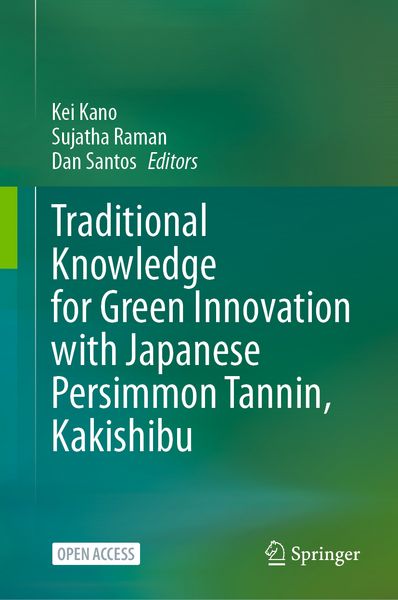
Traditional Knowledge for Green Innovation with Japanese Persimmon Tannin, Kakishibu
-
- Englisch ausgewählt
49,99 €
inkl. gesetzl. MwSt.,
Lieferung nach Hause
Beschreibung
Produktdetails
Einband
Gebundene Ausgabe
Erscheinungsdatum
29.03.2026
Abbildungen
XIII, 43 illus., 39 illus. in color., farbige Illustrationen, schwarz-weiss Illustrationen
Herausgeber
Kei Kano + weitereVerlag
Springer SingaporeSeitenzahl
232
Maße (L/B/H)
24,1/16/2 cm
Gewicht
539 g
Auflage
1. Auflage
Sprache
Englisch
ISBN
978-981-9578-04-7
This open-access volume offers the first comprehensive examination of Kakishibu, a traditional Japanese technology based on fermented bitter persimmon juice, now gaining attention as a sustainable alternative to plastics. At its core, Kakishibu is rich in persimmon tannins, compounds renowned for their multifunctional properties, including waterproofing, antibacterial and antiviral activity, insect repellence, and deodorization.
The authors present an in-depth analysis of the historical development and chemical composition of Kakishibu, while critically exploring the epistemological distinctions between Japanese traditional Knowledge and Western scientific paradigms. Particular emphasis is placed on understanding the cultural values and norms that shape the use of modern technology and efforts to pursue green innovation. This dialogue is situated within broader social science debates on system transformation and diverse innovation pathways towards the UN Sustainable Development Goals (SDGs).
In addition to theoretical insights, the book features practical case studies: a start-up initiative for producing Kakishibu-coated paper as a plastic alternative; innovative business concepts proposed by Japanese high school students; and culturally responsive STEAM education programs incorporating Kakishibu.
Written by leading scholars, practitioners, and educators, this work constitutes an essential resource for students, researchers, and industry professionals engaged in tannin research, knowledge systems, and sustainable innovation. It invites readers to consider the potential of Kakishibu for transforming the petrochemical plastics era and to reflect on ways to integrate traditional and scientific knowledge for sustainable development. Whether you are a scholar, practitioner, or simply interested in green technologies, this book offers critical insights into the intersection of culture, science, and technology.
The English translation of this book, originally in Japanese, was facilitated by artificial intelligence. The content was later revised by the author for accuracy.
Kundinnen und Kunden meinen
Verfassen Sie die erste Bewertung zu diesem Artikel
Helfen Sie anderen Kund*innen durch Ihre Meinung
Kurze Frage zu unserer Seite
Vielen Dank für dein Feedback
Wir nutzen dein Feedback, um unsere Produktseiten zu verbessern. Bitte habe Verständnis, dass wir dir keine Rückmeldung geben können. Falls du Kontakt mit uns aufnehmen möchtest, kannst du dich aber gerne an unseren Kund*innenservice wenden.
zum Kundenservice