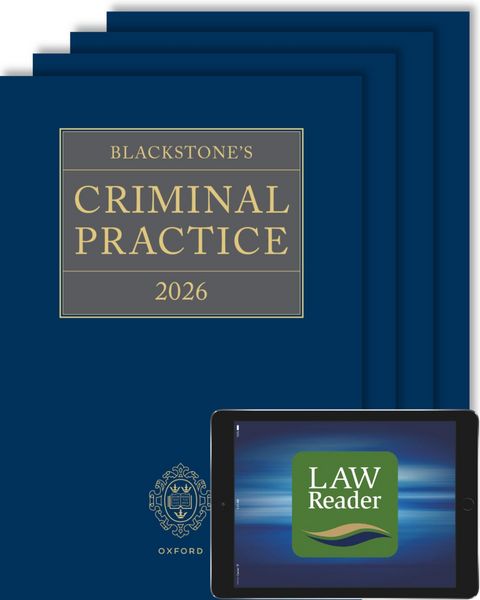
Produktbild: Blackstones Criminal Practice 2026 Digital Pack

Blackstones Criminal Practice 2026 Digital Pack

636,99 €

inkl. gesetzl. MwSt., Versandkostenfrei

Lieferung nach Hause

Beschreibung

Produktdetails

Einband

Gebundene Ausgabe

Erscheinungsdatum

10.12.2025

Verlag

Oxford University Press

Maße (L/B/H)

27,5/17,3/10,1 cm

Gewicht

4001 g

Sprache

Englisch

ISBN

978-0-19-898180-0

Beschreibung

Produktdetails

Einband

Gebundene Ausgabe

Erscheinungsdatum

10.12.2025

Verlag

Oxford University Press

Maße (L/B/H)

27,5/17,3/10,1 cm

Gewicht

4001 g

Sprache

Englisch

ISBN

978-0-19-898180-0

Herstelleradresse

Libri GmbH
Europaallee 1
36244 Bad Hersfeld
DE

Email: gpsr@libri.de

Noch keine Bewertungen vorhanden

Verfassen Sie die erste Bewertung zu diesem Artikel

Helfen Sie anderen Kundinnen und Kunden durch Ihre Meinung.

Kundinnen und Kunden meinen

Bewertungen (0)

  • Produktbild: Blackstones Criminal Practice 2026 Digital Pack
    • Part A: Criminal Law

    • A1: Actus reus: the external elements of an offence

    • A2: Mens rea

    • A3: General defences

    • A4: Parties to offences

    • A5: Inchoate offences

    • A6: Corporate liability

    • A7: Human rights

    • A8: Territorial and extra-territorial jurisdiction

    • A9: European Union law

    • Part B: Offences

    • B1: Homicide and related offences

    • B2: Non-fatal offences against the person

    • B3: Sexual offences

    • B4: Theft, handling stolen goods and related offences

    • B5: Fraud and blackmail

    • B6: Falsification, forgery and counterfeiting

    • B7: Company, commercial and insolvency offences

    • B8: Damage to property

    • B9: Offences affecting security

    • B10: Terrorism, piracy and hijacking

    • B11: Offences affecting public order

    • B12: Offences relating to weapons

    • B13: Offences affecting enjoyment of premises

    • B14: Offences against the administration of justice

    • B15: Corruption

    • B16: Revenue, customs and social security offences

    • B17: Offences involving misuse of computers

    • B18: Offences involving writing, speech or publication

    • B19: Offences relating to drugs

    • B20: Offences relating to dangerous dogs and animal welfare

    • B21: Offences relating to money laundering and the proceeds of criminal conduct

    • B22: Modern slavery, trafficking and immigration offences

    • Part C: Road Traffic Offences

    • C1: Definitions and basic principles in road traffic cases

    • C2: Procedure and evidence in road traffic cases

    • C3: Offences relating to driving triable on indictment

    • C4: Offences relating to documents triable on indictment

    • C5: Drink-driving and drug-driving offences

    • C6: Summary traffic offences

    • C7: Sentencing

    • C8: Schedules 2 and 3 to the Road Traffic Offenders Act 1988

    • Part D: Procedure

    • D1: Powers of investigation

    • D2: The decision to prosecute and diversion

    • D3: Courts, parties and abuse of process

    • D4: Criminal Procedure Rules and case management

    • D5: Starting a prosecution and preliminary proceedings in magistrates' courts

    • D6: Classification of offences and determining allocation (mode of trial)

    • D7: Bail

    • D8: Assets recovery

    • D9: Disclosure

    • D10: Sending cases from the magistrates' court to the Crown Court

    • D11: The indictment

    • D12: Arraignment and pleas

    • D13: Juries

    • D14: Special measures and anonymity orders

    • D15: Trial on indictment: general matters and pre-trial procedure

    • D16: Trial on indictment: the prosecution case

    • D17: Trial on indictment: the defence case

    • D18: Trial on indictment: procedure between close of defence case and retirement of jury

    • D19: Trial on indictment: procedure relating to retirement of jury and verdict

    • D20: Trial on indictment: sentencing procedure

    • D21: Summary trial: general and preliminary matters

    • D22: Summary trial: the course of the trial

    • D23: Sentencing in the magistrates' court

    • D24: Trial of children and young people

    • D25: Behaviour orders

    • D26: Appeal to the Court of Appeal (Criminal Division) following trial on indictment

    • D27: Procedure on appeal to the Court of Appeal (Criminal Division)

    • D28: Reference to the Court of Appeal (Criminal Division) by the Attorney-General and Criminal Cases Review Commission

    • D29: Challenging decisions of magistrates' courts and of the Crown Court in its appellate capacity

    • D30: Appeals to the Supreme Court and the role of the Court of Justice of the European Union and the European Court of Human Rights

    • D31: Extradition

    • D32: Public funding

    • D33: Costs

    • Part E: Sentencing

    • E1: Sentencing Code and sentencing guidelines

    • E2: Sentencing: general provisions

    • E3: Absolute and conditional discharge

    • E4: Referral orders

    • E5: Fines

    • E6: Compensation orders

    • E7: Restitution orders

    • E8: Deprivation orders and forfeiture orders

    • E9: Binding over

    • E10: Orders against parents

    • E11: Youth rehabilitation orders

    • E12: Community orders

    • E13: Custodial sentences: general provisions

    • E14: Suspended sentences

    • E15: Custodial sentences: detention and custody of offenders under 18

    • E16: Life sentences, extended sentences, serious terrorism sentences and custodial sentences for certain offenders of 'particular concern'

    • E17: Mandatory life sentences

    • E18: Minimum custodial sentences

    • E19: Confiscation orders

    • E20: Recommendation for deportation

    • E21: Exclusions and disqualifications

    • E22: Mentally disordered offenders

    • E23: Notification requirements

    • E24: Rehabilitation of offenders

    • Part F: Evidence

    • F1: General principles of evidence in criminal cases

    • F2: Evidence unlawfully, improperly or unfairly obtained and the discretion to exclude evidence

    • F3: Burden and standard of proof and presumptions

    • F4: Competence and compellability of witnesses and oaths and affirmations

    • F5: Corroboration and care warnings

    • F6: Examination-in-chief

    • F7: Cross-examination and re-examination

    • F8: Documentary evidence and real evidence

    • F9: Public policy

    • F10: Privilege

    • F11: Opinion evidence

    • F12: Admissibility of previous verdicts and findings

    • F13: Character evidence: evidence of bad character of accused

    • F14: Character evidence: admissibility of evidence of accused's good character

    • F15: Character evidence: evidence of bad character of persons other than the accused

    • F16: The rule against hearsay: general principles

    • F17: Exceptions to the rule against hearsay (excluding confessions)

    • F18: The rule against hearsay: confessions

    • F19: Evidence of identification

    • F20: Inferences from silence and the non-production of evidence